Houseplant · Araceae
Arrowhead Plant
Syngonium podophyllum
Its young leaves cut clean arrowhead points on a low, leafy plant that later sends out climbing or trailing stems under bright indirect light.
Bright indirect
64–81°F · 18–27°C
USDA 10–12
3–6 ft · 0.9–1.8 m
Overview
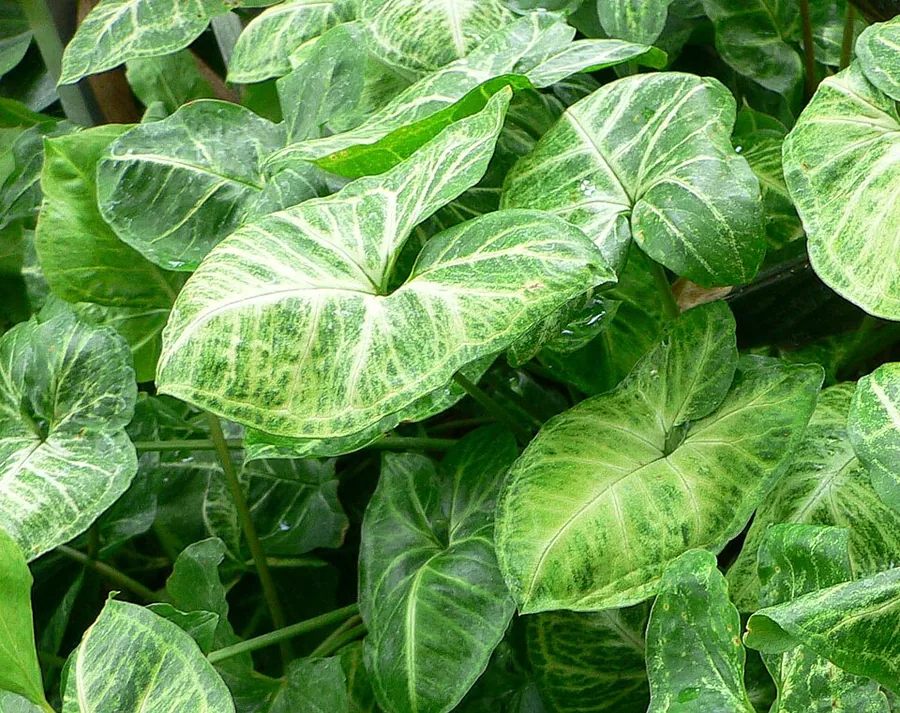
The arrowhead plant is named for the shape of its young leaves, smooth, pointed blades that come up like little arrowheads on a low, bushy plant. Native from Mexico through tropical America and a member of the arum family, it is one of the most forgiving houseplants you can keep. The leaves vary widely by form: solid green, splashed and marbled with cream variegation, or threaded with pink along the veins.
As the plant ages, its leaves and stems remake themselves. The single arrowhead blade of the juvenile gives way, on a lengthening climbing vine, to a compound leaf cut into several distinct leaflets that fan out from the stalk. The stems thicken and run, sending out aerial roots along their length. Pinching the growing tips holds the plant to its earlier, denser arrowhead-leaved form.
Up close the plant reads soft and full, the blades smooth-surfaced and held on slim stalks. It asks little: bright indirect light, lightly moist soil, and warm air keep the foliage firm and well-colored. The sap that runs through every stem and leaf carries calcium oxalate crystals that irritate mouths and skin, so keep the plant where pets and small children cannot reach the leaves.
Care
The short version: the leaves keep their best color and firmness in bright indirect light, soil kept lightly moist but never soggy, and warm, humid air. Water less in winter, and give the lengthening stems a pole or basket once they begin to vine.
Light
In bright, indirect light the leaves hold their deepest color and the plant grows fullest. It keeps its leaves in medium light and even low light, but direct sun scorches the leaves, bleaching and crisping the blades, so keep it back from a hot window.
Water
Keep the soil lightly moist but never soggy through the growing season, watering once the top starts to dry. Cut back from fall through late winter, when the plant slows and wet soil quickly rots the roots.
Soil
Set it in a light, well-draining potting mix with a soil base. Free drainage matters most, since water standing around the fleshy roots is the fastest way to kill this plant.
Temperature
It holds its leaves in ordinary room warmth, roughly 64°F to 81°F (18°C to 27°C). Cold drafts and chilly winter glass damage the foliage, and it has no tolerance for frost.
Humidity
This tropical plant wants high humidity, ideally 60% or more, which keeps the leaf edges from crisping. It survives average household air, but the blades stay firmest near a humidifier or in a steamy bathroom or kitchen.
Feeding
Feed during active growth in the warmer months with a balanced foliage-plant fertilizer to keep the new leaves coming in well-colored. A few feedings across the growing season are plenty, and feeding stops once growth slows in fall.
Pruning
The stems take a hard cutting back without harm, breaking into fresh shoots below the cut. Pinch and prune to shape it into a compact, arrowhead-leaved mound, a trailing fall of stems, or a vine trained up a moss pole or trellis.
Repotting
Repot only when the roots crowd the pot and press against its sides. There is no fixed schedule; move it up a pot size whenever the root mass looks cramped.
Size & spacing
Indoors the stems run to about 3 to 6 feet (91 to 183 cm) as a climbing or trailing vine, with the leafy spread near 1 to 2 feet (30 to 61 cm). Give the stems room to run or a support to climb, and keep air moving around the leaves.
Troubleshooting
Arrowhead plants are tough, and most of their problems trace back to light or water. The first signs show in the look of the leaves and stems, a change in color, texture, or shape. Match what you see below and fix the cause before it spreads.
Firm stems and roots turning dark, soft, and slimy
Soggy soil brings on soft rot, a bacterial decay that turns the firm stems and roots dark and slimy to the touch. Cut the rotted tissue away, then correct the cause with a light, well-draining mix and a pot that drains freely. Ease off the water through fall and winter, when the plant drinks far less.
Fix:
- Remove affected tissue
- Improve drainage and avoid waterlogged soil
- Reduce watering, especially from fall through late winter
Bleached, papery patches and crisp edges on the blades
Too much direct sun scorches the blades, leaving washed-out, papery patches and crisp brown edges where the light strikes hardest. In bright indirect light or dappled shade, the fresh leaves unfurl clean and evenly colored.
Fix:
- Move plant out of direct sun to a bright indirect or part-shade location
Sharp dark lesions scattered across the blades
Sharp-edged dark lesions scattered across the blade usually mean bacterial leaf spot, which spreads in the film of water sitting on wet foliage. Pick off the spotted leaves and keep water off the leaves from then on. Air moving around the plant dries the blades and does most of the work in stopping it.
Fix:
- Remove affected leaves
- Avoid wetting foliage and improve air circulation
Fine webbing, cottony flecks, and sticky curled new leaves
A few common pests feed on arrowhead plants, and each marks the foliage differently. Spider mites fleck the blades with pale stippling and string fine webbing across them, mealybugs sit as white cottony tufts, aphids crowd the soft new growth, and scale clings to the stems as hard little bumps. Isolate the plant the moment any of them appear, wash the pests off the leaves and stems, and follow up with an insecticidal treatment.
Fix:
- Inspect and isolate the plant
- Wash off pests and treat with an appropriate insecticidal control
Bare stems running long with widely spaced leaves
This is the arrowhead plant maturing, its leaves and stems changing shape. The bushy young plant slips into its natural vining habit, the stems lengthening into bare runners with foliage spaced thinly along them. Give those stems a moss pole or trellis to climb, let them cascade from a hanging basket, or pinch them back to crowd the leaves close and keep the plant full.
Fix:
- Provide a moss pole or trellis for the plant to climb
- Grow in a hanging basket to let stems cascade
- Prune or pinch stems to keep the plant compact and bushy
Toxicity
Look closely and you will not see the danger, since it sits in the insoluble calcium oxalate crystals packed through every leaf and stem. A single bite stings the mouth on contact. The clear sap can leave skin irritated as well, so handle cut stems with care and keep the plant where pets and children cannot reach the leaves.
Toxic to
Cats · Dogs · Horses · Rabbits · Livestock · Birds · People
Cats Moderate
When a cat sinks its teeth into a leaf, the burn hits almost immediately. Drool runs heavy, a paw goes to the mouth, and the tongue and lips turn red and swollen, with vomiting and strained swallowing following soon.
Dogs Moderate
A dog shows the same reaction a cat does. The mouth stings on contact, and drooling, swollen lips and tongue, vomiting, and an unwillingness to swallow follow.
Horses Moderate
The crystals rasp at a horse's mouth and gullet, drawing out drooling, swelling, and strained swallowing. A horse cannot vomit, so the upset settles in its mouth and gut.
Rabbits Toxic
Keep the arrowhead plant well out of a rabbit's reach. The same calcium oxalate crystals that harm cats and dogs irritate a rabbit's sensitive mouth and gut, and this is not a safe green to offer.
Livestock Toxic
A grazing animal that chews the leaves gets a stinging mouthful of those crystals, and drooling with oral swelling tends to follow. Keep it beyond the reach of any browsing herd.
Birds Toxic
The sap spares birds no more than the rest. A pet bird tearing at a leaf can suffer the same raw, swollen mouth, so keep the cages and perches well off the plant.
People Caution
No piece of this plant is for eating. A bitten leaf sends a sharp burn across the mouth, and the clear sap can redden the skin, so wash up well after handling cut stems and keep it away from little ones.
All parts contain insoluble calcium oxalate crystals; sap can irritate. UF/IFAS notes the toxic sap makes mechanical handling (e.g., string trimming) inadvisable outdoors
Helpline numbers

United States
ASPCA Animal Poison Control: (888) 426-4435 (fee applies)
Poison Control: (800) 222-1222



Canada
Poison Centres: 1-844-764-7669
Varieties
Growers have selected the arrowhead plant for the color and patterning of its leaves, from near-white blades to bright green ones to leaves veined in deep pink. These are a few of the named cultivars and the way each leaf looks.
'White Butterfly'
Its blades are greenish-white, washed through with creamy white-yellow veins and rimmed in a thin dark green edge, the palest leaf of the group.
'Pink Allusion'
Bred in Florida, it runs deep pink veins straight down the centers of light olive-green leaves, and that pink stays saturated as the blade ages.
'Robusta'
A cultivar carried through the commercial Syngonium trade, grown to UF/IFAS growing rules.
'Neon'
Another commercial selection recorded in the UF/IFAS guidelines for interiorscape Syngonium.
'Lemon Lime'
A production cultivar from the same UF/IFAS guidelines, named for the bright green wash across its leaves.
How to propagate
The plant copies easily from its own stems. A cutting taken in the warm months puts out roots almost on its own, often from aerial roots already standing along the stem, and a longer stem can be air-layered for a fuller new plant.
Stem cuttingsEasy
Spring to summer · Roots in a few weeks
This is the easy route, and the stem nearly roots itself. Cut a tip or nodal piece in spring or summer with a node included, and any aerial roots already standing along the stem give it a head start. Set it in water or moist potting mix and roots push out within a few weeks.
Air layeringModerate
Spring to summer · Several weeks
Air layering takes more patience but works well, and it is the method commercial growers use to bulk up Syngonium. Wound the stem and wrap the spot in spring or summer, then wait several weeks for roots to break from the wound before cutting the new plant free.
Myths
An arrowhead plant is only a philodendron with pointed leaves.
The two share the arum family, but the arrowhead plant is Syngonium podophyllum, a separate genus from Philodendron. The leaves settle it: the young ones cut the arrowhead shape behind the name, then mature into compound blades split into 3 to 11 separate leaflets, a leaf shape philodendrons never form.
Sources
- Plants of the World Online, Royal Botanic Gardens Kew
- NC State Extension Gardener Plant Toolbox
- Missouri Botanical Garden Plant Finder
- ASPCA Animal Poison Control
- Atlas of Florida Plants, Institute for Systematic Botany, University of South Florida
- UF/IFAS Plant Directory
- UF/IFAS EDIS (EP244, Cultural Guidelines for Commercial Production of Interiorscape Syngonium)