Houseplant · Araceae
Dumb Cane
Dieffenbachia seguine
Easy in bright, indirect light, dumb cane rewards a little warmth and humidity with bold, painted leaves.
Bright indirect
61–75°F · 16–24°C
USDA 10–12
3–10 ft · 0.9–3 m
Overview
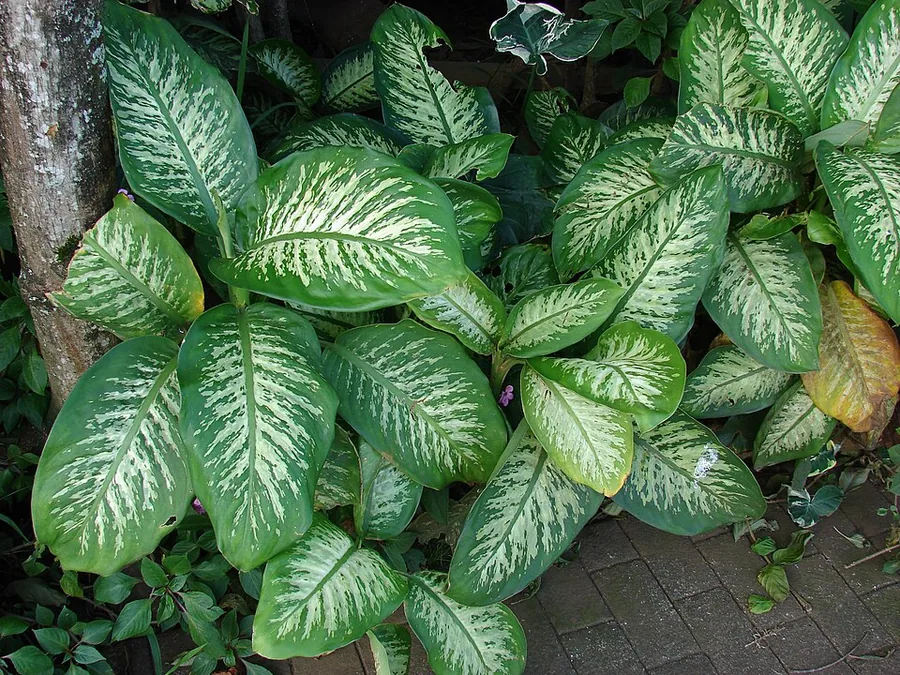
Few leafy houseplants ask as little of you as dumb cane. Its broad leaves arrive painted in cream and green, speckled and brushed in patterns that shift from one cultivar to the next, all of them carried on a single cane that thickens as it climbs, lifting a tabletop plant up toward eye level across the years. It sits in the arum family and comes out of the Caribbean and South American tropics, which is what leaves it craving warmth and damp air.
Its name is a caution in itself. Tissue throughout the plant is loaded with needle-sharp calcium oxalate crystals, and a leaf taken into the mouth scalds it and swells the tongue enough to rob you of speech for a time. So it wants a careful spot in any home that holds cats, dogs, or small children, however undemanding it proves in every other respect.
Set it somewhere bright but shy of direct sun, hold it warm, and let the soil dry just slightly between drinks, and it grows at an unhurried pace and forgives the odd skipped watering. The one thing it will not pardon is a pot left soggy, which rots the roots away from underneath.
Care
The short version: bright indirect light, warmth between 61°F and 75°F (16°C to 24°C), and high humidity. Soak it well in the growing season but let the top inch dry first, root it in a loose peaty mix that drains, and pull on gloves any time you cut into the cane.
Light
Set it in bright, indirect light beside a window but shielded from direct sun, which sears the leaf surface. It will cling on in medium light or even a shaded nook, yet the growth thins out and the painted color washes pale, so the brighter the better.
Water
Soak it well across the growing season, then hold off until the top inch (2.5 cm) of soil has gone dry before the next watering. Pull back from fall into late winter as growth slows. Nothing finishes this plant faster than roots left sitting in sodden soil, which rot them through.
Soil
Root it in a loose, peaty mix rich in organic matter that grips a little water yet lets the rest run off. Anything at a pH anywhere from 5.5 to 7.0 will suit it, which means most good houseplant mixes serve straight from the bag.
Temperature
Hold it within the easy band of 61°F to 75°F (16°C to 24°C), close to the rooms you keep yourself. A cold draft or a sudden chill checks it, so keep it well off doorways and frosty winter glass.
Humidity
At heart this is a high-humidity plant, and parched indoor air announces itself as brown leaf tips. Cluster it among other plants or rest the pot on a tray of wet pebbles to thicken the moisture rising around it.
Feeding
Feed across March through September while it is putting out growth, with a liquid foliage fertilizer at half strength every 2 to 4 weeks, or a time-release feed by the label. Hold off through the dormant stretch, and rinse the soil now and then so salts do not scorch the leaf rims.
Pruning
Little pruning is needed beyond stripping off battered or yellowing lower leaves. Once a cane runs tall and leggy you can cut it back hard and root the severed lengths. Glove up every time, since the sap irritates skin and eyes.
Repotting
Move it up every 1 to 2 years in spring once it has outgrown its pot. Watch for roots circling round or pushing from the drainage holes, water sluicing straight through, and growth that has come to a standstill.
Size & spacing
Indoors it stands somewhere from about 3 to 10 feet (91 cm to 3 m) tall on its single cane and spreads 2 to 3 feet (61 to 91 cm) across. Leave the broad leaves room to fan open without pressing against a wall or a neighboring pot.
Troubleshooting
Nearly every dumb cane complaint shows on the leaves and points back to water, light, or arid air. Catch the first signals and you can move in before a weary plant turns into an ailing one. Find what matches your plant below, then act while the action still counts.
A wilting plant with a soft, collapsing stem base
This is root rot, the price of a pot kept wet far too long. The base of the cane goes soft and discolored, the soil refuses to dry, and the roots turn brown and slimy where they should be firm and pale. Tip the plant out, trim off every rotted root and mushy patch, then settle it into fresh mix that drains, or rescue a clean upper cane and begin again from that cutting.
Fix:
- Remove the plant, cut away rotted roots and soft stem tissue, and repot into fresh well-drained mix
- Reduce watering frequency and ensure the pot has drainage holes
- If the base is badly rotted, take a healthy top cane cutting and re-root it
Lower leaves yellowing off and leaving the cane bare
Start by checking whether the soil sits wet, since overwatering drowns the roots and the foliage pays for it. A little yellowing on the very lowest leaves, though, is simply the plant aging, and the bare cane it leaves behind can be lopped off and rooted afresh. Let that top inch go dry before the next drink, confirm the pot drains, and feed gently across the warm months.
Fix:
- Let the top inch of soil dry before watering and ensure the pot drains freely
- Remove spent lower leaves; a bare lower cane is normal and the top can be cut and re-rooted
- Feed with a balanced foliage fertilizer during the growing season
Faint webbing and a speckled, dusty cast across the leaves
Hot, parched air draws in spider mites, which string thin webs where the leaves meet the stem and across their undersides. Lean in close and the tiny specks shift and crawl, while the leaf surface takes on a dull, bronzed, sandblasted sheen. Hose and wipe the foliage to dislodge them, treat with insecticidal soap or horticultural oil and go again later, then set the plant apart and raise the humidity they cannot stand.
Fix:
- Rinse foliage and wipe leaves to dislodge mites
- Treat with insecticidal soap or horticultural oil, repeating as needed
- Isolate the plant and raise humidity, which discourages mites
Tacky foliage dotted with cottony fluff or bunched insects
A sticky honeydew film across the leaves signals sap-feeders feeding, and their look gives them away. Mealybugs appear as white cottony fluff tucked in the leaf axils, aphids gather thick on tender new shoots, and scale clings as still brown bumps along the canes. Lift the mealybugs and scale away with an alcohol-soaked swab, rinse the aphids off, then chase them with insecticidal soap or oil and hold the plant apart so nothing carries over.
Fix:
- Wipe off mealybugs and scale with a cotton swab dipped in alcohol or wash off aphids
- Apply insecticidal soap or horticultural oil, repeating to catch new hatchlings
- Isolate the affected plant to prevent spread
Crisp brown tips ringing the edges of the broad leaves
The browning that creeps along a leaf's rim and point usually traces back to dry air, because those wide blades hold their shape best in moist conditions. If a chalky white crust sits on the soil surface, the cause is instead a load of fertilizer salts. Lift the humidity, rinse the pot through every so often to carry the salts away, and set the plant clear of chilly drafts and the hot breath of a vent.
Fix:
- Raise humidity by grouping plants or setting the pot on a tray of wet pebbles
- Flush the soil periodically to leach out accumulated fertilizer salts and apply liquid feed at half strength
- Keep the plant away from cold drafts and heat sources and maintain 60-75°F (16-24°C)
A stretched cane with widening gaps between the leaves
A cane that strains and tilts toward the glass is telling you it needs more light. It survives a shadowed corner but pays for it, drawing up thin and spreading its leaves far apart along the stem. Shift it into a brighter spot, give the pot a quarter turn now and then so it grows evenly, and take the tallest canes off to root as fresh cuttings that thicken the plant.
Fix:
- Move to a brighter spot with bright indirect light
- Rotate the pot periodically for even growth
- Cut back overly tall canes and propagate the cuttings to create a fuller plant
Toxicity
This is a truly toxic plant, and the warning is earned. Tissue throughout it carries calcium oxalate crystals that bring fierce burning, drooling, and swelling of the mouth and throat to cats, dogs, horses, and people without distinction, the swelling at times bad enough to take speech away for a spell. Set it well beyond the reach of pets and children, and glove your hands before the sap can touch them.
Toxic to
Cats · Dogs · Horses · Rabbits · Livestock · Birds · People
Cats Severe
One bite touches off fierce burning in the mouth, followed quickly by streaming drool, pawing at the face, and vomiting. The tongue and throat may swell to the point that swallowing becomes hard, so reach a vet without delay.
Dogs Severe
A chewed leaf brings instant mouth pain, drool, and gagging. Most dogs drop it quickly because of the sting, but keep an eye out for a swollen muzzle and any struggle to swallow.
Horses Severe
Those same oxalate crystals scald a horse's mouth and gut, leaving the animal drooling, refusing food, and clearly distressed. Keep this plant far from anything that might take a mouthful of it.
Rabbits Toxic
A rabbit that nibbles the leaves ends up with a stinging, burned mouth and may drool and stop eating. No piece of it is fit to offer, so put it entirely beyond reach.
Livestock Toxic
Goats, sheep, and cattle that reach it meet the same scalding irritation of the mouth and digestive tract. Fence it off, or keep it indoors and away from anything that grazes.
Birds Toxic
The needle-like oxalate crystals wound a bird's tender mouth and crop, so a curious parrot or finch must never get a chance to chew it. Keep cages and perches well clear of the foliage.
People Caution
No piece of it is food, and a chewed leaf scorches the mouth and tongue fiercely enough to slur or stop speech for a while, which is exactly where the plant's name comes from. The sap stings skin and eyes too, so glove up and wash thoroughly afterward, and keep it beyond the reach of small children.
Wear gloves when handling, pruning or propagating, as the sap is a skin and eye irritant; wash hands after contact and keep sap away from eyes
Helpline numbers

United States
ASPCA Animal Poison Control: (888) 426-4435 (fee applies)
Poison Control: (800) 222-1222



Canada
Poison Centres: 1-844-764-7669
Varieties
Almost everything that separates one dumb cane from another lives in the leaf, from its size to the way cream and green are parceled across the blade. Below are the named forms you stand the best chance of running into.
'Camille'
A compact form that holds to around 3 feet, its pale yellow leaves rimmed with a thin white-green margin.
'Tropic Snow'
A bigger plant climbing to roughly 6 feet, hung with large cream-and-green leaves marked by heavy variegation.
'Rudolph Roehrs'
Chartreuse-yellow blades scattered with creamy white, framed by a green midrib and a matching green edge.
'Superba'
A tougher form whose thick leaves carry strong, bold white variegation.
'Exotica'
Its creamy-white, densely variegated foliage makes it one of the easiest forms of the plant to pick out.
How to propagate
Dumb cane multiplies with little fuss, and because a tall plant tends to strip bare at the base, propagating it also serves to renew a leggy specimen.
Stem cuttingsEasy
Spring or early summer · Several weeks to root
The easiest route to more plants runs through cane cuttings lifted in spring or early summer. Slice the stem into pieces, then lay them flat against the soil or set them upright, and roots come over several weeks. Keep gloves on for the job, because the sap stings bare skin.
Air layeringModerate
Spring or summer · Several weeks
Once a cane has stretched tall and lost its lower leaves, air-layering roots a fresh top while it stays joined to the parent plant. Carried out in spring or summer, it needs several weeks to throw roots before you sever the rooted crown and pot it on its own.
DivisionModerate
Spring at repotting · Several weeks
A packed clump comes apart neatly at spring repotting, and each piece roots over several weeks into a plant of its own. Take stem and root cuttings in the same session and you walk away with still more.
Myths
Dumb cane permanently makes you mute or causes lasting loss of speech.
Biting into the plant frees a shower of needle-like calcium oxalate crystals along with a stinging enzyme, and together they swell and numb the tongue, mouth, and throat enough to silence you for a short while. The effect is temporary, not permanent muteness, though heavy swelling of the throat is a real danger that deserves a doctor's eyes.
A dumb cane meaningfully purifies the air in your home.
A 2020 review by Cummings and Waring concluded that potted plants do nothing to clean indoor air at any density a household could actually reach. You would need roughly 10 to 1000 plants per square meter of floor just to match what an open window already accomplishes.