Tree · Sapindaceae
Red Maple
Acer rubrum
Red runs through every part of it, ending in leaves that burn red, orange, and yellow.
Full sun
Every 7–14 days
USDA 3–9
39–89 ft · 12–27 m
Overview
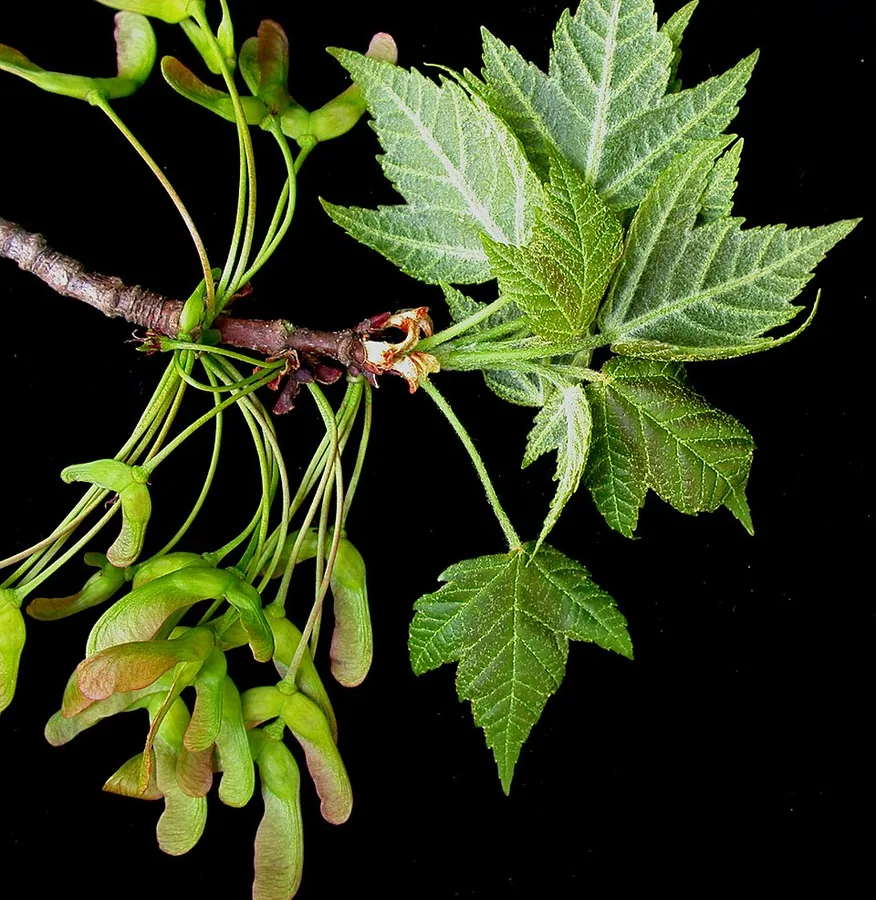
Red is not a name red maple wears lightly, since the color surfaces on the tree in one season after another. In late winter the bare branches carry small red flowers. By spring those give way to winged samaras that ripen from red to yellow, and through summer the leaf stalks hold a red tint of their own. Then fall arrives and the whole canopy ignites in red, orange, and yellow.
Up close, the wood tells its own story. Red maple is a soft maple, and its timber is light and brittle to the touch, the kind that its fast growth builds quickly and a storm can crack just as fast. The narrow, weak forks where limbs meet the trunk are the visible weak points, splitting where the angle pinches tight.
At full size the tree is a broad, towering presence, rising past 40 feet (12 m) with a wide, rounded crown. Below the surface, the roots run shallow and flat, spreading outward close to the ground rather than plunging down, so they can ridge up through a sidewalk or scrape a mower blade where they surface.
Care
The short version: red maple wants full sun to part shade, moist and slightly acidic soil, and steady water while young. It seldom needs feeding, though its brittle, easily split limbs call for early structural pruning.
Light
Red maple colors and fills out with light. It grows best in full sun yet tolerates partial shade, and the more sun it catches, the deeper its fall color runs and the thicker its crown grows. An open, sunlit spot shows it at its most vivid.
Water
This is a tree built for damp ground. It favors moist soil and takes wet sites and the occasional flood in stride, where most shade trees would fail. Water young and street trees through dry spells, and once established it draws what it needs from medium-to-wet ground on its own.
Soil
Give it average, well-drained soil and it adapts, whether the ground is clay, loam, or sand. What it truly prefers is moist, slightly acidic soil at pH 4.5 to 6.5. Let the soil climb past about pH 6.5 and the leaves show it, paling to yellow between the veins as manganese and iron lock away.
Temperature
Cold leaves little mark on this tree. It holds up across a wide -40°F to 100°F (-40°C to 38°C), a span that covers USDA zones 3 through 9, so hard winters seldom scar it.
Humidity
The air around it makes no difference, and there is no humidity figure to chase. What the tree reads is moisture at the roots, drawn from the soil rather than the air.
Feeding
In decent ground an established red maple asks for no fertilizer. Where a feeding helps, a balanced or low-nitrogen, higher-potassium mix in spring is the pick. On alkaline soil the yellow of manganese chlorosis is the real signal, answered with soil acidification or a micronutrient treatment.
Pruning
Prune in late summer or fall, since spring cuts weep sap heavily, and take out the dead, weak, and crossing limbs. The wood is brittle, so the early cuts should target the narrow, weak branch angles, the tight forks that split first when a storm hits.
Repotting
none
Size & spacing
This is a large tree with real bulk, commonly 40 to 70 feet (12 to 21 m) tall and carrying a crown 30 to 50 feet (9 to 15 m) wide. Leave it that much room and keep it back from sidewalks and driveways, since the shallow roots ridge up and buckle pavement in time.
When to plant
Red maple is a tree of the long term, so its planting window stays brief. Young trees settle in during the mild spells of spring or fall. The visible markers follow in order: red flowers on bare wood in late winter, red-to-yellow samaras in spring, and the fiery foliage of fall.
Northern hemisphere
Southern hemisphere
Typical months for a temperate climate: start earlier in warm zones, later where spring frosts linger.
- Plant: Spring or fall
- Harvest: Red flowers late winter to early spring (roughly January-April); red to yellow samaras mature in spring; brilliant red-orange-yellow foliage in fall.
Hardiness
USDA hardiness zones: 3–9
Temperature: down to -40°C
Troubleshooting
A healthy red maple shows little wrong, but a few troubles announce themselves plainly on the tree. Yellowed leaves, wilting limbs, and split, dangling branches each point to a different cause. Match the look below to what stands in front of you.
One-sided wilt with dark streaks under the bark
The wilting is verticillium wilt, a soil fungus that plugs the tree's water vessels and kills limb after limb. Peel the bark on a failing branch and the sapwood shows it, streaked green to black, with the leaves undersized and a heavy load of seed above. There is no cure, so cut out and destroy the dead wood, disinfect the tools between cuts, and keep the tree watered to help it hold on.
Fix:
- Prune out and destroy (burn or landfill) dead branches; do not compost
- Disinfect tools with 10 percent bleach or 70 percent alcohol between cuts
- Water and fertilize with low-nitrogen, higher-potassium fertilizer to support recovery
Newest leaves gone pale yellow between green veins
That yellow-on-green pattern is manganese chlorosis, which shows when soil pH climbs above pH 6.5 to 7.0 and locks the iron and manganese out of reach. Limestone, concrete, and over-liming near foundations and pavement push the pH up. Test the soil, work it back toward acidic with elemental sulfur, and reach for chelated manganese or iron where the paling is worst.
Fix:
- Test and lower soil pH toward slightly acidic with elemental sulfur
- Apply chelated manganese or iron as a soil or foliar treatment
- Mulch and improve drainage to reduce nutrient stress
Split, hanging limbs after ice, snow, or wind
Those torn limbs come from a soft maple frame: brittle wood and the narrow, weak forks that fast growth throws out, both of them splitting under a storm's weight. Clear the broken and hanging wood at once with clean cuts, and bring in an arborist for anything large or overhead. The lasting fix is structural pruning while the tree is young, shaping one strong leader and wide, open branch angles.
Fix:
- Remove broken and hanging limbs promptly with clean cuts
- Structurally prune young trees to favor strong, wide branch angles
- Consult an arborist for large or hazardous limbs
Toxicity
Around cats and dogs, red maple is a safe green presence. The danger lies with horses and hides in the fallen leaves: wilted or dried red maple foliage destroys a horse's red blood cells and can kill within days. The wilted, dried leaves on the ground are the deadly form, so keep horses well clear of them.
Toxic to
Horses · Rabbits · Livestock · Birds
Safe for
People · Cats · Dogs
Horses Severe
This is the deadly one. Wilted or dried red maple leaves destroy a horse's red blood cells, and it starts with weakness, a poor appetite, and a dull, sunken mood. The gums turn brown or blue, the urine runs red-brown, colic and laminitis set in, and a vet is needed at once, since death can follow within 18 hours to 10 days and pregnant mares may abort.
Rabbits Caution
No safe-feeding data exists for rabbits, and the same blood-cell toxin could reach them, so keep red maple leaves and prunings out of the hutch.
Livestock Caution
Cattle, sheep, goats, and other grazers should stay off wilted maple leaves and fallen branches, since the toxin that fells horses can touch related animals too.
Birds Caution
How birds handle it remains little known, so treat the wilted leaves as a risk and keep poultry and pet birds off raked clippings.
Cats None
The ASPCA lists red maple as non-toxic to cats, so a curious nibble at leaf or samara does no harm.
Dogs None
Red maple holds no toxicity for dogs. A fallen leaf or winged samara taken into the mouth will not make a dog sick.
People None
Red maple poses no real danger to people. It is not a food plant, but handling the tree, its leaves, and its winged seeds is harmless.
Horse owners must keep horses away from red maples and, critically, from fallen branches and raked or wilted leaves, which are the deadly form. Do not dump maple prunings or leaves where horses can reach them. The tree poses essentially no toxicity risk to cats or dogs.
Helpline numbers

United States
ASPCA Animal Poison Control: (888) 426-4435 (fee applies)

United Kingdom
Animal PoisonLine: 01202 509000 (fee applies)

Australia
Animal Poisons Helpline: 1300 869 738
Varieties
The red maples grown in gardens are named cultivars, each singled out for the exact color it flies in fall and the shape it holds. These are the ones you will see most.
October Glory
Known for the dependable red-to-orange it flies in fall, a color that comes late and clings to the tree for weeks.
Red Sunset (Franksred)
One of the most planted maples, marked by a strong orange-red fall on a vigorous, upright frame.
Brandywine
A seedless male tree that flares brilliant scarlet in fall, then darkens to a deep reddish purple.
Red Rocket
A slim, upright column of about 40 feet (12 m) tall and only some 15 feet (5 m) wide, a narrow shape for narrow ground.
How to propagate
Red maple grows freely from its winged samaras, though the fall color a seedling turns is never guaranteed. To hold a cultivar's precise color and form, growers rely on cuttings or grafting.
SeedEasy
Sow fresh samaras in late spring to early summer as they ripen; some seed lots benefit from cold stratification. · 1 to 2 growing seasons
Seed is the simplest start. Sow the winged samaras fresh in late spring to early summer as they spin down, chill any reluctant lots with cold stratification, and give them one to two growing seasons to root in. Seedlings vary, fall color most of all, so a named cultivar will not come true from them.
Stem cuttingsModerate
Take softwood cuttings in early summer. · Several weeks to root, then a season or more to establish.
Softwood cuttings are possible, if uneven. Take them in early summer, wait several weeks for the first roots to push, and count on a season or more before the young tree stands on its own.
GraftingDemanding
Bench graft or bud in the dormant or growing season onto seedling rootstock. · 1 or more seasons
Grafting is the nursery's way of holding a cultivar true, since seed never repeats it. Bench graft or bud onto seedling rootstock in the dormant or growing season, then allow a season or more for the union to knit and grow on. It is close, demanding work for practiced hands.
Myths
Red maple is a hazard to have around cats and dogs.
The ASPCA lists the tree as non-toxic to both. The grave, sometimes fatal danger belongs to horses that eat the wilted or dried leaves, so a home with cats or dogs has nothing to fear from it.
Only red maple's seeds or bark are a threat to horses.
The toxin gathers in the leaves, not the seeds or bark. The wilted or dried fallen leaves are the most dangerous form of all, while the fresh green leaves still on the tree carry far less risk.