Tree · Sapindaceae
Bloodgood Japanese Maple
Acer palmatum
Dark burgundy hand-shaped leaves that burn scarlet before fall.
Partial shade
Every 5–10 days
USDA 5–8
15–20 ft · 4.6–6.1 m
Overview
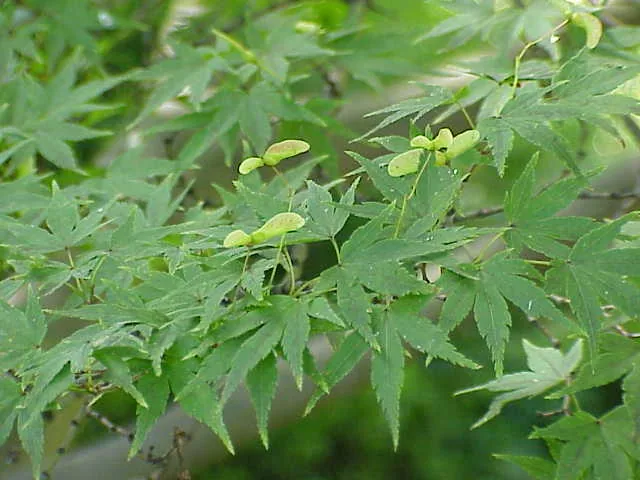
Look closely at a Bloodgood Japanese Maple and the hand-shaped leaves are the first thing you notice. Each blade splits into pointed, finger-like lobes, which is exactly what the name palmatum describes: palm-shaped, deeply cut foliage. Through the heat of summer these blades carry a deep burgundy to blackish-red color that most red cultivars cannot hold, staying dark instead of fading muddy green.
The tree grows into an upright, rounded form, reaching 15 to 20 feet (180 to 240 inches) tall and spreading 12 to 20 feet (144 to 240 inches) across over many slow seasons. In April small reddish-purple flowers open along the branches, modest beside the foliage, and by September into October they give way to clusters of red samaras, the small winged seeds that spin loose from the twigs.
Come autumn the whole canopy shifts gears, the dark summer red brightening into a scarlet, crimson-red blaze that lights up the lobed leaves before they drop. Hardy through USDA zones 5 to 8, this is an outdoor tree built for temperate gardens, slow to fill out but rewarding once those palmate blades catch the light.
Care
The short version: Give this maple part shade with afternoon protection in hot regions, keep the soil evenly moist but never soggy, and watch the thin leaf edges for browning in summer heat. It wants slightly acidic, well-drained loam at pH 5.5 to 6.5, a deep drink every 5 to 10 days, and very little pruning. Hardy in zones 5 to 8, it grows slowly into an upright tree of 15 to 20 feet (180 to 240 inches), and its palmate leaves stay dark burgundy all summer before turning scarlet.
Light
Plant this maple in partial shade, where it sits happiest, though it tolerates full sun and partial sun too. A few hours of direct light each day actually deepen the burgundy in the lobed leaves; too much harsh summer sun, and the thin blade edges crisp brown. In hot regions, give it afternoon shade to keep those palmate leaves intact.
Water
Keep the soil consistently moist but never waterlogged, since this tree is not drought tolerant and its delicate leaves scorch fast when the roots run dry. A deep soak every 5 to 10 days suits it, more often during hot, dry spells. Spread mulch over the root zone to hold moisture and keep roots cool, which spares the leaf margins from browning.
Soil
This maple wants moist, organically rich, slightly acidic, well-drained loam with a pH of 5.5 to 6.5. The roots dislike sitting in water, so drainage matters as much as fertility. Soil that stays heavy and wet stresses the tree and shows up as dieback in the dark red canopy above.
Temperature
Hardy across USDA zones 5 to 8, the tree weathers temperatures from -20°F to 95°F (-29°C to 35°C). It is built for temperate gardens, taking real winter cold in stride while the worst summer heat is what threatens the thin leaves, drying their edges when paired with sun and wind.
Humidity
Average humidity suits this maple fine; it needs no special moisture in the air. The leaf scorch you may see comes from dry soil, sun, and wind acting on the thin blades, not from low humidity, so focus your attention on the root zone instead.
Feeding
Feed in spring, seasonally, with a balanced slow-release fertilizer or compost. Go easy and avoid excess nitrogen, which pushes soft, fast growth that aphids love and does little for the rich leaf color. A light hand keeps the tree steady and the burgundy foliage dense.
Pruning
Keep pruning to a minimum. Remove only dead, damaged, or crossing branches, and do the work in late fall to mid winter while the tree is dormant and the lobed leaves have dropped. The natural upright, rounded shape needs little shaping from you.
Repotting
Container specimens need fresh quarters every 2 to 3 years; landscape trees never need repotting. Watch for roots circling the pot or pushing through drainage holes, water draining straight through, and slowed growth with wilting between waterings, all signs the roots have outgrown their space.
Size & spacing
Give this tree room. It grows slowly into an upright, rounded form of 15 to 20 feet (180 to 240 inches) tall and 12 to 20 feet (144 to 240 inches) wide, so space it well clear of walls and other trees to let the palmate canopy spread without crowding.
When to plant
Set this tree in the ground in spring or fall, once any hard frost has passed and the soil can settle around the roots. Expect reddish-purple flowers in April and red samaras ripening September to October, the small winged seeds that mark the close of the growing year.
Northern hemisphere
Southern hemisphere
Typical months for a temperate climate: start earlier in warm zones, later where spring frosts linger.
- Plant: Spring or fall, after danger of hard frost has passed
- Harvest: Reddish-purple flowers in April; red samaras ripen September-October
Hardiness
USDA hardiness zones: 5–8
Temperature: down to -29°C
Troubleshooting
Most trouble with this maple shows first on the thin palmate leaves, where browning edges, fading color, or a sticky film betray what the roots and stems are dealing with. The three problems below cover scorched margins, one-sided wilt, and the sticky insect mess that crusts the stems.
Limp foliage and dieback on one flank
Whole branches go soft and droop, their deep red leaves fading to a sickly yellow while the rest of the crown looks normal. Peel back the bark on a failing limb and the wood beneath often carries faint greenish or brownish streaks running with the grain.
Fix:
- Prune out and destroy affected branches
- Keep the tree vigorous with proper watering and avoid overfertilizing
- Improve drainage; there is no chemical cure for verticillium
Sticky blades and crusted stems
The new leaves curl and pucker as soft-bodied insects mass along their undersides, and a tacky film coats the surfaces below. Run a finger along a stem and you may feel small raised bumps glued to the bark, sometimes with a dusting of black sooty mold over the red foliage.
Fix:
- Dislodge aphids with a strong spray of water
- Treat with horticultural oil or insecticidal soap
- Encourage natural predators such as lady beetles
Burnt edges along the leaf rims
When the thin palmate blades dry out, the outermost rim of each lobe turns brown and brittle while the center still holds its burgundy color. The crisping starts at the pointed tips and creeps inward, leaving a papery brown band around an otherwise dark red leaf.
Fix:
- Water deeply and consistently to keep soil evenly moist
- Apply mulch over the root zone to retain moisture and cool roots
- Provide afternoon shade in hot climates
- Shelter the tree from strong drying winds
Toxicity
The dark red foliage of this maple carries good news for households with animals. Neither the palmate leaves nor the winged samaras appear on toxic-plant lists, so the main thing to watch is a chewed twig that can splinter rather than anything in the leaf itself.
Safe for
People · Cats · Dogs · Horses · Rabbits · Livestock · Birds
Cats Safe
The thin red leaves are not listed as toxic to cats; a splintered twig is the only real concern.
Dogs Safe
Dogs can mouth the lobed foliage without poisoning, though gnawed branches can splinter and irritate.
Horses Safe
The palmate leaves are not flagged as toxic to horses; watch only for chewed woody pieces.
Rabbits Safe
The slender stems and red blades carry no listed toxic threat to rabbits.
Livestock Safe
No toxic listing covers this maple's foliage for livestock; splintered twigs remain the lone caution.
Birds Safe
The samaras and red leaves are not recorded as toxic to birds.
People Safe
The dark red foliage is not listed as toxic to people; only sharp splintered twigs warrant care.
Although foliage is non-toxic, chewed twigs can splinter and cause choking or digestive upset, so discourage pets from chewing branches.
Varieties
All three forms below grow red-leaved foliage, but they part ways in leaf shape, color steadiness, and overall form, from upright to weeping. Here is how the close-up detail differs from one to the next.
Bloodgood
An upright tree whose hand-shaped leaves stay a deep burgundy to blackish-red right through summer, holding that dark color better than most red cultivars before flaring scarlet in fall and setting small red samaras.
Atropurpureum
A seed-grown red-leaf form, so the depth of color and the cut of each palmate blade wander more from plant to plant than the grafted, true-to-type 'Bloodgood'.
var. dissectum (Tamukeyama)
A weeping laceleaf type with finely dissected foliage cut into thread-thin segments; it stays low and mounding rather than climbing upright like 'Bloodgood'.
How to propagate
Multiplying this maple is genuinely hard, because the deep burgundy color and upright shape only stay true through grafting. Cuttings rarely cooperate. The two methods below explain why nurseries do nearly all the work.
GraftingDemanding
Late winter to early spring (bench grafting) onto seedling rootstock · Several months for the graft union to take; one or more seasons to establish
Grafting onto an Acer palmatum seedling rootstock is the only way to keep that uniform deep burgundy leaf and upright shape true to type, which is why every 'Bloodgood' you buy began this way. Bench grafting runs from late winter into early spring, the union needs several months to knit, and the young tree then spends a season or more settling in. It is demanding work that nurseries handle far better than a home grower can.
Stem cuttingsDemanding
Early summer from softwood growth · Several weeks to months to root, with low success rates
You can try softwood cuttings in early summer, snipping the tender new red-stemmed growth, but expect disappointment. They take several weeks to months to root and most simply fail, which is why grafting stays the dependable route for this cultivar.
Myths
Bloodgood maples will only grow in deep shade and burn in any direct sun.
The tree handles full sun to part shade, and a few hours of direct sun each day actually keep the burgundy pigment in the leaves rich and dark. What it really needs is afternoon shade in hot climates to spare those thin blades from scorching at the edges.
The red leaves of a Japanese maple are poisonous to cats and dogs.
Acer palmatum sits on no ASPCA toxic-plant list, and maples across the genus Acer are treated as non-toxic to cats and dogs. The only real hazard is a chewed twig that splinters, not the dark red foliage itself.