Vegetable · Brassicaceae
Radish
Raphanus sativus
Round and bright red or long and white, the radish swells a crisp root on cool weather and steady water within weeks.
Full sun
Every 3–5 days
39–75°F · 4–24°C
22–60 days
Overview
The radish is a fast-growing member of the cabbage family, and its real character sits underground in a swelling taproot. Above the soil sits a low cluster of green leaves; below, the root fattens fast, and the round salad types firm up into a crisp bulb in only three to five weeks. Few roots in the garden come on that quickly.
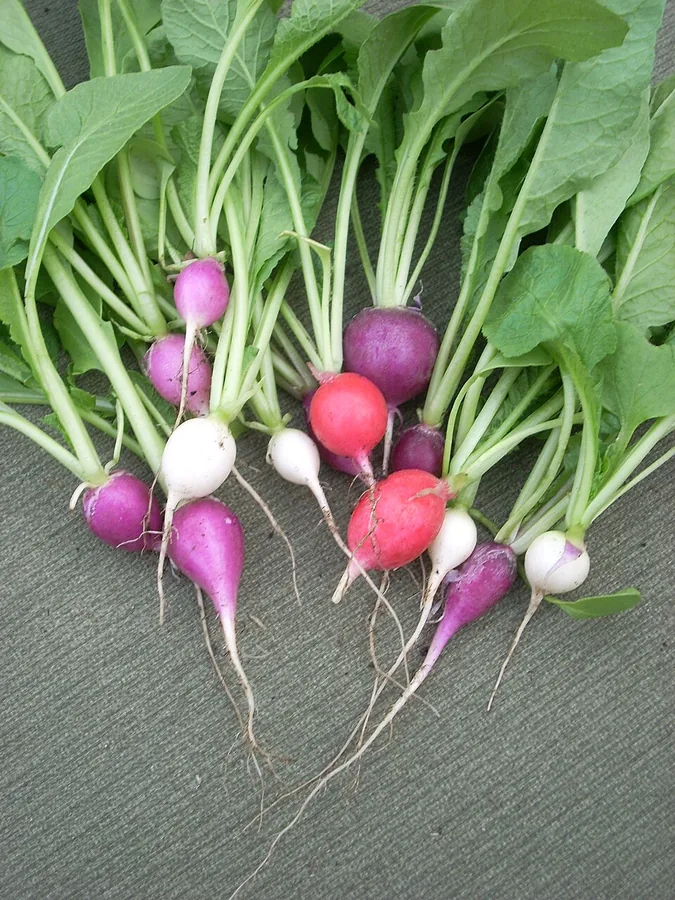
Up close, no two radishes look alike. The round spring types show skins of bright red, and one mix carries white, pink, red, and purple side by side; the long white daikon drives a pale root deep into loose soil, and one odd type skips the root and forms edible seed pods instead. The flesh stays crisp only while cool, since heat leaves it woody and coarse.
A good radish is firm and crisp right through, its skin unbroken. Keep the soil evenly moist, thin the seedlings so each root has space to round out, and pull them on time. Let those slip and the surface cracks in long splits, the flesh turns pithy and hollow, or the plant gives only leaves above bare soil.
Care
The short version: full sun and cool weather, soil kept evenly moist with about an inch of water a week, loose ground low in nitrogen, and the swollen root pulled crisp and firm the moment it reaches size.
Light
The radish leans toward the light and wants full sun, at least 6 hours a day, taking only light afternoon shade in warmth. Starved of sun, it throws up more green leaf and lets the root below stay thin and undersized.
Water
Hold the soil evenly moist, about an inch of water a week, and more in sandy ground or heat. Steady water swells the root firm and crisp; water that comes and goes splits the skin in long cracks and leaves the flesh hot and woody.
Soil
Give the root loose, well-drained sandy loam cleared of stones, so it can push down and round out without hitting anything hard. The pH suits it best between 6.0 and 7.0.
Temperature
Cool air keeps the flesh mild and crisp, and the range runs about 39°F to 75°F (4°C to 24°C). In heat the plant shoots up a flower stalk and the root turns sharp, pithy, and coarse.
Humidity
The air around the leaves needs no attention, since ordinary outdoor humidity is enough. It is the moisture in the soil, held even, that shapes a firm and crisp root.
Feeding
Work compost or well-rotted manure into the bed before sowing and the root has what it needs. Heavy nitrogen shows itself in a mass of green leaves standing over a small, stunted root.
Pruning
There is no growth to cut back, only crowding to relieve. Once the seedlings stand up, thin to about 2 inches apart, or 4 to 6 inches for daikon, so each root has bare soil to swell into.
Size & spacing
By type the leafy tops reach 6 to 35 inches (15 to 90 cm) tall, the long daikon standing highest. Thin to about 2 inches apart, wider for the winter types, so each root rounds out full and firm with air between the plants.
When to plant
The radish shows its crisp, mild character only in cool weather, not in summer heat. Sow the quick round types in early spring once the soil crumbles, then again from late summer into fall, and give the long white daikon and winter types their fall harvest.
Northern hemisphere
Southern hemisphere
Typical months for a temperate climate: start earlier in warm zones, later where spring frosts linger.
- Plant: Direct sow in early spring (April-May) as soon as soil can be worked, and again in late summer to early fall (August-September); winter/daikon types are sown for fall harvest
- Harvest: Spring/salad types harvested 3-5 weeks after sowing; daikon and winter types harvested in fall
Hardiness
USDA hardiness zones: 2–11
Temperature: down to -46°C
Troubleshooting
Trouble in a radish is written on the plant itself, in the root that swells wrong or the leaves that show damage. Look closely at color, texture, and shape. Match what the plant reveals below, then adjust your timing, watering, or feeding.
Pale grubs and brown tunnels through the root
White legless grubs and brown tunnels bored through the flesh mark cabbage root maggots, and a root they have mined is ruined inside. Lift and discard the tunneled roots, rotate away from brassicas, cover the bed at sowing, and keep off recently manured ground.
Fix:
- Remove and discard affected roots
- Practice crop rotation away from brassicas
A mass of leaves over a thread of root
When the plant piles on green leaf and the root below stays a thin thread, the driver is usually too much nitrogen, made worse by a crowded, unthinned row. Heat, long days, and shade tip it the same way. Cut the rich feeding, thin the seedlings apart, and sow in cool weather with at least 6 hours of sun.
Fix:
- Thin seedlings to recommended spacing
- Stop applying high-nitrogen fertilizer
- Sow during cool spring or fall weather in full sun
A flower stalk stretching up from the center
A stalk rising from the heart of the plant is bolting, set off by warm weather and lengthening days and hurried by drought or crowding. As it climbs, the root beneath grows woody and turns sharp on the tongue. Pull what is still firm, then sow again in the cool of spring or fall.
Fix:
- Harvest promptly before quality declines
- Replant in cooler spring or fall conditions
Flesh gone woody, pithy, or hollow
A root held too long loses its crispness, its flesh turning woody, pithy, and hollow with a sharp, peppery burn, and drought and heat speed the change. Once the texture coarsens, it stays that way. Pull the roots while firm and keep the soil evenly moist as they grow.
Fix:
- Harvest at peak size
- Keep soil consistently moist during growth
Long cracks splitting the root open
Splitting shows as long cracks running down the root, and it follows moisture that swings, most often a heavy soak onto dry ground, along with roots left in too long. Even watering keeps the skin whole, so water steadily and lift each root at size before it splits.
Fix:
- Harvest at proper size
- Maintain even watering
Tiny round holes pricked through the leaves
Small round holes punched across the young leaves are the feeding of flea beetles, minute dark beetles that spring off the foliage when touched. The tender seedling leaves take the most damage, so cover the young plants with a floating row cover and rotate brassicas each year.
Fix:
- Use floating row covers over seedlings
- Monitor and manage early pressure
Toxicity
Every part of the radish is edible, from the crisp root to the green leaves, the flowers, and the seed pods. It brings no harm to pets or livestock. The one physical note is the cut root, whose pungent flesh can sting sensitive skin.
Safe for
People · Cats · Dogs · Horses · Rabbits · Livestock · Birds
Cats None
Radish does cats no harm. A bite of the crisp root or a green leaf might bring a little gas or a soft stool, and nothing beyond that.
Dogs None
Radish is safe for dogs. Plain slices of the root are fine in moderation, though a large helping of the peppery flesh can leave a dog gassy.
Horses Safe
Horses eat the root and the leafy tops without harm. A modest amount keeps radish a small part of the diet.
Rabbits Safe
Rabbits crop the green tops readily, and a little of the crisp root suits them too. The leaves are the better part for them.
Livestock Safe
Cattle, goats, and sheep graze both the leafy tops and the roots without harm, and radish is sometimes sown as forage.
Birds Safe
Backyard hens peck at the green leaves and the roots without trouble, and the foliage gives them fresh green matter.
People Safe
People eat radish raw or cooked, taking the crisp root, the green leaves, the flowers, and the seed pods alike. Cutting into the pungent root can sting sensitive skin.
Leaves and roots contain isothiocyanates that may cause mild skin irritation in sensitive individuals when handling, and the raw root is pungent.
Varieties
Hundreds of radishes exist, and they differ most in the color and shape of the root. These few show that range at a glance.
Cherry Belle
A round, bright red salad radish that swells to size in about three to four weeks.
Easter Egg
A single sowing that turns up roots colored white, pink, red, and purple.
Sparkler
A round red radish tipped with a clean patch of white at its base.
Daikon (var. longipinnatus)
A long white winter radish that drives a deep root and needs a longer season and loose soil.
Rat's Tail (var. caudatus)
An odd type that forms edible, spicy seed pods in place of a swollen root.
Companions
Radishes earn their keep beside slower crops, holding space and marking rows before they're pulled and the neighbors fill in.
Plant near
Lettuce: Quick-maturing radishes interplant well with lettuce, using space before the lettuce fills in.
Carrots: Radishes are sown as a fast marker crop with slow-germinating carrots and are pulled before the carrots need the room.
Cucumbers: Radishes are commonly interplanted with cucumbers as an early quick crop in the same bed.
How to propagate
The radish begins as a small seed dropped into the soil where it will swell its root.
SeedEasy
Direct sow in early spring and again in late summer/fall · Germinates in about 3 to 7 days under cool, moist conditions
The radish starts from a small seed set straight in the ground, since the root will not take to being moved. Press the seeds about 1/4 to 1 inch deep in early spring and again from late summer into fall, and in cool, moist soil the first green shoots break through in 3 to 7 days. Thin the young seedlings early so each root has bare soil to round out into.
Myths
A radish must have rich, heavily fed soil to swell a large root.
The opposite shows in the bed: heavy nitrogen throws up leaves and leaves the root small and thin. A radish swells best in moderately fertile, well-prepared soil, not a richly fed one.
A radish can sit in the ground and still pull firm whenever you want it.
Left too long, the root goes woody, pithy, and cracked, and the flesh sharpens to a hard bite. Pull it firm and crisp the moment it sizes up to catch it at its best.