Houseplant · Araceae
Pink Princess Philodendron
Philodendron erubescens 'Pink Princess'
Dark, heart-shaped leaves splashed with bubblegum pink stay boldly patterned when the plant gets filtered brightness and steady soil moisture.
Bright indirect
65–85°F · 18–29°C
USDA 10–12
2–60 ft · 0.6–18.3 m
Overview
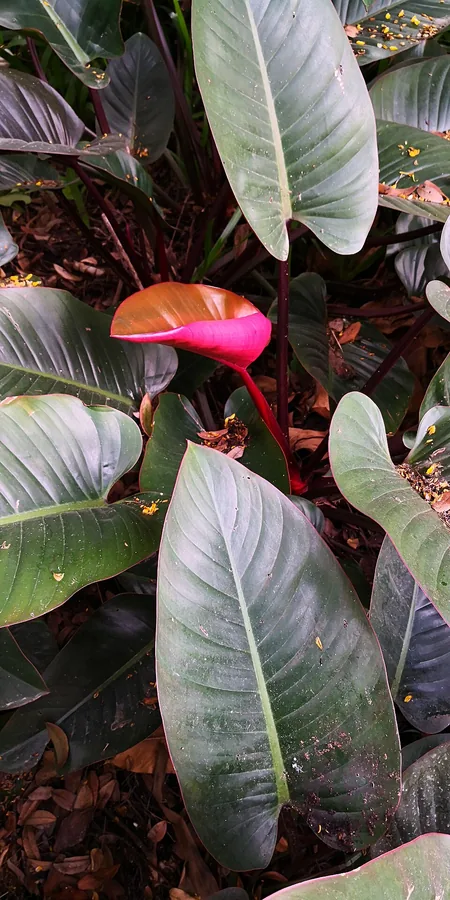
The Pink Princess is a climbing philodendron of the arum family, and its draw is written across the leaves: broad, heart-shaped blades of deep green brushed with splashes of bubblegum pink. The pink lands differently on every leaf, a streak here, a whole half-blade there, so no two match. That scattered, unrepeatable marking is the appeal, and it is also what makes the plant a project.
The color is a chimeral variegation, meaning the pink sits in only part of the leaf's tissue and is never promised to the next blade that opens. A stem can turn out solid green and, left to itself, outgrow every pink-marked leaf around it. Watching each new leaf as it unfurls and pruning at the right node is how the pink stays in the picture.
Indoors it climbs to a modest height, usually around 3 feet (90 cm) as it winds up a moss pole or trellis, though the species will scale far higher in the wild. Give it warmth, bright indirect light, and a mix that drains well, and it puts out those pink-flecked, heart-shaped leaves at a steady, moderate pace.
Care
The short version: bright indirect light, warmth between 65°F and 85°F (18°C to 29°C), and a moist but free-draining mix, with reverted green stems pruned back so the pink-streaked leaves keep coming.
Light
Set it in bright indirect light near a window but clear of the hot, direct beam, which scorches pale patches across the blades. That light is also what feeds the pink, so a dim corner leaves you with thin, mostly green leaves and little of the candy color.
Water
Keep the mix evenly moist but never soggy, letting the surplus run out each time. Waterlogged soil is the fastest path to root rot, which softens and browns the roots, so favor free drainage over frequent watering.
Soil
Plant it in a rich, well-draining mix built on organic matter such as loam or silt. An acidic to neutral pH suits it, and the drainage matters more than the exact blend, since standing water rots the pale roots.
Temperature
It does best in a warm room between 65°F and 85°F (18°C to 29°C). Keep it back from cold drafts and chilly winter windowsills, since it has no tolerance for the cold and chilling marks the leaves.
Humidity
The plant favors high humidity and answers with broader, glossier, healthier leaves. It will adapt to average room air, but a humidifier or a pebble tray set nearby brings out its fullest foliage.
Feeding
Feed monthly through spring and summer with a balanced liquid houseplant fertilizer at half strength. Ease off through the darker months when growth slows and few new leaves open.
Pruning
Prune to shape the plant and, above all, to protect the pink. When a stem reverts to solid green, cut it back to a node still carrying pink, or that vigorous green growth crowds out the variegated blades.
Repotting
Repot in spring once it turns root-bound, which shows when the pale roots fill the pot or push out through the drainage holes. Step up just one pot size so the fresh mix does not stay wet around the roots.
Size & spacing
24–720 in (61–1829 cm) tall
Troubleshooting
Most of what goes wrong with a Pink Princess writes itself across the leaves and roots, and watering and light lie behind nearly all of it. Read the early marks and the fixes are simple. Match the look of what you see below, then act before it spreads.
Leaves turning yellow and flopping while the mix stays wet
Leaves gone limp and yellow above soil that stays dark and wet are the face of root rot. Overwatering or a mix that holds too much water sets it off. Below the surface the roots turn from firm and pale to soft, brown, and mushy to the touch. Slide the plant into a fresh, fast-draining mix, cut away the slack brown roots, and water less often as it recovers.
Fix:
- Reduce watering frequency
- Repot into a fresh, well-draining, organic-rich mix
- Trim away rotted roots
Fresh blades unrolling in plain dark green with no pink splashes
A new leaf that unfurls a flat, solid green with no pink at all is a chimeral variegation the plant has failed to carry forward, and an all-green stem can push ahead and swallow the variegated growth. A dim spot pulls it the same way. Cut the reverted stem back to a node that still shows a blush of pink, then give it bright indirect light so the pink-marked leaves return.
Fix:
- Prune the reverted stem back to a node that still bears pink variegation
- Provide bright indirect light
Ringed brown spots and dark lesions marching across leaf surfaces
Dark, sunken spots on the leaf blade, some ringed by a thin yellow halo, mark a fungal or bacterial leaf spot that settles in where the air is still and the surface stays wet. Pick off every leaf carrying the lesions, and give the plant room so air can slip around the foliage. Keep water off the blades when you water and the spotting fades.
Fix:
- Remove affected leaves
- Improve air circulation
- Avoid wetting the foliage
Silky webbing, a glossy sticky glaze, or white cottony fuzz
Thin silken webbing strung across the leaf undersides, a tacky glaze on the blades, or little white cottony tufts tucked into the stems all announce sap-feeding pests such as spider mites, mealybugs, aphids, scale, and thrips. The fine webbing belongs to mites, the cottony fluff to mealybugs, and the sticky sheen to whatever is drawing sap. Rinse or wipe them off the surfaces, coat the plant with insecticidal soap or horticultural oil, and set it apart from the rest until the leaves come up clean.
Fix:
- Wipe off or rinse away pests
- Treat with insecticidal soap or horticultural oil
- Isolate the affected plant
Whitened, crisped patches burned into the leaf surface
Bleached, papery patches burned across the side of the blade that faces the glass are sun scorch from a direct beam. This plant takes bright light best when it arrives filtered and soft rather than as a hard shaft through the window. Draw it back from the pane or hang a sheer curtain, and the new leaves come in whole and unmarked in bright indirect light.
Fix:
- Move to bright indirect light, out of direct sun
Toxicity
This is a toxic houseplant, so set it well out of reach of pets and children. Every part holds insoluble calcium oxalate crystals, tiny sharp needles that sting and burn the mouth the instant they are chewed, and the sap can leave bare skin red and irritated. Nothing on this plant is meant to be eaten.
Toxic to
Cats · Dogs · Horses · Rabbits · Livestock · Birds · People
Cats Moderate
A leaf crushed between a cat's teeth releases sharp calcium oxalate crystals that burn the soft tissue of the mouth on contact. Drooling, pawing at the face, and vomiting follow, and the cat holds off swallowing while its mouth and tongue swell and turn sore.
Dogs Moderate
A dog that bites into the blade takes a mouthful of those same stinging crystals. Heavy strings of drool, retching or vomiting, puffy swollen lips and tongue, and a hard time swallowing show up soon after.
Horses Moderate
The crystals inflame the tender lining of a horse's mouth and throat, raising drooling, painful swelling, and difficulty swallowing. A horse cannot vomit, so the burning stays put in the mouth and gut.
Rabbits Caution
The oxalate crystals prick and irritate a rabbit's mouth the same way they do other animals, so keep the plant out of reach. A single nibbled leaf can leave a rabbit sore-mouthed and turned off its food.
Livestock Caution
Grazing animals that mouth the leaves meet the same stinging irritation and streaming drool. It is no pasture plant, but a curious goat or sheep that reaches it can end up with a sore, swollen mouth.
Birds Caution
A bird that bites into the foliage runs into the same irritant crystals, with swelling and raw discomfort in the mouth. Keep pet birds clear of the leaves and stems.
People Caution
No part of this plant is meant to be eaten. A chewed leaf burns the mouth and lips, and the sap can leave skin flushed red and itchy, so wear gloves when you prune and keep it away from small children.
Sap can cause contact dermatitis - wash hands or wear gloves when pruning
Helpline numbers

United States
ASPCA Animal Poison Control: (888) 426-4435 (fee applies)
Poison Control: (800) 222-1222



Canada
Poison Centres: 1-844-764-7669
How to propagate
You can raise more Pink Princess plants from the one in front of you, but only from a piece that already wears pink. Both methods below work, so long as the cutting starts at a node that shows the variegation.
Stem cuttingsModerate
Spring to summer, during active growth · Several weeks to root
Take cuttings in spring or summer while the plant is in active growth, and make sure every piece carries at least one node marked with pink. A cutting drawn from a plain all-green stretch grows only green leaves, since the variegation is chimeral, so the pink on the node is what you are after. Bed it into a moist medium and give it several weeks to push out roots.
LayeringModerate
Spring to summer, during active growth · Several weeks to root before separating
Layering is the lower-risk route, worked in spring or summer during active growth. The stem grows its own roots while it stays joined to the parent, and after the several weeks it needs to root you sever it into a standalone plant.
Myths
Pink splashes are baked into the plant, so every new leaf emerges variegated.
The pink is a chimeral variegation that is not fixed in place, so leaves can emerge plain green at any time. Left alone, a vigorous all-green stem grows straight past the pink-marked parts and buries them. Prune reverted growth back to a pink node to keep the color coming, and the candy-pink streaking holds.
Green stems that lost their pink will streak up with color again in time.
Once a stem has hardened to solid green it stays that shade, since the green tissue is stable and never wins back its pink. Cut it back to a node that still shows pink and let new variegated leaves push out from that point.