Houseplant · Araceae
Philodendron Birkin
Philodendron 'Birkin'
Give it bright, filtered light and steady moisture, and this pinstriped philodendron unfurls one clean white-on-green leaf after another.
Bright indirect
64–84°F · 18–29°C
USDA 10–12
0–3 ft · 0.2–0.9 m
Overview
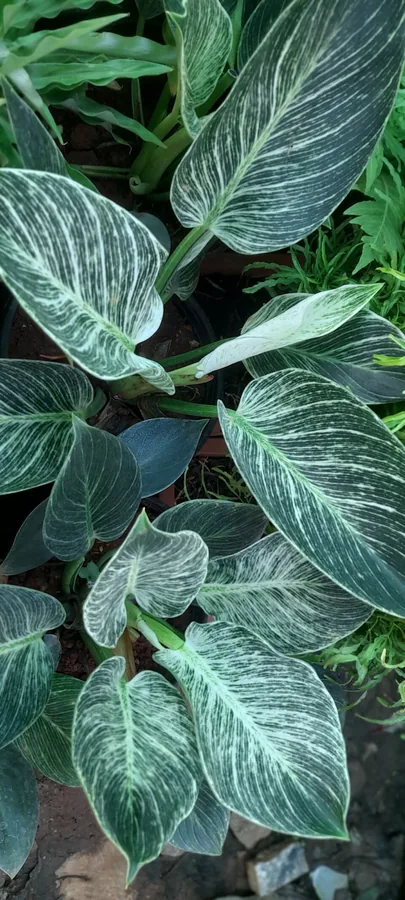
The Philodendron Birkin is an easy houseplant grown for leaves that carry fine white pinstripes brushed across a deep green blade, each fresh leaf unrolling from the center of the plant. It arose as a chance sport of 'Rojo Congo' rather than a wild species, and it holds a compact, upright form, its leaves stacking close on short stems. Indoors it stays small and slow, inching toward around 3 feet (91 cm) over a long time.
A member of the aroid family, the Birkin wants what most tropical foliage plants want: warmth, bright but indirect light, and air that is not bone dry. Those crisp pale lines are the whole appeal, running feather-thin from the midrib to the leaf edge, and they hold their contrast only in good light. Set the plant in a dim corner and the striping blurs toward flat green while the stems draw out long and thin.
It earns its easy name by shrugging off the odd missed watering and growing slowly enough that it rarely crowds its pot in a hurry. The weak point sits below the soil, in roots that rot fast in soggy soil and turn soft and slick when they stay wet. Match the light and the watering and the leaves keep coming in cleanly lined.
Care
The short version: bright, indirect light to keep the white lines crisp, soil kept lightly moist but never soggy, warmth above 64°F (18°C), and humidity around 50% to 60%.
Light
The Birkin holds its bright white pinstripes sharpest in bright, indirect light; it manages in medium indirect light, but the lines soften and blur. Harsh direct sun scorches the leaf surface, so keep it out of that, and turn the pot now and then so the plant fills out evenly rather than leaning to one side.
Water
Keep the soil lightly moist but never waterlogged, letting the top inch dry between waterings. Overwatering harms this plant far more than a dry spell, since the roots go soft when they sit wet, so empty the saucer and never leave them standing in water.
Soil
Plant it in a well-drained, organic-rich mix of loam and sand, dark and crumbly enough to hold a little moisture without turning to muck. A slightly acidic to neutral pH of 6.0 to 7.0 suits it, and a pot with open drainage holes does most of the work of keeping the roots firm and pale.
Temperature
Ordinary room warmth is ideal, somewhere between 64°F and 84°F (18°C to 29°C). Cold drafts, frost-chilled windows, and the dry gust of a heat vent all leave a mark on the leaves, so keep it clear of them.
Humidity
The Birkin likes it humid, ideally around 50% to 60%. When the air dries out the thin leaf tips crisp and brown, so group it with other plants, set it over a tray of pebbles and water, or run a small humidifier nearby to keep the blades smooth.
Feeding
Feed monthly through the growing season and skip it in the darker months when the plant pushes out few new leaves. A regular houseplant fertilizer at the label rate is plenty, since this is a slow grower that adds foliage a leaf at a time.
Pruning
There is little pruning to do beyond tidying the plant's shape. Snip any yellowed or damaged leaves off at the base, close to the stem, and trim a stray stem to keep the leafy crown full and compact.
Repotting
Repot in spring, and only once the plant is genuinely root-bound, with pale roots crowding the pot or curling out through the drainage holes. Move it up just one pot size, since too large a pot holds extra wet soil around the roots that invites rot.
Size & spacing
Indoors the Birkin stays small and slow, reaching roughly 6 to 36 inches (15 to 91 cm) tall and about as wide, its leaves fanning out in a low, rounded mound. That tidy, upright habit needs little room, so it settles onto a shelf, desk, or windowsill with ease.
Troubleshooting
Most Birkin trouble shows either below the soil in the roots or across the leaf blades above, and the cause usually traces to watering, light, or dry air. The earliest signs are written right on the plant, so reading them lets you step in before it slides downhill. Match what you see below, then act.
Yellowing leaves and soft, mushy roots
Leaves fading to sickly yellow above roots gone soft and slippery are the marks of root rot, and a pot kept too wet is nearly always the source. Soil that never dries leaves water clinging to the roots, which starve of air and turn slick and mushy while the color drains from the foliage. Ease off the watering, shift to a mix that drains freely, and repot into fresh soil once any root feels slimy between the fingers.
Fix:
- Reduce watering
- Improve drainage
- Repot in fresh mix
White lines blurring to plain green on lanky, drawn-out stems
When the crisp white lines blur toward plain green and the stems draw out long with bare stretches between each leaf, the plant is hungry for light. A Birkin in shadow lets its pinstriping wash away and pushes lean, thin growth toward the nearest window. Bright, filtered light brings the next leaves in boldly striped again, packed tight along a sturdier stem.
Fix:
- Move to bright filtered light
Gauzy threads, a glistening film, or minute crawlers on the leaf blades
Sap-sucking pests such as spider mites, mealybugs, aphids, scale, and thrips leave their trace on the leaves, from gauzy webbing strung across the surface to a tacky, glistening film. Wiping the foliage clean and treating the plant with insecticidal soap clears them, repeated until not one remains. A close look over the new leaves and the undersides catches them early, while the trouble is still small.
Fix:
- Wipe leaves
- Treat with insecticidal soap
Crispy brown tips on the leaves
Leaf edges gone dry and brown, brittle enough to crumble at a touch, usually mean the air is too dry. Lifting the humidity around it toward 50% to 60% with a nearby water tray, a huddle of plants, or a small humidifier keeps the fresh foliage supple. The scorched brown tips will not green over again, but the leaves that follow unfurl smooth and whole.
Fix:
- Raise humidity to 50-60%
Toxicity
This is a plant to keep out of reach. Like other philodendrons, every part of it, leaf and stem alike, holds insoluble calcium oxalate crystals that cause burning, drooling, and swelling in the mouth if chewed. No part is edible, and the clear sap can sting bare skin, so handle it with care and keep it away from pets and small children.
Toxic to
Cats · Dogs · Horses · Rabbits · Livestock · Birds · People
Cats Toxic
A cat that bites a leaf meets a mouthful of sharp crystals at once. Expect heavy drooling, pawing at the mouth, vomiting, and a sore, swollen mouth and throat.
Dogs Toxic
Chewing brings on intense oral burning, so look for drooling, foaming, and a dog that suddenly refuses food. Vomiting and a swollen muzzle can follow.
Horses Toxic
In a horse the crystals inflame the tender lining of the mouth and gut, bringing strings of drool, refused feed, and obvious discomfort. Keep the pot far from any stall, aisle, or turnout where a searching muzzle might find it.
Rabbits Toxic
Safe forage this is not. Even one nibble stings the delicate lining of a rabbit's mouth and gut, so set the pot far above the range of any free-roaming, inquisitive bunny.
Livestock Toxic
Cattle, goats, and sheep respond to the sharp crystals with aching mouths, ropes of drool, and unsettled guts. Never toss trimmings or spent leaves where farm animals feed.
Birds Caution
A companion bird that gnaws the foliage picks up the same stinging mouth and wet, drooling beak, so count this plant as forbidden and supply bird-safe greens to chew instead.
People Caution
Every part of the plant is inedible. One taste sets the lips alight, puffs the tongue, and starts drool flowing, and the clear sap can nip exposed skin, so wash up after handling and station it well above a small child's reach.
Keep away from pets and children; wash hands after handling sap
Helpline numbers

United States
ASPCA Animal Poison Control: (888) 426-4435 (fee applies)
Poison Control: (800) 222-1222



Canada
Poison Centres: 1-844-764-7669
How to propagate
A Birkin is simple to multiply at home, and spring or summer is the time to do it, while fresh leaves and roots are forming fast.
Stem cuttingsEasy
Spring to summer · Several weeks to root
The simplest way to raise more Birkins is from stem cuttings taken in spring or summer, while fresh growth is pushing out. Slice a firm section carrying a node or two, the knobby joint where roots will emerge, then stand it in water or press it into moist potting mix and give it several weeks to send out pale new roots before it becomes a plant of its own.
LayeringModerate
Spring to summer · Several weeks
Air layering in spring or summer is a second route that suits philodendrons across the genus. Pack moist medium around a node on a stem still joined to the parent, wait the several weeks it takes for roots to thread out into that damp pocket, then cut the rooted section free just below them.
Myths
The Birkin stands as a true philodendron species in its own right.
The plant began as a chance sport of 'Rojo Congo' rather than a true species, and that is why the fine white pinstriping never settles into a fixed pattern. A Birkin can revert, unfurling leaves of solid green or even deep, glossy red, and dim light makes the shift more likely. Bright, filtered light keeps each new leaf crisply lined.