Herb · Apiaceae
Parsley
Petroselinum crispum
Give it rich soil, steady moisture, and a little patience at sowing, and parsley keeps the kitchen in fresh leaves.
Full sun
Every 2–4 days
50–75°F · 10–24°C
70–90 days
Overview
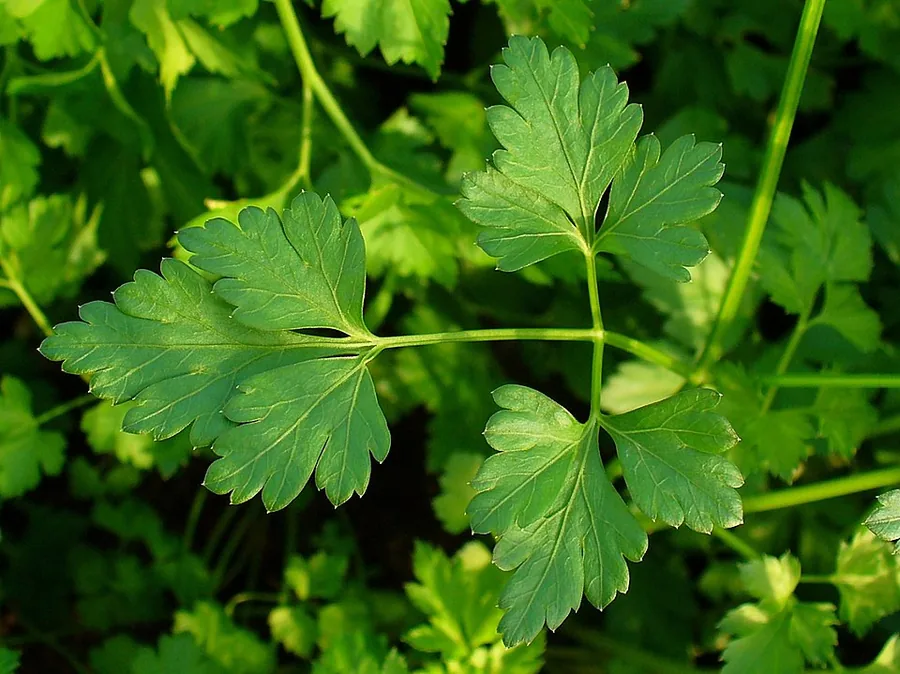
Parsley is a leafy herb of the carrot family, a low mound of bright, clean-tasting green built from finely divided leaves on slender stalks. It splits into two clear looks: the tightly curled, ruffled type, densely frilled at every edge, and the flat-leaf Italian type, whose broad, deeply cut leaves lie open and carry the stronger flavor. Both fill out into rounded tufts of foliage in a bed or a pot on a sunny sill.
Parsley lives as a biennial, and its two seasons look very different. The first year is a dense rosette of leaf after leaf close to the soil, and that leafy crown is the harvest. In the second year a tall stalk rises from the center, the plant turns to flower and seed, and the once-soft foliage stiffens into tough, bitter leaves, so most gardeners start again from seed each spring.
Once up, parsley grows slowly and asks for little, but the start tests patience. The small seed can take weeks to send up its first thin green thread, and a taproot thickens below that resents any disturbance. Sow it where it will grow, keep the soil evenly moist, and the crown fills out for months of cutting.
Care
The short version: full sun to part shade, rich well-drained soil kept evenly moist, and a steady monthly feed to keep new green leaves unfurling all season.
Light
Parsley colors up deepest in full sun but holds its green in partial shade, which suits a spot that loses the afternoon light. Where summers run hot, a little shade through the worst of the day keeps the leaves soft and tender rather than scorched.
Water
Keep the soil evenly moist so the leaves stay plump and springy, and never let the plant dry to a wilt, which matters most in pots and hot spells. Watering every 2 to 4 days holds that balance, short of the soggy ground that rots the roots below.
Soil
Root it in rich, well-drained loam worked with compost, dark and crumbly enough to hold moisture without packing wet. A pH between 6.0 and 7.0, slightly acidic to neutral, suits it.
Temperature
Parsley grows greenest cool to mild, from 50°F to 75°F (10°C to 24°C). It shrugs off a light frost, but a long hot stretch drives up the tall stalk and turns the leaves tough and bitter.
Humidity
Average humidity of 40% to 60% suits parsley. Airflow matters more, since leaves left damp in crowded, still air are where the tan spots of leaf spot first freckle the foliage.
Feeding
Feed monthly through the growing season with a balanced fertilizer or a side-dressing of compost. That steady supply is what keeps new green leaves unfurling from the center after each cutting.
Pruning
Harvest is the pruning here. Cut the outer stems at the base once the crown is established, and regular picking pushes fresh leaves up from the center. In the second year, snap off the rising flower stalks as they appear to hold off bolting a while longer.
Repotting
Potted parsley wants a fresh start about once a year, since the thickening taproot soon fills the container. Roots circling the soil, fast drying, and pale, stunted top growth are the plant's signal that it is time to move up or, more often, resow.
Size & spacing
Parsley builds a compact tuft, reaching 8 to 16 inches (20 to 40 cm) tall with a spread of 8 to 12 inches (20 to 30 cm) across. Give each plant that much room so air threads through the leaves and they dry between waterings.
When to plant
Parsley is cold-hardy and stirs into growth early. Start the seed indoors in late winter or direct-sow in early spring a few weeks before the last frost, and the first year fills out into a leafy crown for cutting. The tall flower stalk and seed belong to the second year.
Northern hemisphere
Southern hemisphere
Typical months for a temperate climate: start earlier in warm zones, later where spring frosts linger.
- Sow: 8-10 weeks before the last spring frost
- Plant: Early spring, a few weeks before the last frost; parsley is cold-hardy
- Harvest: Harvest outer leaves once plants are full in the first year; flowers and seeds form in the second year
Hardiness
USDA hardiness zones: 4–9
Temperature: down to -34°C
Troubleshooting
Parsley is an easygoing herb, and most of its trouble shows right on the leaves, in spots and chewed edges, or follows soil left too wet. Learn the few common marks and you can step in early. Match what you see below, then act while it still helps.
Stems fold at the base while the roots turn soft, dark, and mushy
This is stem and root rot, and it shows as a base that folds over while the roots below go soft, dark, and mushy to the touch. It sets in where soil stays too wet and drains too slowly. A rotted base cannot recover, so lift and discard the plant, correct the drainage before replanting, and water container plants more sparingly.
Fix:
- Remove and discard affected plants
- Improve drainage before replanting
Small tan to brown spots edged in dark speckling the leaves
This is Septoria leaf spot, a fungus that stipples the foliage with small tan to brown spots, each ringed by a darker margin, once the leaves stay wet and humid. The freckling starts low and deep inside the plant, then the spots widen and bleed together the longer the leaves hold moisture. Thin the stand for better airflow, water at the soil line, and pick off every marked leaf.
Fix:
- Remove and discard affected leaves
- Improve air circulation by thinning plants
- Avoid overhead watering
A tall flower stalk climbs and the leaves turn tough and bitter
This is bolting, marked by a tall central stalk that climbs above the low mound of leaves as the plant reaches for flower and seed in its second year. Heat and stress can push it early, and the once-tender foliage goes stringy, tough, and bitter. There is no reversing it, so grow parsley as an annual, replant each spring, and harvest hard before the stalk shoots up.
Fix:
- Start new plants from seed each year rather than maintaining biennials
- Harvest heavily before bolting
- Remove flower stalks to briefly prolong leaf production
Leaves chewed away by plump green caterpillars ringed with black and yellow
The feeder is the parsleyworm, the caterpillar of the eastern black swallowtail, a fat green body wrapped in black and yellow bands that clings to the stems and leaves. It grazes the outer foliage fast, leaving ragged, half-eaten edges. Handpicking removes them, though many gardeners lift them onto a spare plant to grow into butterflies, and a little extra parsley leaves enough green to share.
Fix:
- Handpick caterpillars if leaf supply is limited
- Relocate caterpillars to a sacrificial plant since they become swallowtail butterflies
- Cover plants with row cover if protection is needed
Toxicity
Parsley is a safe culinary herb for people, and a green sprig in your food is nothing to worry about. The catch lies in the furanocoumarins packed through its leaves and stems, the same compounds found across the carrot family, which can give pets and grazing animals an upset stomach or sun-sensitive skin if they eat a real quantity. Cats, dogs, and especially birds deserve a light touch, so keep harvested bunches out of reach.
Toxic to
Cats · Dogs · Horses · Rabbits · Livestock · Birds
Safe for
People
Cats Mild
A single nibbled leaf does little harm, but a cat that eats a real mouthful can end up with a queasy stomach and loose stools. The furanocoumarins in the green tissue can also leave the skin touchy in sunlight.
Dogs Mild
Small culinary amounts sit fine with most dogs. A large helping of the leaves is another matter, since the same furanocoumarins bring on drooling, an upset stomach, and skin that reddens or burns in the sun.
Horses Mild
Grazing through a large stand of parsley can leave a horse photosensitive, so light-skinned areas redden and chap after time in the sun.
Rabbits Mild
A few leaves make a fine treat. Pile on too much and the furanocoumarins can unsettle the gut, so parsley is best kept to an occasional share of the greens.
Livestock Mild
Goats, sheep, and cattle can develop sun-triggered skin irritation if they graze parsley heavily, though a stray plant in the pasture rarely amounts to much.
Birds Mild
Birds are the most sensitive of the group. The concentrated furanocoumarins can irritate the gut and skin in even modest amounts, so parsley is offered sparingly and not as a staple green.
People Safe
Parsley is a kitchen staple and safe to eat. Handling huge quantities of the fresh, green plant in bright sun can leave sensitive skin prone to a rash, but that is a worker's hazard, not a mealtime one.
Furanocoumarins can cause sun-triggered skin and eye irritation in animals that ingest substantial amounts; small culinary garnish quantities are typically low-risk.
Helpline numbers

United States
ASPCA Animal Poison Control: (888) 426-4435 (fee applies)

United Kingdom
Animal PoisonLine: 01202 509000 (fee applies)

Australia
Animal Poisons Helpline: 1300 869 738
Varieties
A few distinct parsleys grow in gardens, told apart by the shape of their leaves and whether the prize is the foliage or the root. These are the ones worth knowing by name.
Curly parsley (var. crispum)
Its leaves are tightly curled and ruffled, densely frilled at the edges, which is what makes it the classic choice for garnish and for the front edge of a bed.
Italian flat-leaf parsley (var. neapolitanum)
Its leaves lie flat and are deeply cut into pointed segments, and they carry the strongest flavor of the group, the reason cooks reach for it.
Hamburg parsley (var. tuberosum)
Below the greenery it swells into a thick, parsnip-like taproot, and that pale root, not the leaves, is what this kind is grown for.
How to propagate
Parsley grows from small seed, the way nearly every gardener starts it. The work is in coaxing that slow, thin first sprout and in leaving the taproot below undisturbed.
SeedModerate
Spring; start indoors 8-10 weeks before the last frost or direct-sow when soil can be worked · About 3-4 weeks to germinate, plus several more weeks to establish
Parsley grows from small seed, and it makes you wait. Sow indoors 8 to 10 weeks before the last frost, or direct-sow once the soil can be worked, and the first threads of green take 3 to 4 weeks to germinate, plus several more weeks to bulk into a leafy plant. An overnight soak of the seed speeds sprouting. Below the surface parsley drives a taproot that resents being moved, so sow it where it will grow, or lift young seedlings with the root ball intact.
Myths
Parsley is a safe culinary herb, so it poses no risk to pets.
Garden parsley does carry furanocoumarins, the same family of compounds found across the carrot family, and a pet that eats a large amount can get an upset stomach or skin that burns in the sun. Small garnish-sized portions are low-risk, and the toxic 'spring parsley' on the ASPCA list is a different plant entirely, Cymopterus watsonii.
Parsley seed simply will not germinate.
The small seed does sprout, only slowly, and the wait can stretch to several weeks before the first thread of green pushes through the soil. Soaking the seed overnight before sowing brings that sprouting on faster.