Ornamental · Convolvulaceae
Moonflower
Ipomoea alba
In full sun and warm soil, moonflower spirals open pure-white trumpets the width of a saucer each evening.
Full sun
Every 3–7 days
50–90°F · 10–32°C
60–120 days
Overview
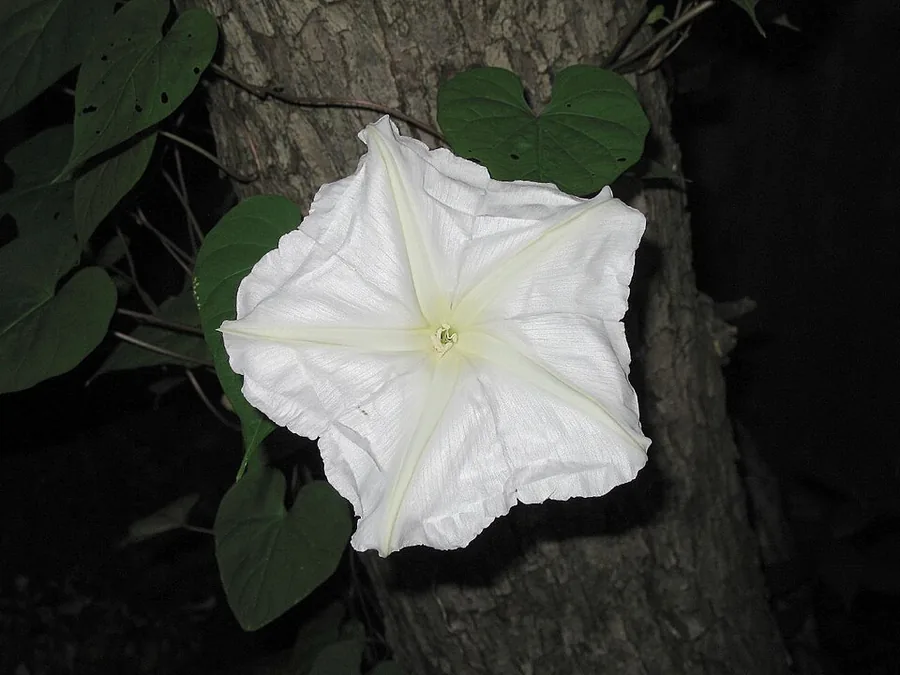
Moonflower is a fast, twining vine, and its flower is the sight that defines it. At dusk a tightly furled bud spins loose into a pure-white, fragrant trumpet as wide as a saucer, its five-pointed rim flaring flat from a long slender throat, and by the next morning the bloom has folded shut again. The sphinx and hawk moths that pollinate it work the open flowers through the dark. It sits in the morning glory family and carries the same twining stems as its day-blooming kin.
The stems coil and wrap as they climb, hauling broad green leaves up a support fast enough to clear head height in a single season. In frost-free ground the vine is a tender perennial, though most gardeners grow it as an annual from fresh seed each spring. Those pale, scented flowers stand out most against the deep green of the foliage and the dark of a summer evening.
The plant asks little once its roots take hold. Two conditions blunt the display: a cold, short season and overly rich soil, both of which pile on green leaves while the white buds stay scarce. With warmth and lean soil, the vine mainly needs a frame to twine its stems around.
Care
The short version: full sun, warm and average (not rich) well-drained soil, and steady moisture, with a strong trellis or fence for the vine to climb.
Light
Give moonflower full sun, ideally 6 or more hours a day, and the leaves and stems stay dense and strong. It takes a little afternoon shade, but anything less than full sun thins the vine and leaves fewer of the white flowers.
Water
Keep the soil evenly moist without letting it turn soggy, watering roughly every 3 to 7 days as the heat and rain shift. Steady, medium moisture keeps the broad leaves firm, and well-drained ground protects the roots.
Soil
Average, well-drained soil suits it, whether loam, clay, or sand, at a pH from 6.0 to 7.8. Skip the rich, heavily amended beds, since lush soil swells the green foliage and holds back the pale buds.
Temperature
This is a heat lover, comfortable from 50°F to 90°F (10°C to 32°C). The stems lengthen fastest in the warmth of high summer, and frost blackens and ends the plant.
Humidity
Ordinary outdoor humidity keeps the foliage fine, so there is no figure to aim for. The vine takes typical garden air in stride.
Feeding
A light, balanced fertilizer about once a month through the growing season is enough. Go easy on nitrogen in particular, since a heavy hand swells the leaves and delays the white trumpets.
Pruning
Pinch out the soft young tips early to push the vine to branch and thicken. Beyond that, cut away any dead or stray growth and keep winding the twining stems onto their support as they climb.
Repotting
In a container, plan to repot once a year. Roots circling the pot, poking from the drainage holes, or growth that stalls all show the plant has filled its space.
Size & spacing
This is a long, twining vine, climbing 10 to 30 feet (3 to 9 m) in a good season and spreading 3 to 6 feet (91 to 183 cm) across. Give it a tall, sturdy trellis, fence, or arbor for its stems to wind up.
When to plant
Moonflower needs a long stretch of warmth and blackens at the first frost. Nick and soak the hard, dark seeds, start them indoors 6 to 8 weeks before your last frost, and set the young plants out once the cold has passed. From there the white flowers come from mid-summer into fall.
Northern hemisphere
Southern hemisphere
Typical months for a temperate climate: start earlier in warm zones, later where spring frosts linger.
- Sow: 6-8 weeks before last spring frost, after nicking and soaking the hard seed coat
- Plant: 1-2 weeks after last spring frost once soil is warm
- Harvest: Mid-summer into fall; flowers open at dusk and close by morning
Hardiness
USDA hardiness zones: 10–12
Temperature: down to -1°C
Troubleshooting
Moonflower shows few real troubles, and most reveal themselves in the leaves or the missing flowers rather than in the roots. The common sight is a leafy vine with no buds; the rest is an occasional pest on the foliage. Match what you see below and act early.
A wall of green with barely a white bud in sight
When the vine hangs thick with broad green leaves yet almost no pale buds form, the warm season has usually fallen short or the soil sits too rich underfoot. Heavy nitrogen swells the foliage and starves the buds, and shade dims the whole plant. Full sun, leaner soil, and an early seed start bring the white trumpets back.
Fix:
- Site in full sun with a sturdy support
- Avoid rich soil and high-nitrogen fertilizer
- Start seed indoors early in short-season areas to extend the warm growing window
Puckered tips, freckled leaves, and threads of web
New shoots that curl and leaves flecked with pale stipple mark aphids and spider mites, with the ragged holes of a caterpillar or the pale tunnel of a leaf miner turning up too. The aphids crowd the soft green tips in tight knots, while mites veil the leaf undersides in a faint gray web over the mottling. A hard jet of water strips them off, insecticidal soap finishes the soft-bodied ones, and caterpillars pull free by hand. A strong vine carries the marks lightly.
Fix:
- Dislodge aphids and mites with a strong spray of water
- Treat soft-bodied pests with insecticidal soap
- Handpick caterpillars and remove mined leaves
Toxicity
The hard seeds are the part to respect. Like all morning glories, moonflower packs LSA alkaloids into its seeds, which can sicken pets, livestock, and people and bring on a hallucinogenic reaction if eaten. The broad leaves are a much milder concern, but keep the seeds and their pods well away from animals and children.
Toxic to
Cats · Dogs · Horses · Rabbits · Livestock · Birds · People
Cats Mild
The hard seeds hold the LSA alkaloids and carry the real hazard for a cat. A few chewed seeds bring drooling and vomiting, and a bigger mouthful can set off tremors, a wobbly walk, and a glazed, disoriented look. The broad leaves are a far gentler matter.
Dogs Mild
A dog that crunches the seeds usually ends up with an upset stomach and vomiting. More of them, and the same alkaloids stir agitation, tremors, and a spaced-out, hallucinogenic haze. The foliage on its own seldom causes worse than mild stomach upset.
Horses Caution
A horse rarely picks at the twining vine, but the seeds hold the same alkaloids that trouble other animals. Keep them clear of the seed pods, and watch for colic or a dull, listless look if any are eaten.
Rabbits Caution
Moonflower is no forage for a rabbit. The small hard seeds in particular unsettle its gut, so keep the vine and its pods out of the hutch and run.
Livestock Caution
Cattle, goats, and sheep mostly turn away from the bitter vine, yet the seeds stay the concern. Fence stock off from any plants hung with seed pods to be safe.
Birds Caution
The seeds are again the part to guard against. Keep pet birds away from any that scatter, since a swallowed seed can bring vomiting and a jittery, disoriented spell.
People Caution
No part of the vine is food, and the seeds hold the danger. Eaten, they cause nausea, vomiting, and hallucinogenic effects from the LSA alkaloids, so keep the seeds and pods well out of children's reach.
Keep seeds out of reach of pets and children; ingestion of large amounts of seeds can cause neurologic signs.
Helpline numbers

United States
ASPCA Animal Poison Control: (888) 426-4435 (fee applies)
Poison Control: (800) 222-1222



Canada
Poison Centres: 1-844-764-7669
Varieties
There is really just one moonflower, the species itself, though it is often grown next to a day-blooming relative. These are the two worth telling apart by eye.
Ipomoea alba (species moonflower / moonvine)
This is the true moonflower, the vine whose fragrant, pure-white trumpets spiral open up to 4 to 6 inches across at dusk for the sphinx and hawk moths to pollinate.
Day-blooming morning glory (Ipomoea purpurea / Ipomoea tricolor)
This close cousin, often grown next to moonflower, carries colorful flowers that open through the day rather than in the dark.
Companions
Moonflower pairs naturally with its day-blooming morning glory cousins, which fill the trellis with color while the moonflower sleeps and then hand the night shift back over at dusk.
Plant near
Day-blooming morning glory (Ipomoea purpurea/tricolor): Planted together they provide round-the-clock flowers, day and night.
How to propagate
Moonflower grows from its hard, dark seeds, and the one hurdle is breaking that tough coat so water can seep in.
SeedEasy
Start indoors 6-8 weeks before last frost or sow outdoors after frost when soil is warm · 1-3 weeks to germinate; rapid growth once weather warms
Moonflower rises easily from its hard, dark seeds once their tough coat is broken. Nick each seed with a knife or scrape it over sandpaper to cut through that shell, then soak it overnight so it swells with water before planting. Set the seed indoors 6 to 8 weeks before the last frost, or press it into warm outdoor soil, and a pale sprout breaks the surface in 1 to 3 weeks before the vine lengthens fast in the heat.
Myths
The vining moonflower is the same deadly plant as the jimsonweed or thorn apple that shares its name.
These are two unrelated plants that merely share the name moonflower. The vine here is Ipomoea alba, a twining morning glory whose seeds hold mildly toxic LSA alkaloids. The truly dangerous one is Datura, an upright nightshade whose tropane alkaloids, atropine, scopolamine, and hyoscyamine, can be fatal. Datura is by far the more poisonous of the two, so the shared name tells you nothing about the risk.