Tree · Rutaceae
Kumquat
Citrus japonica
Give it full sun, even water, and shelter from hard frost, and this little citrus holds its bright fruit through winter.
Full sun
Every 5–10 days
USDA 8–11
8–15 ft · 2.4–4.6 m
Overview
The kumquat is a small, slow-growing citrus tree that hangs thumb-sized fruit along its twigs, each one small enough to eat whole in a single bite. It comes from East Asia and can grow in a sunny yard or a large pot brought under cover when the cold sets in. The fruit reverses the usual citrus, with a sweet rind wrapped around tart flesh.
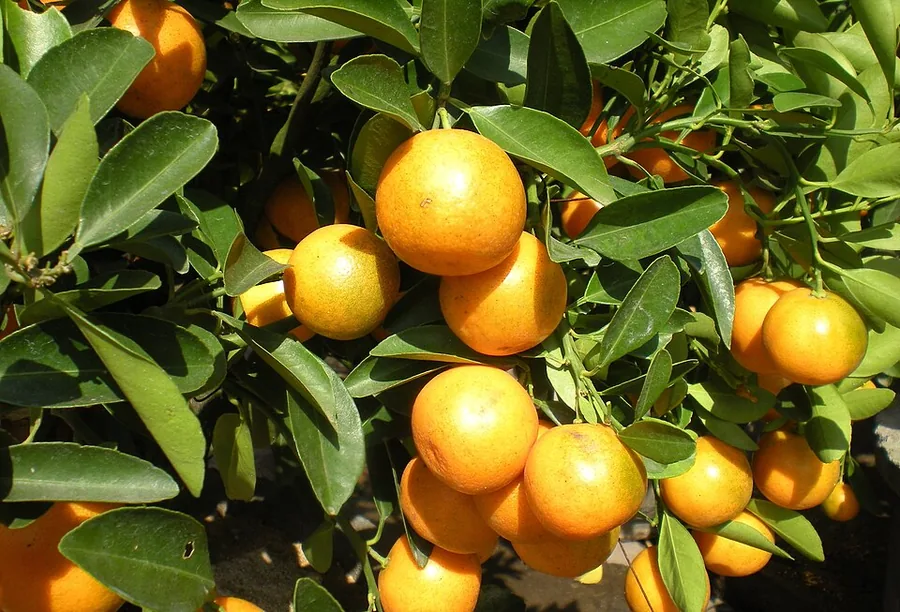
Bite one and the surprise is in the order of the flavors: the smooth, thin rind carries the sweetness while the juicy flesh inside turns sharp and tart, the opposite of an orange. The fruit stays small, no more than a couple of inches, and clings to the branch in clusters. Set against the tree's glossy green leaves, the ripening fruit reads as a scatter of bright color along the twigs.
Beyond the fruit, the tree itself is compact and neatly built, growing slowly into a tidy shape. Its real trick is toughness, since it holds hardiness well below freezing where most citrus would give up, so the fruit can hang on the branch straight through the cold months while the leaves stay green.
Care
The short version: full sun, loamy soil that drains fast, and even moisture that never leaves the roots wet. Feed monthly through spring and summer, and shelter the tree from a hard freeze.
Light
Give a kumquat full sun, six or more hours a day, for the heaviest crop and the sweetest fruit. It will take a little afternoon shade in a hot climate, but deep shade thins the canopy and leaves the tree sparse.
Water
Keep the soil evenly moist and let the surface dry slightly between waterings, roughly every 5 to 10 days. Heat and container life dry the roots faster, so water more often then, and let it drain freely, since soggy roots harm this tree faster than anything else.
Soil
Plant in loamy, well-draining ground on the acidic side, near a pH of 6.0 to 6.5. Sharp drainage matters more than rich soil here, since standing water is what kills kumquats.
Temperature
The tree handles a wide range, from about 10°F to 100°F (-12°C to 38°C), which puts it among the hardier citrus. It still wants shelter during a hard freeze, especially while young.
Humidity
Average air of about 40% to 60% suits a kumquat, so outdoors there is nothing to adjust. Indoors in dry winter heat, a little extra humidity keeps the leaf edges from browning.
Feeding
Feed monthly through spring and summer while the tree is growing, using a balanced citrus fertilizer. Choose one carrying the micronutrients citrus needs, namely iron, zinc, and manganese, since a shortage of these turns the green leaves yellow.
Pruning
A kumquat needs very little cutting. Take out dead, damaged, or crossing branches and any rootstock suckers in late winter to early spring, after the harvest.
Repotting
A potted kumquat wants a fresh, larger container every 2 to 3 years, or sooner if the roots start circling and water races through. Roots poking from the drainage holes and stalled growth are the other signs it is time.
Size & spacing
A kumquat grows slowly to about 8 to 15 feet (2.4 to 4.5 m) tall with a 6 to 10 foot (1.8 to 3 m) spread. A container holds it toward the smaller end, which is part of why it moves indoors so well.
When to plant
The kumquat runs on a long, cool-season clock. It blooms in late spring around May and June, then ripens its fruit slowly through the colder months, so the small fruit colors up and the harvest stretches from October into March. Set new trees out in spring, once the danger of frost has passed.
Northern hemisphere
Southern hemisphere
Typical months for a temperate climate: start earlier in warm zones, later where spring frosts linger.
- Plant: Spring, after danger of frost has passed
- Harvest: Blooms late spring (May to June); fruit ripens October through March
Hardiness
USDA hardiness zones: 8–11
Temperature: down to -12°C
Troubleshooting
Most kumquat troubles surface first in the leaves or the fruit, and they trace back to water, feeding, or cold. Read the early marks on the foliage and the fruit and you can settle the cause before it spreads. Match what you see below, then act while it still helps.
Green leaves fading to yellow
Watch where the yellow lands on the leaf. When it pools in the tissue between the veins and leaves those veins a lingering green, the tree is short on a micronutrient like iron or zinc, and when the whole blade fades to an even pale wash it wants nitrogen. Waterlogged soil paints the same yellowing, so offer a chelated citrus feed and let the roots dry until the deep glossy green returns.
Fix:
- Apply a citrus fertilizer with chelated micronutrients
- Correct drainage and reduce watering frequency
Small fruit falling before it ripens
When the little green fruits let go of the twig before they color up, the tree is stressed, and uneven watering is the usual reason, whether the roots ran dry or drowned. A cold snap or a sharp temperature swing loosens the fruit the same way, sometimes leaving it shriveled or cold-burned. Look back at your watering and the weather, hold the soil evenly moist, and cover the tree ahead of frost.
Fix:
- Maintain consistent soil moisture
- Protect the tree from frost during cold snaps
A black film clouding the leaves
A sooty black film spreading over the leaf surface with a sticky sheen beneath it is sooty mold. It takes hold on the tacky honeydew that sap-feeding insects dribble across the foliage, so turn the leaves and you will see soft scale, whiteflies, or aphids clustered on the undersides. Clear those insects with horticultural oil or insecticidal soap, then wipe the black coating from the leaves.
Fix:
- Treat the insect pest with horticultural oil or insecticidal soap
- Wash off the mold once pests are controlled
Toxicity
The fruit is a treat for people, but the rest of the tree is not for pets. The oil-rich peel, the leaves, and the stems hold essential oils and psoralens that irritate the gut, so a cat, dog, or horse that chews them tends to get a mild upset stomach. Keep prunings and the small fallen fruit picked up where animals graze.
Toxic to
Cats · Dogs · Horses · Rabbits · Livestock · Birds
Safe for
People
Cats Mild
A cat that bites into the oily peel or a glossy leaf lands an upset stomach, with drooling, vomiting, and loose stools. The essential oils can leave a patch of skin reddened where they touch.
Dogs Mild
A dog that chews the leaves or a fallen fruit tends toward vomiting, diarrhea, and a flat, low mood. The upset usually stays mild and clears without help.
Horses Mild
The same pungent oils and psoralens sour a horse's gut, bringing colic-like discomfort and loose droppings. Keep prunings and the small windfall fruit out of the paddock.
Rabbits Caution
A rabbit's fine-tuned gut reacts to the oil-rich peel and the bitter, aromatic leaves. Kumquat should never go in as forage.
Livestock Caution
Goats, sheep, and cattle can pick at a stray dropped fruit with little effect, but a heap of oily peel and glossy foliage can sour the rumen and blunt their appetite.
Birds Caution
Birds are sensitive to the sharp citrus oils, which irritate the gut. A small taste of the bright flesh is fine, but the peel and leaves are best kept away.
People Fruit safe
The whole thumb-sized fruit, sweet rind and tart flesh together, is safe to eat and a kitchen favorite. Slicing through a lot of the oily peel or leaves can leave sensitive skin a little irritated.
The fruit flesh is edible to people, but pets chewing peel, leaves, or large amounts of plant material can get mild GI irritation; essential oils may also irritate skin.
Helpline numbers

United States
ASPCA Animal Poison Control: (888) 426-4435 (fee applies)
Poison Control: (800) 222-1222



Canada
Poison Centres: 1-844-764-7669
Varieties
Only a few kumquats turn up in gardens and groceries, and they differ mostly in the shape of the fruit, its sweetness, and how much cold the tree takes. These are the ones worth knowing by name.
Nagami
Nagami is the most widely grown kumquat, its oval fruit holding tart flesh inside a sweet, edible rind.
Meiwa
Meiwa carries a round, larger, nearly seedless fruit that tastes sweeter than the rest and eats best fresh.
Marumi
Marumi ripens a round, slightly tart fruit on a thorny tree that takes the cold better than most.
How to propagate
Kumquats are grown from grafts, cuttings, or seed, and the method you pick decides how fast you get fruit and how true the tree runs to the parent.
GraftingModerate
Spring to early summer when bark slips · 1 to 2 years to a sizable tree
Grafting is the standard commercial way to raise new kumquats. Set in spring or early summer while the bark slips freely from the wood, the union grows a true-to-type tree that fills out quickly and keeps the parent's cold tolerance, reaching a sizable tree in 1 to 2 years.
Stem cuttingsModerate
Late spring to summer · Several months to root
Cuttings pulled in late spring or summer will root, but slowly and unevenly, often taking several months to push out roots. Rooting hormone on the cut end and gentle bottom heat under the pot improve the odds.
SeedEasy
Spring · Several years to fruiting
Seed sown in spring is the easy route and the least predictable. The seedlings often stray from the parent and can take several years to set their first fruit, so they mostly serve as rootstock or a slow experiment.
Myths
You should peel a kumquat before eating it because the skin is the bad part.
The kumquat is the rare citrus eaten whole. The sweet flavor sits in the rind and the tart bite in the flesh, the reverse of an orange, so peeling strips away the best of it. The rind is safe for people and meant to be eaten.
Kumquats are too tender to survive any frost.
The kumquat is among the toughest citrus in the cold. It shrugs off brief dips well below freezing, with sources reporting hardiness down to about 10°F (-12°C).