Houseplant · Araceae
Heartleaf Philodendron
Philodendron hederaceum
Forgiving, fast, and glossy-leaved in a shady corner, the heartleaf philodendron asks for little more than the odd drink.
Bright indirect
50–84°F · 10–29°C
USDA 11–12
3–13 ft · 1–4 m
Overview
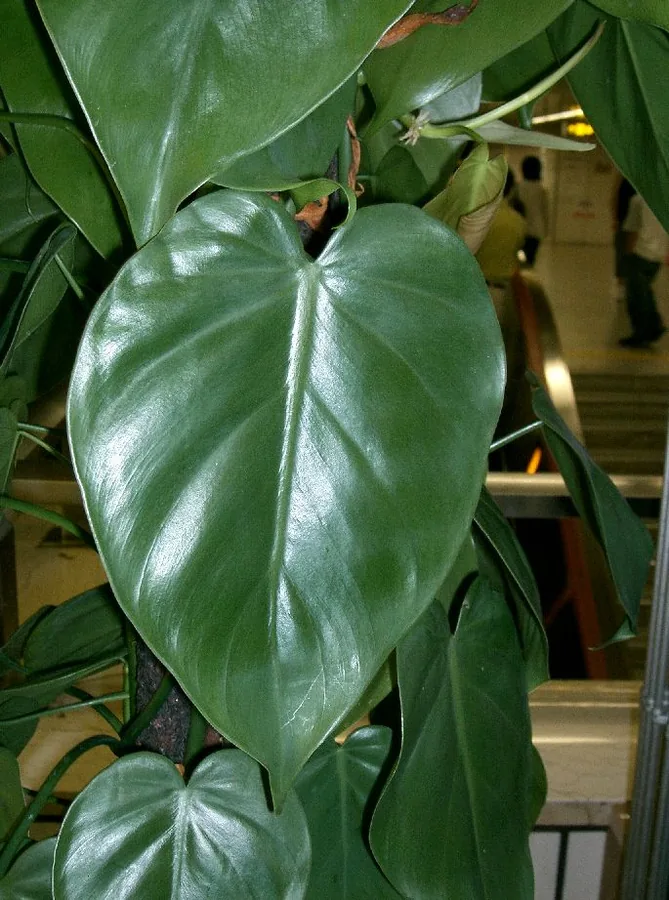
The heartleaf philodendron takes its name from its most striking feature: leaves shaped like small, tapering hearts, each one a smooth, glossy green that catches the light along its surface. New leaves emerge a soft coppery bronze and firm up to deep green as they open, unfurling from a thin papery sheath at the growing tip. They line up along slender green stems that trail and climb, and the plant puts them out fast enough to lengthen visibly in a single season.
Up close, the vine reveals its climbing nature. Slim stems carry small brown nodes at intervals, and it is from these that the plant grips and roots as it scrambles, a habit it keeps from the forests of Mexico and tropical America where it winds up tree trunks. In brighter indirect light the leaves sit close together and deepen in color; in shade the stem draws thin and the heart-shaped leaves space out and shrink.
Every part of that green tissue, from leaf to stem to root, is laced with insoluble calcium oxalate crystals, tiny needle-like structures that make the plant an irritant to pets, livestock, and people. A cut stem also weeps a sap that can bother skin. The plant looks lush and soft, but those crystals are the reason to handle it with care.
Care
The short version: the plant shows its best glossy green in bright indirect light but copes with less, it wants water only once the top inch of soil dries, and it takes light feeding through the growing season. It stays warm and out of reach of pets and children.
Light
The leaves hold their deepest, glossiest green in bright indirect light, set near a window but out of the direct sun that scorches and bleaches the surface. In medium light or a dim corner the plant hangs on, but the growth slows and the stem stretches thin, so brighter light keeps the foliage full and close.
Water
Let the top inch of soil dry before watering again, then water until it runs from the drainage holes. Watering eases through winter, when the plant draws up far less. Soggy soil rots the roots faster than anything else, so it is kept on the drier side.
Soil
The roots sit best in a rich, well-drained potting mix. They need air around them as much as moisture, so a loose, open mix that drains freely keeps the pale roots firm and white and holds rot off.
Temperature
Normal room warmth suits the plant, anywhere from 50°F to 84°F (10°C to 29°C). It stays above 50°F and clear of cold drafts and heating vents, since a sudden chill sets the growth back.
Humidity
Average household humidity is fine, so there is no number to track. Damp air puts a touch more shine on the leaves and speeds new growth, but the plant does not sulk in dry winter air.
Feeding
The plant takes feeding monthly through spring and summer with a dilute water-soluble houseplant fertilizer. Feeding stops in autumn and winter as growth slows, and stays light rather than heavy, since a salt buildup dries and browns the leaf tips.
Pruning
A pinch to the stem tips keeps the vine full and leafy rather than thin and bare. The cut sits just above a leaf node, and the trimmed piece, carrying its own node, roots into a new plant.
Repotting
The plant moves up a pot size every 1 to 2 years in spring, or sooner once pale roots creep from the drainage holes and the soil dries fast. A pot only slightly larger keeps those roots out of wet, unused soil.
Size & spacing
As a trailing or climbing vine the stems reach 3 to 13 feet (1 to 4 m) with support and the plant spreads 3 to 6 feet (90 to 180 cm) across. The long stems drape from a shelf or grip a pole to climb.
Troubleshooting
Most trouble shows first in the leaves and stems, and it traces back to watering or light. Yellowing on the lowest leaves, a stem drawn thin and bare, and small pests along the foliage are the signs to read. Match what you see below and act before it spreads.
Mushy brown roots and a wilting plant
When the once-firm white roots turn brown, soft, and slick to the touch, root rot has set in, the plant's gravest trouble. The vine wilts as those roots give way. Slide it from the pot, cut back to pale, solid tissue, settle it in fresh, open mix, and water far less.
Fix:
- Unpot and trim rotted roots
- Repot in fresh well-drained mix
- Reduce watering
Lower leaves turning yellow
When the lowest leaves fade from deep green to a soft, translucent yellow, overwatering is nearly always behind it, with too little light next in line. Press a finger into the soil, and if it comes up wet, hold the water and confirm the pot drains. A brighter spot away from direct sun brings the fresh leaves back to a firm, glossy green.
Fix:
- Reduce watering
- Ensure drainage
- Move to brighter indirect light
White cottony tufts tucked into leaf joints
Soft, cotton-white tufts wedged where a leaf stalk meets the stem are mealybugs, waxy and fuzzy to the eye. Touch each one with an alcohol-dipped swab, then wash the plant over with insecticidal soap to reach the rest. Set it apart from the others until no white specks remain.
Fix:
- Dab with alcohol-dipped swab
- Apply insecticidal soap
- Isolate plant
Fine webbing and speckled, dull leaves
In dry air, spider mites stipple the glossy leaves with tiny pale dots and string fine silk webbing across the undersides and leaf joints. Rinse the foliage well, treat with insecticidal soap or a miticide, and search the undersides where the mites cluster. Raising the humidity leaves the surface far less inviting to them.
Fix:
- Rinse foliage
- Apply insecticidal soap or miticide
- Raise humidity
Hard brown bumps and a sticky residue
Hard, dome-shaped brown bumps pressed flat against the stems are scale insects, and the clear, sticky honeydew they leave glazes the leaves nearby. Scrape the shells off with a fingernail, then treat with horticultural oil or insecticidal soap to reach any missed. Keep the plant apart while the treatment works.
Fix:
- Scrape off scales
- Apply horticultural oil or insecticidal soap
- Isolate plant
Long bare stems with leaves far apart
When the stem thins to a bare green thread with wide gaps between each heart-shaped leaf, the plant is stretching toward light. Set it in medium or bright indirect light and the fresh growth comes in close-spaced and full again. A pinch to the drawn-out stem draws bushier shoots from the nodes lower down.
Fix:
- Move to medium or bright indirect light
- Pinch stems to encourage branching
Brown, curling tips on the leaves
When the leaf tips dry to a brittle brown and curl inward at the point of the heart, fertilizer salts have built up in the soil after overfeeding. Pour plain water through the pot until it runs clear from the base and carries the salts out. Then feed less often and at a weaker mix.
Fix:
- Flush soil with water
- Reduce fertilizer rate
Clusters of small insects on new growth
Aphids gather in soft green clusters on the newest, tenderest shoots, glazing them with sticky honeydew. A firm rinse under the tap sweeps most of the cluster away. Insecticidal soap clears the few that cling to the growing tip.
Fix:
- Rinse off with water
- Apply insecticidal soap
Toxicity
For all its soft, glossy looks, this plant is not one to leave within reach of anyone who might chew it. Every leaf, stem, and root is packed with insoluble calcium oxalate crystals, needle-fine structures that bite into the mouth and throat and bring burning pain, heavy drooling, and swelling. It is an irritant to cats, dogs, horses, rabbits, livestock, birds, and people, with no part safe to eat, so place it high and out of the way and wash your hands after cutting it, since the sap can sting skin.
Toxic to
Cats · Dogs · Horses · Rabbits · Livestock · Birds · People
Cats Moderate
A cat that bites into a leaf releases needle-fine calcium oxalate crystals against the soft tissue of its mouth. Drooling, pawing at the mouth, vomiting, and swollen lips and tongue follow.
Dogs Moderate
Crushing a leaf between the teeth drives the sharp crystals into the gums, bringing a fierce burning, heavy drooling, and vomiting. As the tissue puffs up, some dogs gag or struggle to swallow.
Horses Moderate
The same tiny crystals scratch at a horse's mouth and throat, so drooling and difficulty swallowing set in. Keep the plant well clear of paddocks and feed.
Rabbits Toxic
The irritant crystals run through every leaf, stem, and root, so a single nibble leaves a rabbit drooling and turned off its food. Keep it out of any space a rabbit can reach.
Livestock Toxic
Goats, sheep, and cattle that browse the foliage meet the oxalates with a raw, painful mouth and refusal to eat. The plant belongs nowhere near grazing animals.
Birds Toxic
A bird that shreds a leaf with its beak feels the same burning sting and swelling in the mouth. Hang or place it where no bird can pick at it.
People Caution
No part of it is edible. A bite burns the mouth and can swell the lips and tongue, and the milky sap on a cut stem may leave skin itchy, so wash after pruning and keep it from small children.
Sap may irritate skin; wash hands after cutting stems
Helpline numbers

United States
ASPCA Animal Poison Control: (888) 426-4435 (fee applies)
Poison Control: (800) 222-1222



Canada
Poison Centres: 1-844-764-7669
Varieties
Beyond the plain green species, a few cultivars stand out for the color and texture of their leaves.
'Brasil'
Down the center of each deep green leaf runs a broad, irregular splash of lime-yellow, as if brushed along the midrib.
'Micans'
Its leaves wear a soft, velvety nap that shifts from bronze to deep green in the light, with a warm reddish flush on the undersides.
'Lemon Lime'
Every leaf blazes a single clear tone, from bright chartreuse to an almost neon yellow-green.
'Rio'
A crisp band of cream and silvery grey streaks down the middle of each leaf, framed by the green margins.
How to propagate
The plant copies itself with almost no effort. A single stem cutting set in a glass of water pushes pale roots from its nodes within a few weeks, and a longer vine can be air layered for a fuller start.
Stem cuttingsEasy
Spring or growing season · Roots in 2-4 weeks
This is the easiest way, and almost everyone uses it. In spring or through the growing season, cut a length of stem just below one of the small brown nodes that ring the vine, keeping a leaf or two, then set it in water or press it into moist mix. Pale, thread-like roots push from the node in about 2 to 4 weeks, and the cutting becomes a whole new plant.
Air layeringModerate
Growing season · Several weeks
Air layering is the slower, more deliberate route, best on a long, established vine during the growing season. You nick the stem and wrap the wound so roots creep out into the damp packing before you cut, and over several weeks a rooted length forms that can be severed and potted on its own.
Myths
Philodendrons clean the air in your home.
The idea grew out of a sealed-chamber lab test, nothing like a lived-in room. A peer-reviewed analysis found the VOCs a single potted plant removes are so small that opening a window does far more. The heart-shaped leaves are reason enough to grow it, not any filtering.
Heartleaf philodendron and pothos are the same plant.
The two look nearly identical but belong to different genera. Run a finger along the leaf stalk: a philodendron's petiole is smooth and rounded where a pothos runs grooved, and each new philodendron leaf pushes out sheathed in a thin, papery wrapper that pothos never grows.
This plant is a deadly poison to children.
The insoluble calcium oxalate crystals packed in the tissue do cause real, stinging mouth irritation, but they are classed low-severity, and serious outcomes are rare. Keep the plant out of a small child's reach, and treat a chewed leaf as something to rinse and watch, not an emergency.
It thrives in a dark corner.
It hangs on in low light, but it does best in medium to bright indirect light. Left in deep shade, the stem draws out thin and pale and the heart-shaped leaves come in small and far apart.
It needs high humidity to survive.
Damp air suits it, but the plant gets by fine in ordinary household air. No mister or pebble tray is needed to keep the leaves firm and glossy.
Sources
- ASPCA Animal Poison Control
- North Carolina Extension Gardener Plant Toolbox (NC State)
- Missouri Botanical Garden Plant Finder
- Pet Poison Helpline
- University of Florida IFAS Gardening Solutions
- Clemson Cooperative Extension HGIC
- Plants of the World Online, Royal Botanic Gardens Kew
- Cummings & Waring 2020, J Exposure Science & Environmental Epidemiology (PubMed/NLM)
- Atlas of Florida Plants, Institute for Systematic Botany, University of South Florida