Tree · Pinaceae
White Fir
Abies concolor
Give it room, sun, and well-drained acidic soil, and the white fir keeps its silvery-blue pyramid sharp for generations.
Full sun
Every 7–14 days
USDA 3–7
30–70 ft · 9.1–21.3 m
Overview
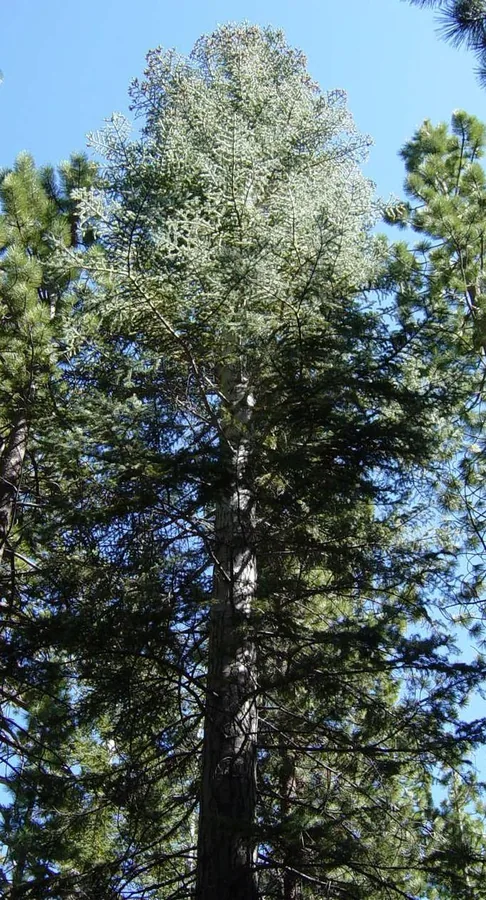
White fir is a true fir off the western mountains of the United States, and it has spread far past its home range as a prized shade and specimen tree. It holds a clean pyramidal silhouette, and its soft blue-green to silvery-blue needles mark it out at a glance from the harsher green of spruce and pine. Run a hand along a twig and the needles flex rather than jab, each one springing from a flat, round base. Grown well it stands for a very long time, a slow, long-lived perennial evergreen.
Among the firs people set in gardens, white fir is one of the most forgiving. It endures cold to -40°F (-40°C), takes summer heat better than most of its kin, and stomachs city air and clay where other firs sulk and brown. Its one weakness is wet feet. Drainage alone decides whether this tree holds its full, dense crown or rots from the roots up.
Most gardeners grow the plain species, though a handful of blue-needled selections push the color toward an even cooler, more silvered tone. Whichever you choose, plan around its bulk. This tree grows huge, so the single most important call you make is where it will stand.
Care
The short version: full sun, deep acidic soil that drains freely, and steady moisture while it takes hold. Once settled it asks for almost nothing but elbow room, and the one thing it will not forgive is a wet, heavy site.
Light
Set white fir in full sun for the thickest growth and the truest color. It will accept partial shade and still grow well, but a tree out in the open keeps its crisp pyramid and its silvery-blue cast far sharper than one in the gloom.
Water
Water deeply and on a steady schedule while the tree establishes and through any drought, since it likes its soil evenly damp. Let the top half of the root zone dry between soakings, and never leave the roots standing in wet ground, which rots them fast.
Soil
This fir wants rich, deep, acidic soil that drains freely, sandy or loamy alike. A pH from 5.0 to 7.0 suits it well, and heavy packed clay or a low wet pocket will kill it slowly from the roots.
Temperature
Few garden trees match it for cold. White fir shrugs off winters down to -40°F (-40°C) and summers up to roughly 95°F (35°C), which is why it stands in climates that finish off softer firs.
Humidity
Plain outdoor air suits it, so there is no figure to chase. Of the western firs, this one weathers dry heat and swinging humidity the best across the wider garden.
Feeding
An established white fir in decent ground rarely needs feeding. Reach for a balanced or acidifying tree fertilizer in spring only when a soil test turns up a real shortfall, never as routine.
Pruning
Mostly leave it be. Cut out dead, damaged, or crossing branches in late winter, and guard the central leader so the tree keeps its natural pyramidal shape.
Repotting
none
Size & spacing
White fir is a forest tree at heart, rising 30 to 70 feet (9 to 21 meters) tall with a spread of 15 to 30 feet (4.5 to 9 meters), and taller yet in the wild. Hand it that whole footprint and set it well clear of buildings and power lines.
When to plant
White fir goes into the ground as a young tree, never sown straight into the garden, and the timing could not be plainer. Set balled-and-burlapped or container stock in early spring or in fall, while the soil sits cool and damp enough to settle the roots into their new home with ease.
Northern hemisphere
Southern hemisphere
Typical months for a temperate climate: start earlier in warm zones, later where spring frosts linger.
- Plant: Plant balled-and-burlapped or container stock in early spring or fall.
Hardiness
USDA hardiness zones: 3–7
Temperature: down to -40°C
Troubleshooting
A healthy white fir asks for little, and nearly all of its troubles trace to a wet site or a few familiar pests. Watch the needles and read the bark, because that is where the earliest signs surface. Match what you see to the list below, then act before the damage reaches the roots or the leader.
Waxy white wool on the bark and joints that swell into knots
Those small puffs of waxy white wool clinging to the bark and the branch nodes are the balsam woolly adelgid, a sap feeder so tiny you notice the wool long before the insect. As it feeds, the joints thicken into swollen, knotted bulges, fresh growth stays short and stubby, and the crown begins to die back. Cut out the worst limbs, treat with a labeled horticultural oil or systemic, and keep the roots watered so the tree has the strength to push back.
Fix:
- Prune out and destroy heavily infested branches
- Apply a labeled horticultural oil or systemic insecticide following the product label and local extension guidance
- Maintain tree vigor with proper watering and avoid drought stress
Needles fading to brown and a canopy gone thin after a wet spell
When the blue-green needles bleach out, droop, and turn brown, and the dense pyramid opens into a thin, see-through crown after a soggy stretch, the damage is almost always Phytophthora or Armillaria root rot at work underground. Both settle into wet, packed, or slow-draining ground and decay the roots from the collar outward. A declining tree cannot be saved, so scrape the bark at the root collar to check, correct the drainage, and never set another fir into the same poisoned soil.
Fix:
- Improve site drainage and stop overwatering
- Remove and destroy severely affected trees to limit spread through root grafts
- Avoid replanting firs in the same infected soil
A bronzed, dusty cast over the needles laced with fine webbing
When the silvery-blue needles take on a bronzed, dusty cast and the foliage carries a film of fine webbing through the heat of summer, suspect spruce spider mites. They thrive in dry, baking weather and pepper the needles with pale stippling as they drain them. Hold a sheet of white paper under a branch and rap it to watch the specks crawl, blast the foliage with a hard jet of water, and turn to a labeled miticide only if their numbers refuse to drop.
Fix:
- Hose down foliage with a strong stream of water
- Apply horticultural oil or a labeled miticide if populations are high
Spindle bags dressed in needle bits swinging from gnawed twigs
Those small silken bags, shingled over with bits of chewed needle and dangling from the twigs, each hold a bagworm caterpillar that hauls its woven case along as it strips the foliage. Spruce budworm chews through the tender new growth in the same fashion. Pinch the bags off through winter and into early spring, then spray Bacillus thuringiensis while the larvae are still small in late spring.
Fix:
- Handpick and destroy bags in fall through early spring
- Apply Bacillus thuringiensis or a labeled insecticide while larvae are small in late spring
Toxicity
Good news for homes with pets and children: white fir is not toxic. It stands in millions of living rooms each December as a Christmas tree with no risk of poisoning. The needles are sharp and resinous, so a big mouthful might turn a stomach, but there is no toxin behind it.
Safe for
People · Cats · Dogs · Horses · Rabbits · Livestock · Birds
Cats None
There is no toxin in a fir for a cat to absorb, so a curious bite is harmless. The needles are sharp and stiff, so a mouthful might bring a little drooling or a single bout of vomiting, and nothing worse.
Dogs None
A dog can mouth fallen needles without poisoning, since the tree holds nothing toxic. A large helping of the prickly, resinous needles may unsettle the stomach for a day before it clears on its own.
Horses None
Fir foliage poses no danger to horses and is not among the conifers known to harm them. The needles are stiff and prickly enough that most horses ignore the tree entirely.
Rabbits None
A rabbit nibbling the smooth bark or the needles meets no poison from a true fir. The resinous, sharp foliage seldom appeals to one in the first place.
Livestock None
Cattle, goats, and sheep can browse fir without the abortion risk linked to certain other conifers. It is sound forage, though the stiff, sharp needles keep their grazing brief.
Birds None
Birds shelter and nest among the dense pyramidal branches with nothing toxic to fear, and many crack open the seeds from the upright cones. The tree holds no poison for them.
People None
White fir is safe around children, which is why it stands indoors each December as a Christmas tree. The sharp needles are not for eating, but a stray one swallowed causes no poisoning.
Needles are not chemically toxic, but ingestion of needles or sap can cause mild mouth and stomach irritation with vomiting or drooling, and large amounts of stiff needles could pose a GI obstruction risk.
Varieties
Most gardens grow the plain species, but a few selections are worth knowing for the depth of their blue, for their smaller frame, or for their place beneath the holiday lights.
Candicans
Its needles run to the most intense silvery-blue of any white fir, a near-metallic sheen that holds its color straight through every season.
Violacea
The foliage carries a glaucous blue-gray bloom, the same cool coloring as Candicans but pitched in a quieter, softer key.
Compacta
A dwarf, slow-growing form of irregular outline clad in blue-green needles, compact enough for a small garden where a full fir could never stand.
Abies fraseri (Fraser fir)
The leading commercial Christmas tree out of the Appalachians, its short dark-green needles silvered on the underside, though it cannot abide real heat.
Abies balsamea (balsam fir)
A northern true fir prized for the strong balsam scent that rises from its crushed needles at Christmas, but unsuited to the heat and humidity of the Southeast.
How to propagate
White fir is slow to multiply, and the method you pick depends on what you are after. Seed yields the true species over several patient years, while grafting keeps the named blue forms true to their silvered color.
SeedModerate
Sow stratified seed in spring. · Several years to a sizable sapling
Seed is the common path, and it tests your patience. The seed wants a long cold, moist chill before it will break, so you stratify it and then sow in spring once that is done. The young firs rise slowly, push out their first soft needles, and resent hot, dry ground, so a little partial shade carries them through the early years. It takes several seasons before one stands up as a sizable sapling.
GraftingDemanding
Late winter under cover. · 1-2 seasons to a viable graft
The blue selections like Candicans will not hold their silvery-blue color from seed, so growers join a cutting of the named form onto fir rootstock by grafting. The work happens under cover in late winter and rewards a steady, practiced hand. Allow one to two seasons for the union to knit and the graft to grow away on its own.
Myths
Douglas fir is a true fir, the same kind of tree as white, Fraser, and balsam fir.
Douglas-fir sits in the genus Pseudotsuga and is no true fir at all. A real fir in the genus Abies carries its seed cones standing upright on the branch, where they crumble apart in place rather than dropping whole, and each needle meets the twig on a flat, round base that peels away clean to leave the bark smooth. The cones of Douglas-fir hang downward, fall in one piece, and show three-pointed bracts poking out between the scales, while a spruce drops its needles off little woody pegs that stay behind on the twig.