Tree · Pinaceae
Douglas Fir
Pseudotsuga menziesii
Give it room, moist soil, and years to fill out, and the Douglas fir grows into one of the tallest trees in the forest.
Full sun
Every 7–14 days
USDA 4–6
39–79 ft · 12–24 m
Overview
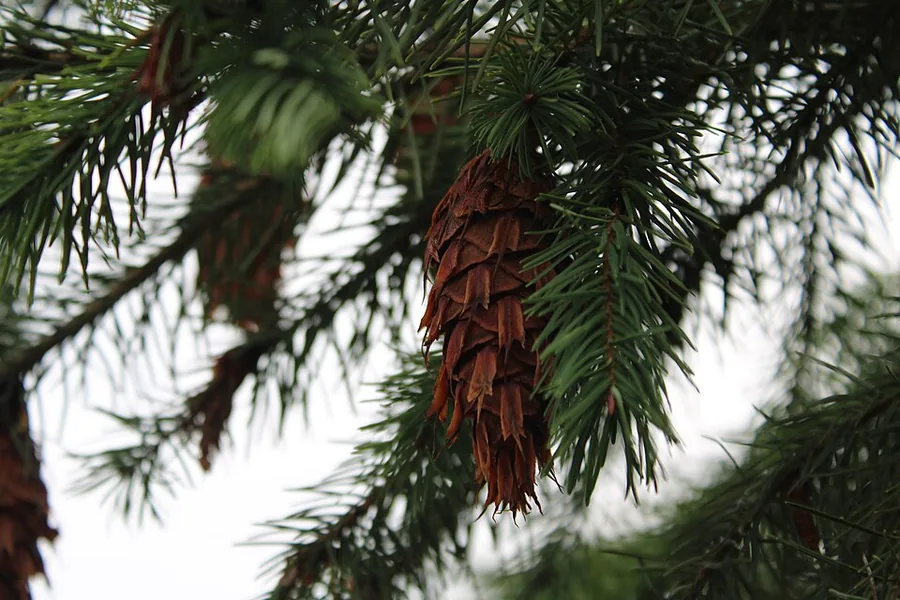
The Douglas fir is one of the giants of western North America, a fast-growing conifer that climbs past 80 feet (24 m) in a yard and far higher in the wild. Up close it gives itself away with soft, flat, deep-green needles that brush smooth between the fingers, and with cones that hang straight down, papery three-pointed bracts slipping out between the woody scales like the tails and hind feet of tiny mice. Despite the name it is no true fir but an evergreen of its own, the classic Christmas tree of the Pacific Northwest and a backbone of the timber trade.
Two main forms turn up in gardens, and the needles tell them apart at a glance. The coast type grows fast and tall with green foliage and favors the damp, mild weather west of the mountains, while the Rocky Mountain blue form is smaller, its needles washed a cooler blue-green, and far tougher in the cold down to zone 4. Reading which form suits your climate matters more here than with almost any other tree, since the wrong seed source ends up scarred by disease.
This is a tree for space and time, not a quick screen. It wants deep, moist, well-drained ground and full sun, and it resents drought, compaction, and waterlogged roots. Plant it well away from the house and let it broaden, and the slim young whip thickens into a landmark tree, a tall straight trunk under a wide green crown that outlives the person who planted it.
Care
The short version: full sun, deep and steadily moist acidic-to-neutral soil that drains well, and plenty of open space, since this is a tree that can reach 40 to 80 feet in the yard.
Light
Give a Douglas fir full sun for the fullest, densest needle cover. It tolerates some partial shade, especially while young, but a tree grown in too much shade stretches thin and leggy, its branches spaced and sparse.
Water
This tree is intolerant of drought and wants soil that stays deep and steadily moist without ever turning waterlogged. Water young trees on a regular cycle until established, every 7 to 14 days depending on the weather, and never let a long dry spell pass unwatered.
Soil
Plant in deep, moist, organically rich loam that drains freely and sits acidic to neutral, anywhere from pH 4.5 to 7.2. It will not accept poorly drained or compacted ground, where the roots suffocate and root rot sets in.
Temperature
Douglas fir is hardy and weather-tough, taking anything from -29°F to 90°F (-34°C to 32°C) depending on the form planted. The blue-needled Rocky Mountain type handles the hardest cold of all, down to zone 4.
Humidity
Outdoor humidity is whatever the climate gives, so there is nothing to adjust. Air circulation matters far more than moisture in the air, since stagnant, crowded conditions keep the needles damp and let needle cast settle in.
Feeding
Feed in spring with a balanced fertilizer or one made for conifers and evergreens. The aim is not to push growth but to keep the tree unstressed, which keeps the needles dense and far less prone to needle cast.
Pruning
Pruning is barely needed. Take out only the dead, damaged, or diseased branches and leave the natural, layered form alone, unless you are shearing a Christmas tree.
Repotting
This is a forest tree, not a container plant, so repotting rarely comes up beyond the nursery stage. Watch a potted young tree for roots circling the pot, stalled new growth, or soil that dries out very fast, all signs the roots have filled the pot and want the ground.
Size & spacing
A Douglas fir grows large and fast, its straight trunk reaching 40 to 80 feet (12 to 24 m) tall under a crown spreading 12 to 20 feet (3.7 to 6 m) wide. Plant it well clear of buildings, power lines, and septic lines, and give it the open space a landmark tree needs.
When to plant
Douglas fir is a long game, not a seasonal crop. Stratify seed through late winter, set young trees out in spring once the hard frosts have passed, and look for cones rather than flowers, since this conifer carries no bloom and ripens its hanging cones from late summer into fall.
Northern hemisphere
Southern hemisphere
Typical months for a temperate climate: start earlier in warm zones, later where spring frosts linger.
- Sow: Late winter after cold-moist stratification of seed for about 1-2 months.
- Plant: Spring, after the last hard frost, while trees are small and easy to transplant.
- Harvest: Non-flowering conifer; cones mature late summer to fall. No ornamental bloom.
Hardiness
USDA hardiness zones: 4–6
Temperature: down to -34°C
Troubleshooting
Most Douglas fir trouble shows up in the needles or down at the roots. The needle problems often trace to the wrong seed source in a wet climate, while the serious threats sit underground out of sight. Match what you see below and act early, since a stressed tree falls to disease far faster than a vigorous one.
A pale, thinning crown with dieback from failing roots
A crown gone pale and sparse with branches dying back from the tips usually betrays trouble hidden at the roots. Armillaria root rot spreads thick, creamy white fungal fans flat between the bark and wood at the root crown and trails black, shoestring-thin rhizomorphs through the soil, while Phytophthora root rot turns the roots dark and soft in ground that stays wet or compacted. No spray reaches an infected tree, so the answer lies in better drainage, a shallower planting depth, and lifting a failing tree before replanting with a tougher species.
Fix:
- Improve drainage and avoid overwatering or planting too deeply
- Remove and destroy severely infected trees including small roots
- Replant the site with more resistant species
Older needles blotch yellow then brown and fall away
Older needles mottling from yellow-green to brown and dropping until only the freshest needles remain on the twig is the mark of needle cast, a fungus that claims the oldest needles first. Turn a fading needle over: Swiss needle cast studs the underside with tiny black dots set in rows, while Rhabdocline stains second-year needles with reddish-brown blotches. Thinning crowded trees to dry the foliage, watering the roots, and planting Pacific Coast seed sources in damp ground all curb it, since coastal stock resists far better than Rocky Mountain stock.
Fix:
- Improve air circulation by thinning crowded trees and increasing spacing
- Keep trees adequately watered and properly fertilized to reduce stress
- Apply a labeled fungicide at budbreak and as new needles expand where infection pressure is high
- Remove and dispose of heavily infected fallen needles
Bristly larvae strip the needles, starting at the crown
Bristled, tuft-backed caterpillars chewing the needles bare from the top of the tree downward are the Douglas-fir tussock moth or western spruce budworm, and in outbreak years they leave branches stripped to the wood. The dark egg masses sit on the bark before they hatch in spring, a clear early tell. Btk sprayed on the young larvae checks them, and in many years natural predators and a native wilt virus collapse the swarm within a season or two.
Fix:
- Monitor for egg masses before spring hatch
- Apply Bacillus thuringiensis (Btk) or a labeled insecticide while larvae are young
- Allow natural enemies and the naturally occurring wilt virus to collapse outbreaks over a season or two
Woolly white tufts on needles that curl and yellow
The cottony white tufts clinging along the needles are the Cooley spruce gall adelgid, a sap feeder whose waxy fluff coats Douglas-fir needles and twists them rather than swelling them into the cone-shaped galls it raises on spruce. A scattering of tufts needs nothing, since natural predators thin them out. Heavier coatings call for a dormant horticultural oil before budbreak, and spruce set nearby gives the insect the alternate host it needs.
Fix:
- Tolerate light infestations; natural enemies often suppress populations
- Spray dormant-season horticultural oil or treat before budbreak
- Soil-applied imidacloprid can control populations on high-value trees
Toxicity
Good news for households with pets and children: Douglas fir is not toxic. It is the traditional Christmas tree across much of the country for exactly that reason. A pet that chews the fallen needles might get a mildly upset stomach, but there is no poison in the green to worry about.
Safe for
People · Cats · Dogs · Horses · Rabbits · Livestock · Birds
Cats Safe
Douglas fir is safe for cats. A cat that mouths a few of the slim needles may drool or bring them back up, but the green carries no real toxin.
Dogs Safe
Nothing in the tree poisons a dog. Crunching the firm, pointed needles can leave a dog with a mildly upset stomach, so a shed branch is still worth clearing away.
Horses Safe
Horses can graze around a Douglas fir unharmed. It is not one of the pines blamed for mare abortion, and the needles carry no listed toxicity.
Rabbits Safe
The tree is harmless to rabbits, and wild ones gnaw its thin twigs and rough bark as winter browse.
Livestock Safe
Cattle, sheep, and goats can browse Douglas fir safely. Unlike ponderosa pine, its needles are not tied to lost pregnancies in grazing stock.
Birds Safe
The tree is no threat to birds, which tuck into its dense, needled branches and pry the small seeds from inside the cones.
People Safe
Douglas fir is safe around people. The soft, bright green spring tips are even steeped into a citrusy tea, though the stiff, sharp mature needles are best kept from small hands.
Eating needles can cause mild mouth/stomach irritation with possible vomiting, drooling, or diarrhea, and large quantities of sharp needles could rarely cause GI blockage.
Varieties
Most Douglas firs sold are simply the straight species, but a few named forms are worth knowing when a particular spot or climate is in mind.
var. glauca / 'Glauca' (Rocky Mountain blue Douglas-fir)
This smaller Rocky Mountain form carries distinctly blue-green needles, runs hardy to zone 4 and colder-tolerant than the coast type, and trades that for slower growth and a greater tendency to needle cast in wet air.
'Fastigiata'
A narrow, columnar selection whose branches press tight and upright into a slim spire, fitting tighter spaces than the broad, spreading species ever could.
'Pendula'
A weeping form whose limbs hang and cascade in long curtains of needled growth, grown as an ornamental specimen for the shape alone.
How to propagate
Douglas fir is grown from seed for ordinary trees and by grafting for the named cultivars, and neither route is quick. Both take a couple of years before there is something to plant out.
SeedModerate
Sow in spring after 1-2 months of cold-moist stratification. · 1-2 years to a transplantable seedling
Seed grows the ordinary species, and the small winged seeds shaken from the cones need chilling first. Hold them in cold, moist conditions for 1 to 2 months over winter, sow them in spring, and wait 1 to 2 years for a seedling tall enough to move. The young trees lift cleanly while small, before the pale taproot drives deep into the ground.
GraftingDemanding
Late winter onto seedling rootstock. · 1-2 years
Grafting is the exacting route, kept for the named cultivars like the cascading weeping and slim columnar forms that will not come true from seed. The union is cut and bound in late winter onto a seedling rootstock, and a graft that knits still takes 1 to 2 years to firm into a dependable young tree.
Myths
Douglas fir is a true fir, like the firs in the genus Abies.
It is not a true fir at all. The hyphen in Douglas-fir is the giveaway, and the tree sits in its own genus, Pseudotsuga, a name meaning false hemlock. True firs hold their cones upright on the branch and let them crumble apart there, while Douglas-fir cones dangle downward and drop whole, their papery three-pointed bracts poking out between the brown scales like the tails and hind feet of tiny mice.
Sources
- USDA Forest Service, Silvics of North America
- USDA Forest Service FEIS
- USDA Forest Service FEIS
- NC State Extension Gardener Plant Toolbox
- Pacific Northwest Pest Management Handbooks (OSU/WSU/UI Extension)
- Pacific Northwest Pest Management Handbooks (OSU/WSU/UI Extension)
- Colorado State University Extension
- Pacific Northwest Pest Management Handbooks (OSU/WSU/UI Extension)
- UC Statewide IPM Program (UC ANR)
- ASPCA
- Pet Poison Helpline
- Oregon State University Extension
- USDA NRCS Plant Fact Sheet