
Introduction
Spider plants are the houseplant your grandmother grew. They are also the same plant filling shelves again in the new plant boom. They forgive just about every mistake you can make. Pros still keep them for the free baby plants they grow. This guide leans on university Extension sources like NC State and UW-Madison, not the vague tips on most plant blogs.
The plant here is Chlorophytum comosum. It is a clumping perennial from tropical Africa. It grows 12 to 15 inches (30 to 38 cm) tall. Thin arching stems reach up to 2 feet (60 cm) long and dangle little plantlets over the pot. NC State Extension lists it as non-toxic to cats, dogs, and horses. That makes it one of the safest greens to keep near curious pets.
Here is where most pages fall short. They either skip air cleaning or oversell it. Few name a real source on pet safety. This guide gives you an honest, sourced answer to both. You get the lab facts on air cleaning. You get the limits NASA itself notes. And you get a clear take on what these plants really do in your home.
You can relax about killing this one. I grew spider plants that went two or three weeks with no water and still pushed out new leaves. They store water in thick fleshy roots, so they shrug off a missed watering and bounce right back. That backup is the real reason this low-maintenance houseplant is so easy. The rest of this spider plant care guide covers light, water, types, and new plants. Even a true beginner ends up with a thriving pet-safe plant.
Spider Plant Care Basics
Good spider plant care comes down to a few easy numbers you can hit without much fuss. Your mature plant reaches 12 to 15 inches (30 to 38 cm) tall. The arching stems stretch up to 2 feet (60 cm) as they spill plantlets over your pot rim.
Give the plant room and it spreads 2 to 2.5 feet (60 to 75 cm) wide once the clump fills out. Keep the room between 60 and 75°F (16 to 24°C). That range is the comfort zone for Chlorophytum comosum. The grid below pins down the rest at a glance.
Spider plants store water in thick, fleshy roots, so an occasional missed watering does far less harm than steady overwatering and soggy soil.
My 'Vittatum' hung in a basket by a north-facing kitchen window the whole two weeks I was away. I came home braced for crispy leaves, but the stems still arched out and threw fresh plantlets like nothing had happened. The soil was bone dry and the plant had not skipped a beat.
That kind of bounce-back is no accident. I have grown spider plants for years, and they pack water into thick, fleshy roots and rhizomes, the same way a camel carries a reserve. Those swollen roots buffer the gaps, which is the real reason your plant forgives a missed watering or two.
Plant yours in well-draining soil so your stored water never tips over into soggy, rotting roots. A basic indoor potting mix with a handful of perlite drains fast. It still holds just enough to keep your plant happy between drinks.
Feeding is just as relaxed. Give yours a balanced houseplant fertilizer every 3 to 4 months to keep the leaves green. Too much food pushes soft, leggy growth, so skip the weekly routine your other plants demand.
All of this is why it earns its name as a low-maintenance houseplant and a true beginner houseplant. It shrugs off a wide range of light, heat, and watering habits. Travelers, busy students, and first-time owners can grow it well from day one.
Light, Temperature, Humidity
Spider plant light requirements come down to one rule you can memorize today. Your plant wants bright indirect light, which means a spot bright enough to read a book in without a lamp, but where the sun never lands straight on the leaves. Your north and east windows usually give you that safe glow. An unshaded south window can scorch the foliage, so set your plant a step back from the glass.
Last March I moved my oldest spider plant onto a south sill to give it more light. Two weeks later the outer leaves went pale and crisp, with dry tan patches where the noon sun hit them. I slid the pot back about 18 inches from the glass, and the new growth came in green and striped again. So watch out for this one nuance you can easily get wrong. Your spider plant is happy in medium light and even deep shade, yet it cannot stand direct sun. Growth slows and plantlet production drops in a dim corner, but your plant keeps going. If your room runs dark or winter days get short, a small LED grow light fills the gap and keeps the variegated stripes crisp.
Your spider plant temperature needs trace back to where the plant comes from. It grows wild in tropical and southern Africa. So your plant likes mild warmth and steady humidity, not dry, cold rooms. Hold it between 60 and 75 degrees Fahrenheit (16 to 24 degrees Celsius) and it will thrive for you. It can take a wider band, from about 45 to 80 degrees Fahrenheit (7 to 27 degrees Celsius). But below 55 degrees Fahrenheit is too cool. Above 80 degrees Fahrenheit is too warm, so keep your plant clear of hot vents.
Light Requirements
- Best light: Bright indirect light keeps variegation strong and growth steady without scorching the arching foliage.
- Shade tolerance: Spider plants tolerate medium light and even deep shade, though growth slows and plantlet production drops.
- Avoid direct sun: Direct sunlight bleaches and burns the leaves, so keep plants a step back from unshaded south windows.
- Grow lights: A simple LED grow light helps in dark rooms or short winter days when natural light is limited.
Temperature Range
- Ideal range: Spider plants are happiest between 60 and 75 degrees Fahrenheit (16 to 24 degrees Celsius) year round.
- Cold limit: Keep them above 45 degrees Fahrenheit (7 degrees Celsius); below 55 degrees Fahrenheit (13 degrees Celsius) is too cool for active growth.
- Heat limit: Above 80 degrees Fahrenheit (27 degrees Celsius) the plant is stressed, so avoid hot, dry spots near heating vents.
- Drafts: Move plants a few feet from cold windows in winter to protect them from chilling drafts.
Humidity Preferences
- Moderate humidity: Average household humidity suits spider plants, reflecting their tropical and southern African origins.
- Dry-air signs: Very dry indoor air can worsen brown leaf tips, especially in heated winter rooms.
- Boost options: A nearby humidity tray or grouping plants together gently raises local moisture without daily misting.
- Balance: Good humidity helps, but correct watering and clean water matter more for healthy leaf tips.
Seasonal Adjustments
- Winter light: Shorter winter days mean less natural light, so move plants closer to a bright window.
- Draft check: Keep foliage a few feet from cold glass and away from heating vents during winter.
- Summer care: Longer, stronger summer light is fine as long as the sun never lands directly on the leaves.
- Steady comfort: Aim to hold the plant in its ideal 60 to 75 degrees Fahrenheit (16 to 24 degrees Celsius) range year round.
Get light, warmth, and humidity roughly right and the rest of your spider plant care gets easy. Average household air suits your plant. So you do not need to mist it every day. Watch your plant for brown leaf tips in heated winter rooms, since dry air makes them worse. Still, clean water and steady watering help your plant more than any humidity trick you can try.
Watering and Water Quality
Watering trips up more new owners than any other care step, and the advice online keeps muddling it. Get spider plant watering right and most other problems fade. The plain rule is simple. Let the upper inch of soil dry out for a short stretch between drinks, then water again.
People ask me how often to water spider plant roots, and they want a number. There is no fixed schedule. Push a finger into the soil and check. Water when the top inch feels dry, which often lands around once a week in summer. In the cooler, darker winter months you should water less, because the plant drinks slower and soggy soil turns dangerous fast.
Water quality matters as much as timing. Spider plants have a real fluoride sensitivity, and the chlorine in tap water hurts them too. Both push salts into the leaves and scorch the tips brown. Rainwater is the cheapest clean option. Distilled water works well when rain is hard to collect.
Brown, papery tips crept across the lower leaves of a 'Vittatum' I kept in a hanging basket by a north kitchen window. They spread for months while I watered straight from the tap. I switched to rainwater I caught in a bucket on the back step, and the fresh blades that pushed out after that came in clean and green. The old scorched tips stayed brown, but nothing new burned.
Press a finger into the soil and water only when the top inch (about 2.5 cm) feels dry to the touch.
Use rainwater or distilled water when possible, since fluoride and chlorine in tap water cause brown leaf tips.
Soak the soil until water drains from the bottom, then empty the saucer so roots never sit in standing water.
Reduce watering frequency during the cooler, lower-light winter months to prevent soggy soil and root rot.
This plant is particularly sensitive to fluoridated water; if your water is treated with fluoride, watering with rainwater or distilled water is best for the health of your plant.
No clean water on hand? Fill a jug from the tap and let it sit out overnight. The chlorine gases off on its own, and you get a gentler drink for almost nothing. It does not strip out fluoride, but it takes the edge off ordinary tap water.
One last thing keeps these plants alive for years. Overwatering and poor drainage cause root rot, the fastest way to kill an easy plant. The thick, fleshy roots store water, so a thirsty spider plant bounces back with ease. A soggy one often does not. When you are unsure, wait. A slightly dry plant is far safer than a drowned one.
Spider Plant Varieties to Know
Most people picture one plant when they hear the name, but the spider plant varieties on sale today range wider than you might guess. Some have a bold white stripe down the center. Others wear pale edges or twist their leaves into tight curls. Once you learn a handful of named types, you can walk into any shop and tell them apart in seconds.
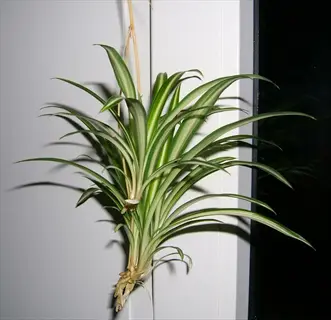
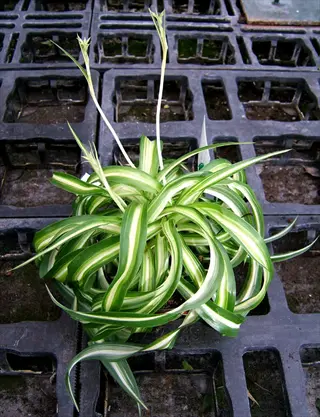
The two most common types make the easiest lesson because their stripes sit in opposite spots. Vittatum carries one broad white stripe straight down the middle of each green blade. Variegatum flips that, with green leaves edged by creamy white margins instead. Center stripe versus edge stripe is the fast way to name the variegated spider plant in front of you.
A curly spider plant breaks that mold. The Bonnie spider plant keeps its leaves short and looped, so it stays bushy and compact instead of arching long. One detail ties almost all of these named types together. Give your variegated ones brighter indirect light than solid green plants, or those pale stripes fade to plain green on you.
Vittatum
- Appearance: Long arching leaves with a single broad white stripe running down the center of each green blade.
- Popularity: This is the most common and widely sold spider plant, the one most people picture by name.
- Light: Bright indirect light keeps the central stripe crisp, while low light dulls the variegation over time.
- Habit: Vigorous and fast-growing, it produces long stems with plenty of plantlets in fall.
- Best use: A reliable hanging-basket choice that shows off the cascading, striped foliage.
- Care: Treat it like a classic spider plant with the standard watering, light, and feeding routine.
Variegatum
- Appearance: Green leaves edged with creamy white margins, the mirror image of Vittatum's central stripe.
- Contrast: Holding the two side by side is the easiest way to learn the difference between the common cultivars.
- Light: Like other variegated types, it needs bright indirect light to keep the pale edges from fading.
- Habit: A strong, full-looking plant that arches as the foliage matures.
- Best use: Works well in containers where the bright leaf edges stand out against a plain wall.
- Care: Standard spider plant care applies, with clean water to protect the delicate leaf margins.
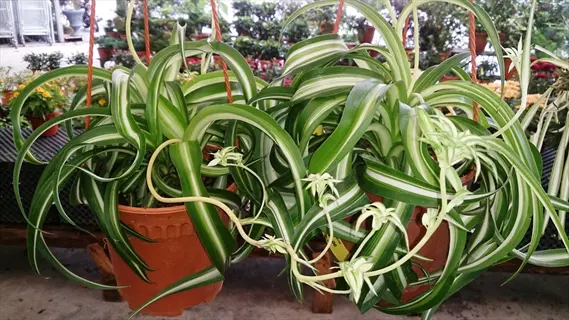
Bonnie (Curly)
- Appearance: Compact plant with tightly curled and kinked leaves rather than the usual straight arching blades.
- Size: It stays smaller and bushier, which suits shelves, desks, and tight spaces well.
- Light: Bright indirect light keeps both the curl and the variegation looking their best.
- Habit: Bonnie still produces spiderettes, so it propagates as well as straight-leaved types.
- Best use: A fun, distinctive pick when you want a spider plant with a different texture and shape.
- Care: The same watering and clean-water rules apply to keep the curled tips from browning.
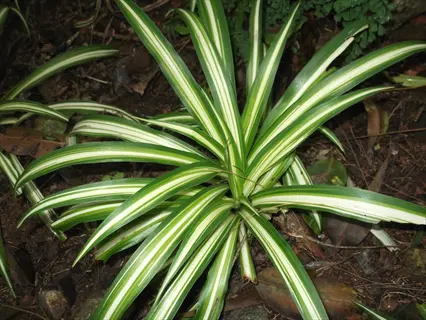
Hawaiian and Milky Way
- Hawaiian: Often shows fresh, soft variegated growth that turns greener as the leaves mature.
- Milky Way: Features broad white centers with thin green margins for a brighter, paler overall look.
- Collectible: These named selections appeal to growers building a varied spider plant collection.
- Light: Their pale variegation depends on consistent bright indirect light to stay vivid.
- Habit: Both grow and propagate like other spider plants, throwing plantlets on long stems.
- Care: Standard care keeps them healthy, with extra attention to light levels for color.
Tight ribbons of leaf spilled over the shelf edge, each blade kinked and looped back on itself like a curl of ribbon under scissors. I set my Bonnie on the shelf in the north kitchen window. Right beside it I lined up a straight-leaved Vittatum, its blades long and flat. Same plant, same family, yet you can spot the two apart from across the room.
Propagation and Spiderettes
Spider plant propagation is about as easy as it gets in the houseplant world. Your plant does most of the work for you. Each of those little spiderettes dangling off the arching stems is already a small, finished plant. Think of it as the mother plant handing you ready-made seedlings, complete and waiting to root.
Look closely at the base of a healthy spiderette and you will often spot small nub roots poking out while it still hangs on the stem. That head start is the secret to fast rooting. The plantlet has already begun building a root system, so all you need to do is help it finish.
You have two solid ways to root spider plant babies, and both work well. With water propagation, you set the plantlet in a glass of water and watch white roots stretch out over a week or two. The soil method skips the water step and presses the spiderette straight into moist potting mix instead.
Choose a healthy spiderette that already shows small nub roots at its base on the arching stem. The bigger the plantlet, the faster it takes off.
Set the plantlet in a glass of water until roots lengthen, or press it directly into moist potting mix. Change the water every few days to keep it fresh.
For soil rooting, leave the plantlet on the mother plant until it anchors, then snip the connecting stem. This gives you the fastest and most reliable results.
Once roots are an inch or two (3 to 5 cm) long, move the young plant into well-draining potting soil. Water it in and keep the soil lightly moist for the first week.
The trick that beats both methods is to pin the spiderette into a nearby pot before you ever cut it loose. Set a small container of moist soil next to the mother plant and press a plantlet onto the surface. Because the spiderette still draws support from the parent, it roots faster and almost never fails. Snip the stem only after it anchors itself.
If your plant refuses to make any spiderettes at all, the cause is usually light, not a problem with the plant. Plantlets form when the mother plant gets short days and long, dark nights, under 12 hours of light a day for at least three weeks. Most offshoots show up as fall days grow shorter, so a plant sitting under a lamp every evening may never bud out.
Spiderettes need short days and long, uninterrupted nights for at least three weeks, so a plant under constant evening light may never form plantlets.
One more thing helps the babies keep coming. A slightly root bound plant tends to push out more plantlets than one swimming in a fresh, roomy pot. So resist the urge to over-pot an older spider plant. A snug home and a long night are all most of them need to start handing you new plants.
Air Cleaning and Pet Safety
You have probably seen the spider plant sold as an air-purifying houseplant that scrubs toxins from your living room. The claim has some truth behind it, but the full story matters more than the marketing. Here is what the science actually shows.
Researchers did find that this plant pulls formaldehyde, xylene, benzene, and carbon monoxide out of the air. Those tests ran inside sealed chambers, not in a normal home with open doors and windows. The famous NASA plant study even says its own results do not apply to typical buildings.
The gap between the lab and your home is huge. To match the chamber numbers, you would need roughly 10 to 1000 plants per square meter of floor space. A study by Li and colleagues found another catch too. Removal fell 35% to 50% after repeated exposure, so the effect does not even hold steady.
- Sealed-chamber tests show spider plants absorb formaldehyde, xylene, benzene, and carbon monoxide.
- NASA documented strong pollutant removal under controlled, airtight conditions.
- A fresh plant matched its original removal rate on the first day of repeated testing.
- NASA states the lab results are not applicable to typical buildings with normal airflow.
- Matching the lab effect would need roughly 10 to 1000 plants per square meter of floor.
- Li et al. found removal efficiency dropped 35% to 50% on repeated real-world-style exposure.
These results are not applicable to typical buildings, where outdoor-to-indoor air exchange already removes volatile organic compounds (VOCs) at a rate that could only be matched by the placement of 10–1000 plants/m2 of a building's floor space.
So grow this plant because it looks great and asks little of you, not as a fix for your indoor air quality. Cracking a window for a few minutes swaps stale air for fresh faster than any shelf of pots ever could. Think of clean air as a nice bonus, never the main reason to buy.
Pet safety is the better selling point, and here the news is genuinely good. Is the spider plant toxic to cats or dogs? No. NC State Extension lists it as non-toxic to cats, dogs, and horses, so a curious nibble will not poison your pet.
One small catch is worth knowing. Cats love the dangling foliage and tend to chew it, and a cat that eats a lot can get a mild upset stomach. Hang the plant high or keep an eye on a determined chewer, and you have a pet-safe plant that earns its spot on the windowsill.
5 Common Myths
A single spider plant will purify the air in an entire room and remove most household pollutants within a day.
NASA confirmed lab absorption but stated those results do not apply to typical buildings, where it would take 10 to 1000 plants per square meter.
Spider plants are poisonous and should be kept far away from cats, dogs, and small children at all times.
NC State Extension lists spider plants as non-toxic to cats, dogs, and horses, though cats may nibble and get a mild upset stomach.
Spider plants need constant watering and will die quickly if you forget to water them for a few days.
Their thick, fleshy roots store water, so they tolerate inconsistent watering and prefer the top inch of soil to dry out first.
Brown leaf tips mean the spider plant is dying and the whole plant should be thrown out right away.
Brown tips usually signal fluoride or chlorine in tap water, salt buildup, or low humidity, and the plant recovers once the cause is fixed.
Spider plants thrive in bright direct sunlight and grow faster the more strong sun they receive each day.
They prefer bright indirect light and tolerate deep shade, but direct sun scorches the foliage and causes faded, bleached leaves.
Conclusion
Few houseplants forgive your slip-ups the way a spider plant does. Its thick, fleshy roots store water. Miss a watering or two and it will not die. That toughness has earned it real praise. The plant goes by the botanical name Chlorophytum comosum. University Extension teams call it one of the most common houseplants around. It also sits near the top of any list for new growers.
Good spider plant care comes down to a short list you now know cold. Give it bright indirect light, then water when the top inch of soil feels dry. Reach for rainwater or distilled water if your tap has fluoride. That one swap stops most brown tips. Keep the room between 60 and 75°F (16 to 24°C). And rest easy. This is a true pet-safe houseplant, since NC State Extension lists it as non-toxic to cats, dogs, and horses.
Be honest with yourself about the air-cleaning claims. In sealed lab chambers, spider plants do soak up formaldehyde and other pollutants. But a few pots will not clean the air in a normal, ventilated room. NASA's own study notes you would need dozens to hundreds of plants per square meter to make a dent. So grow this plant for how easy it is and how good it looks, not for cleaner air.
Two traits made this plant a 1970s staple. It is tough, and it makes babies with ease. Those same traits put it back at the front of the houseplant revival. Each fall, as the days grow short, your mother plant sends out arching stems tipped with spiderettes. That free harvest makes spider plant propagation simple. One pot becomes a small collection without a dime spent. Pot up a few plantlets, hand some to a friend, and let this beginner houseplant keep paying you back season after season.
Glossary
- Bright indirect light
- Plenty of light near a window but without the sun's rays hitting the leaves directly, which can scorch them.
- Chlorophytum comosum
- The botanical (scientific) name for the spider plant, a clump-forming houseplant in the asparagus family.
- fluoride sensitivity
- A plant's tendency to develop brown, scorched leaf tips when watered with fluoride-treated tap water.
- Herbaceous perennial
- A non-woody plant that lives for many years, regrowing and renewing itself rather than dying after one season.
- root rot
- A condition where soggy soil and poor drainage cause a plant's roots to decay and die.
- Spiderettes
- The baby plantlets that grow on long arching stems from a mature spider plant and can be rooted into new plants.
- Variegated
- Having leaves marked with two or more colors, such as the white or cream stripes on many spider plant varieties.
- Volatile organic compounds
- Common indoor air pollutants, such as formaldehyde, that some plants can absorb in laboratory test chambers.
External Sources
Frequently Asked Questions
Do spider plants clean the air?
In sealed lab chambers spider plants absorb pollutants like formaldehyde, but NASA states those results do not apply to normal rooms.
Are spider plants safe to keep in the bedroom?
Yes. Spider plants are non-toxic, tolerate low light, and need little care, which makes them a safe and easy bedroom plant.
Are spider plants toxic to cats, dogs, or people?
No. NC State Extension lists spider plants as non-toxic to cats, dogs, and horses, though cats may nibble and get mild stomach upset.
How often should you water a spider plant?
Water when the top inch of soil feels dry, often about once a week, and reduce watering in winter to avoid root rot.
What are the most common spider plant care mistakes?
The most common mistakes are overwatering, fluoride or chlorine tap water, direct sun, and over-fertilizing.
How long do spider plants live?
With basic care, dividing, and repotting, spider plants are long-lived perennials that keep renewing themselves and can outlast many other houseplants.
What are the benefits of growing a spider plant?
Spider plants are non-toxic, beginner-friendly, fast to propagate, and tolerant of irregular watering thanks to water-storing roots.
Why does my spider plant have brown leaf tips?
Brown tips come from fluoride or chlorine in tap water, salt buildup, low humidity, dry soil, or over-fertilizing.
How do you propagate spider plant babies?
Snip a spiderette with small nub roots and root it in water or press it into moist soil while still on the mother plant.
Why is my spider plant not producing babies?
Plantlets form when the plant gets short days and long, uninterrupted nights for at least three weeks, usually in fall.