
Introduction
The first thing you notice about a calathea plant is the leaves. They look hand-painted, with bold stripes and feathered patterns in green, pink, and deep purple. Then evening comes and the leaves slowly fold up like hands closing, which is why people call it a prayer plant. Most guides stop at gushing over those leaves and give you vague advice. This one hands you a care plan tied to real science, with no guessing.
Here are the numbers that matter, and every one comes from a trusted source. Your calathea wants bright indirect light and never direct sun. It needs humidity of around 60% minimum, per NC State Extension. Keep the room at 65 to 75 degrees Fahrenheit (18 to 24 Celsius). And skip the tap water, because the fluoride in it browns the leaf edges over time.
That last point is where most calathea advice falls apart. Other guides rarely cite a real study or expert, so you get folklore sold as fact. I tie every figure here to a named source you can check. That means NC State Extension, the RHS, Brooklyn Botanic Garden, and a 2021 study. You get the why behind each rule, not just the rule.
This tropical houseplant has a name for being fussy, and I won't pretend it is a cactus. But the drama is overblown. Get the light, the water, and the humidity right, and your calathea turns steady and easy to read. It also fits a busy home for one big reason. The plant is safe for cats, dogs, and horses if they take a bite. It grew up on the shaded rainforest floor of southeast Brazil, so soft light and damp air are home.
Up ahead I walk you through real calathea care, from watering and water quality to fixing brown and curling leaves. You will also meet the best varieties and learn the odd story of why botanists renamed most of them. Let's start with the basics that keep this plant alive and looking sharp.
Calathea Plant Care Basics
I set an Orbifolia and a rattlesnake calathea on a bright north-facing bathroom windowsill three years ago. Within two weeks the Orbifolia pushed out a fresh rolled leaf. Daily showers kept the room humid. The glass softened the morning sun into the bright indirect light this plant loves. That new leaf opened before I had touched the food or fussed over the soil.
Good calathea care starts with one idea. This is a tropical houseplant that grew up on the shaded, humid rainforest floor of southeastern Brazil. Every choice you make indoors should copy that home: filtered light, warm air, and soil that stays evenly damp. Get those conditions close and your calathea plant rewards you with deep color and bold patterns.
Light comes first. Your calathea wants bright indirect light and never direct sun. NC State Extension, the RHS, and Brooklyn Botanic Garden all back that baseline. Harsh rays scorch the leaves and bleach the markings. Too little light fades the color and slows new growth to a crawl. An east or north window works well. So does a spot a few feet back from a brighter one.
Water and humidity work as a pair. Keep the moist soil evenly damp, never soggy, because standing water rots the roots fast. Aim for humidity of 60% minimum, the figure NC State Extension ties to a thriving plant. Dry indoor air is the top cause of the brown, crispy edges that frustrate so many owners. A humidifier or a tray of pebbles and water near the pot closes the gap.
Round out the basics with warmth and steady food. Hold the temperature between 65 and 75°F (18 to 24°C) and keep the plant clear of drafts and radiators. Feed it a balanced fertilizer once a month through spring and summer, then stop in winter when growth slows. This prayer plant rests in the cold months and does not need the extra push. The quick grid below puts the full starting point in one place.
Treat steady humidity and bright indirect light as non-negotiable from day one; fixing those two before anything else prevents most of the brown edges and faded color that frustrate new calathea owners.
Watering and Water Quality
Watering trips up more calathea owners than any other task. The plant wants steady moisture, but it also hates soggy roots, so the gap between too dry and too wet feels narrow. The good news is that a simple test takes all the guesswork out of it.
So how often to water calathea plants? Forget a fixed weekly schedule and check the soil instead. Push a finger into the pot, and when the top inch of soil feels dry at about 2.5 cm down, it is time to water. That usually lands somewhere near once a week, but your room and the season shift the timing.
In spring and summer the plant grows fast and drinks more, so keep the mix evenly moist the whole time. In autumn and winter growth slows down and you should ease off, watering less often. Never let the soil dry out all the way, though, since a fully parched root ball stresses the plant and crisps the leaf edges.
You also get to choose how you deliver that water. Top watering and bottom watering both work, and each has a real trade-off, so the table below lays them side by side.
- Pour distilled water or rainwater evenly over the soil until it drains from the bottom.
- Flushes salts and excess fertilizer out through the drainage holes.
- Fast and simple, but wetting the leaves can encourage fungal leaf spots.
- Stand the pot in a tray of clean water and let the soil draw moisture up.
- Keeps foliage dry and lets the plant take only what it needs.
- Slower, and salts can build up over time, so flush from the top occasionally.
What you pour matters as much as how you pour it. The mineral content of plain tap water is the single biggest reason calathea leaves turn crisp and brown at the edges. Fluoride in particular builds up in the soil and burns the delicate foliage over time.
The best choices are distilled water or rainwater. Both skip the harsh minerals and chlorine that hard tap water carries. Calathea filtered water can help too, but a basic carbon filter does not always pull out the fluoride.
Distilled water or rain water is recommended for watering since the fluoride in tap water can cause browning of the leaves.
If distilled water or rain feels like too much fuss, there is a workable middle ground. Fill a jug from the tap and let it stand for 24 hours before you use it, which gives the chlorine time to evaporate. It will not remove fluoride, but it softens the worst of the water and protects your plant between rain collections.
Light, Humidity and Warmth
The leaf tips on my rattlesnake calathea went brown and crisp halfway through a dry winter. It sat on a bright north window in the bathroom. So the calathea light was fine. But the radiator heat had pulled the moisture out of the air. I set a small humidifier beside the pot and left it running. Within a few weeks the new leaves came in clean and soft. The old dry-air leaves stayed brown. A daily mist never did that. Steady damp air did.
On the rainforest floor a calathea lives under a canopy in soft light and air that stays damp. Get those same three things right indoors and most problems go away. The plant wants bright indirect light with no direct sun. For calathea humidity, aim for 60% humidity as your floor. And it wants a calathea temperature of 65 to 75°F (18 to 24°C). Hit that band and hold it steady. Sudden swings hurt the leaves more than one off day does.
This is why a warm, humid bathroom or kitchen often suits a calathea so well. The everyday steam from showers and cooking keeps bathroom humidity up without any extra gear from you. The spot still has to deliver bright indirect light and steady warmth though. A dim, cold bathroom will not save the plant on damp air alone, so check all three pillars before you pick the shelf.
Light: Bright But Filtered
- Direction: Place the plant near a north or east window in summer and a brighter south window in winter, always out of direct sun (RHS).
- Why it matters: Direct rays scorch and fade the patterns, while too little light leaves growth weak and washed out.
- Quick check: If your hand casts a soft, fuzzy shadow rather than a sharp one, the light is about right for a calathea.
Humidity: Aim For Sixty Percent
- Target: NC State Extension cites about 60% minimum for the peacock calathea, so treat that as your floor, not your ceiling.
- Best tools: A humidifier, a gravel-and-water tray under the pot, or grouping plants together hold humidity far better than misting.
- Warning sign: Brown, crispy leaf edges and tips are the classic symptom that the air around the plant is too dry.
Warmth: Steady And Draft-Free
- Range: Keep the plant between 65 and 75 degrees Fahrenheit (18 to 24 Celsius) and avoid sudden temperature changes (NC State Extension, RHS).
- Avoid: Cold drafts from doors and windows, plus direct heat from radiators and fires, both of which stress the foliage.
- Placement: A warm, humid bathroom or kitchen with bright indirect light is often an ideal home for a calathea.
Air Movement And Dust
- Gentle flow: Some fresh air helps prevent fungal issues, but keep the plant out of the path of strong drafts and air conditioning vents.
- Clean leaves: Wipe dust off the broad leaves with a damp cloth so they can gather the filtered light they need.
- Grouping benefit: Standing several humidity-loving plants together raises the moisture in the air around all of them.
Fixing Common Calathea Problems
Most calathea problems show up first in the leaves, and that is good news for you. The plant tells you what is wrong before things turn serious. Once you learn to read the signs, almost every issue traces back to one of a few simple causes you can fix at home.
Brown leaf tips and crispy edges are the complaint I hear most often. They almost always mean dry air or hard tap water, not a dying plant. Curling leaves point to thirst or low humidity, while soft yellowing leaves usually mean the roots are too wet. Each symptom has its own clear cause, so match the look of your plant to the fix below.
The crispy brown edges on my own calathea spread for weeks before I pinned down the cause. I checked the soil and it was fine, so I tried distilled water in place of the hard tap water I had been using. The new leaves came in clean and green. Hard water was the culprit all along, not my watering.
Before you act, feel the soil. Push a finger into the top inch (2.5 cm) and see how it reads. Dry soil with curled leaves means your plant wants water. Wet soil with a soft, mushy base points to root rot, and that calls for a different fix. The same moisture test you use for watering also tells you which problem you are facing.
Watch out for pests too, since stressed plants draw them in. Spider mites leave fine webbing and tiny moving dots on the undersides of leaves. A quick rinse and some insecticidal soap or neem oil clears them fast. And keep your calathea out of harsh midday sun, because leaf scorch bleaches pale patches that never recover. Bright indirect light keeps the colors rich.
If a calathea wilts while the soil is still wet, do not water more; that is the signature of root rot from overwatering, and the plant needs to be unpotted and have its soft, brown roots trimmed instead.
Varieties and the Goeppertia Story
My rattlesnake plant sits on the bathroom windowsill. At dusk it lifts and folds its leaves up, turning the patterned undersides out toward the room. I noticed it only because the plant sits in my own evening line of sight. The slow fold pulls your eye each evening. I watched mine do this for two weeks before I understood it. The flowers are forgettable. The leaf movement is the whole reason you grow these plants.
That motion has a name. It's called nyctinasty, and it runs on water pressure at the pulvinus, the small joint where each leaf meets its stalk. Pressure builds and the leaf rises at night. It eases off so the leaf spreads by day. The Maranta does the same thing, just faster. That matters because prayer plant most often means a Maranta, not a true calathea.
The name on the tag trips people up too. Most plants once sold as calathea got moved into the genus Goeppertia. The switch came after a 2012 DNA study. It showed the old Calathea grouping was a mixed bundle of plants that weren't close relatives. Botanists have a word for that bundle. They call it polyphyletic. So a tag that reads Goeppertia is the same plant your grandmother grew. The genus holds about 60 species in the family Marantaceae, plus a long list of cultivars.
Here is a fun way to prove the science is real. A 2021 citizen-science study checked the leaf spirals on 159 plants across 4 countries. It found a clear pattern. 109 spiraled counter-clockwise and 0 spiraled the other way. Look at your own plant. It will almost for sure twist the same way as mine.
You don't need all 60 species to fill a shelf. A handful of calathea varieties cover the looks most people want, from bold round leaves to fine pink stripes. The list below pairs the popular types of calathea with the care quirks that set them apart. You can pick by both pattern and effort. The peacock plant and the round-leaved Orbifolia are great places to start.
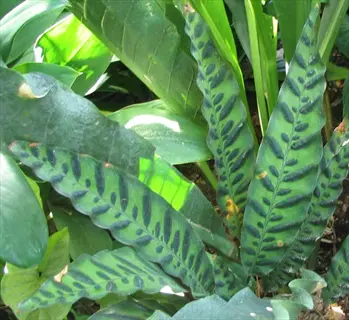
Rattlesnake Calathea (Goeppertia insignis)
- Look: Long, wavy lance-shaped leaves marked with alternating dark and light green blotches, with deep purple undersides.
- Origin: Native to the rainforests of southeastern Brazil, the same shaded, humid habitat as its relatives.
- Difficulty: Rated high-maintenance by NC State Extension, in large part for its strong humidity needs.
- Movement: A reliable performer of the nightly leaf-folding that gives the wider family its prayer plant nickname.
- Best spot: Bright indirect light with humidity near 60%, away from drafts and direct sun.
- Pet note: Non-toxic to cats, dogs, and horses, like other calatheas.
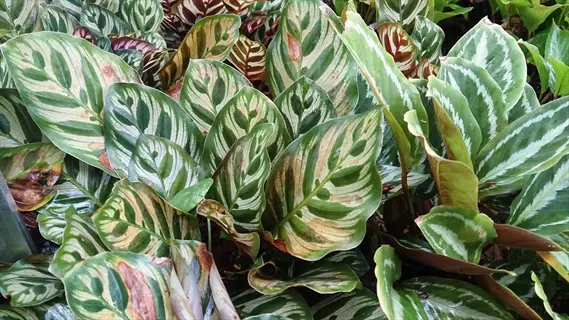
Peacock Calathea (Goeppertia makoyana)
- Look: Thin, almost translucent leaves with a feathered pattern resembling peacock plumage, earning the name cathedral windows.
- Origin: From the tropical rainforests of southeastern Brazil, classed as medium-maintenance by NC State Extension.
- Humidity: This is the species NC State Extension ties to a 60% minimum humidity figure.
- Water: Quite sensitive to fluoride, so distilled water or rainwater keeps its delicate leaves from browning.
- Best spot: Bright indirect light or partial shade with steady warmth of 65 to 75 degrees Fahrenheit (18 to 24 Celsius).
- Care: Divide the rhizomes about every two years to keep the clump vigorous.
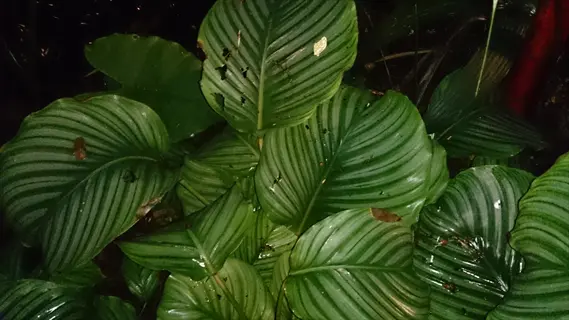
Orbifolia (Goeppertia orbifolia)
- Look: Large, round, pale silver-green leaves with broad darker stripes, giving a calm, oversized appearance.
- Appeal: A favorite for its bold, simple pattern and dramatic leaf size among indoor growers.
- Humidity: Like all calatheas it wants steady humid air, so a humidifier or grouping helps it thrive.
- Water: Keep the soil moist with distilled water or rainwater and never let it dry out all the way.
- Best spot: Bright indirect light suits its big leaves, which scorch fast in direct sun.
- Growth: A vigorous grower that rewards steady care with frequent new rolled leaves.
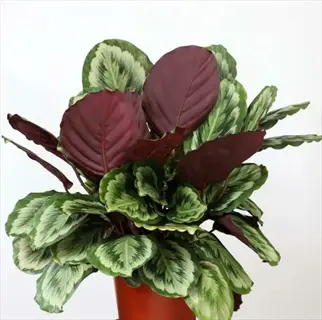
Medallion and Pinstripe
- Medallion: Rounded leaves with a feathered green pattern and rich purple undersides, a common ornamental calathea.
- Pinstripe (ornata): Dark green leaves striped with fine pink lines that look hand-painted across the surface.
- Shared needs: Both want bright indirect light, around 60% humidity, and evenly moist soil.
- Water quality: Both show browning fast from fluoride, so soft water matters a lot for these two.
- Use: Popular as tabletop accent plants thanks to their compact, decorative foliage.
- Pet note: Both are non-toxic to cats, dogs, and horses.
All calathea have leaves that move! This characteristic, called nyctinasty, allows the plant to move to a circadian rhythm by changing the water pressure at the joint where the leaf meets the stalk (pulvinus)—it pushes its leaves upward at night to efficiently gather the dew, and spreads its leaves during the day to follow the sun.
Repotting, Feeding and Dividing
There are three jobs that keep a calathea going for years. You need to feed it, repot it, and split it into new plants. Get these right and a healthy plant rolls into its second and third year with ease.
Feed your plant monthly with a balanced calathea fertilizer in spring and summer. That is the growing season, from about April to September. Stop once autumn comes, since a resting plant cannot use the food and the extra salt browns the leaf edges. Repot every few years in spring or summer, and go up just one or two pot sizes so the roots are not swimming in soil.
When repotting calathea roots, use a free-draining, moisture-retentive, peat-free compost with added grit or perlite. That mix holds enough water to keep the roots happy but drains fast to stop rot. This is also the best time to make new plants, since you already have the calathea out of its pot.
You make new plants by division. Calathea propagation does not work from cuttings. A cut leaf will not root, so do not waste one trying. Instead you split the rhizomes, the thick underground stems that store energy and send up new shoots. Divide about every two years in late spring.
Divide in late spring or early summer during active growth, ideally when you are already repotting, roughly every two years.
Water the day before, then slide the plant from its pot and gently shake or rinse soil from the rhizomatous roots so you can see natural clumps.
Tease apart, or cut with a clean knife, sections that each have several healthy stems and a good portion of roots attached.
Plant each section in a free-draining, moisture-retentive, peat-free mix with added grit or perlite, at the same depth it grew before.
Water with distilled water or rainwater, place in bright indirect light and warmth, and keep humidity high while the divisions recover.
Feed monthly with a balanced fertilizer only during spring and summer growth, then stop through autumn and winter; feeding a resting plant in cold months risks salt buildup that browns the leaf edges.
My own peacock plant had stalled, pushing out small leaves and packing the pot edge to edge. One May I divided the tight clump into three sections, each with its own roots and stems, and I potted them up at the same depth. Within a month all three were sending up fresh leaves. Dividing does more than hand you a free plant. A crowded clump grows slow, but splitting it gives each section room again. That single habit is a big reason a well-kept calathea lasts for years rather than fading out.
Give the new divisions the same warmth the parent likes, around 65 to 75°F (18 to 24°C), and keep the air humid while they settle. Skip the fertilizer until they show new leaves, then fall back into the monthly spring and summer feeding rhythm. Repotting a calathea this way keeps the whole plant young.
5 Common Myths
A calathea is toxic and dangerous to keep around curious cats, dogs, and small children in the home.
The calathea is classified as non-toxic to cats, dogs, and horses by the ASPCA and corroborated by NC State Extension, making it pet-safe.
Misting a calathea every day is the best and only way to give the plant the high humidity that it needs.
Daily misting raises humidity only briefly and can encourage leaf spots; a humidifier, pebble tray, or grouping plants is far more effective.
Calatheas thrive in bright, direct sunlight on a sunny windowsill, just like many other popular flowering houseplants do.
Direct sun scorches and fades calathea leaves; these rainforest-floor plants need bright indirect light only, never harsh direct rays.
Any ordinary tap water straight from the kitchen faucet is perfectly fine for watering a calathea plant.
Fluoride and chlorine in tap water can brown leaf edges; distilled water, rainwater, or tap stood for a day is much safer.
A calathea and a true prayer plant are exactly the same plant sold under two interchangeable common names.
They share the Marantaceae family and leaf movement, but prayer plant usually means Maranta, while most calatheas are now genus Goeppertia.
Conclusion
Good calathea care comes down to four things you set once and then keep steady. Give the plant bright indirect light. Keep the soil evenly moist with soft water. Hold calathea humidity near 60%, and keep the warmth from swinging. Fix that checklist in your head, and most of the guesswork falls away.
Lock in the numbers and you stop fighting the plant. Hold the air between 65 and 75°F (18 to 24°C). Push humidity to 60% or higher. Water with distilled water or rainwater so the fluoride in tap water can't brown the leaf edges. Feed it once a month in spring and summer, then stop through winter while growth slows down.
The fussy reputation is real, but it only shows up when light, water quality, and humidity get left to chance. Set those three and the calathea plant turns predictable instead of dramatic. It earns extra points as a houseplant too, since it is non-toxic to cats, dogs, and horses, so a curious pet near the pot is no cause for worry.
The edges of my own calathea went crisp and brown within a month of bringing it home. I checked the light and the humidity first, but both were fine. Then I swapped tap water for rainwater I collected off the windowsill, and the new leaves came in clean. One change fixed weeks of guessing.
What keeps this plant interesting goes past the leaf patterns. Watch it in the evening and you'll see the foliage lift and fold for the night, the same trait that earns it the prayer plant name. The leaves even spiral the same way, counter-clockwise, on plant after plant. Divide the clump every couple of years and you keep that quiet nightly show running for many more seasons.
Glossary
- Bright indirect light
- Plenty of light that reaches a plant without the sun's rays shining straight onto its leaves.
- Goeppertia
- The plant genus most former calathea species were moved into after a 2012 DNA study, so many calatheas are now botanically named Goeppertia.
- Marantaceae
- The prayer-plant or arrowroot family of tropical plants that includes both calatheas and marantas.
- Nyctinasty
- The nightly leaf movement of a calathea, where leaves raise at night and lower by day in response to the light cycle.
- Oedema
- Swollen, blistered spots on leaves caused by the plant taking up more water than it can release, often from winter overwatering.
- Pulvinus
- The swollen joint where a calathea leaf meets its stalk, which moves the leaf by changing internal water pressure.
- Rhizome
- A thick underground stem that a calathea grows from, which can be divided to make new plants.
- Root rot
- Decay of the roots caused by soil staying too wet, which makes a calathea wilt even though the soil is damp.
External Sources
Frequently Asked Questions
Is a calathea a good indoor plant?
Yes. The calathea is a pet-safe, low-light tolerant tropical with striking patterned leaves, though it does demand steady humidity and moisture.
How often should you water a calathea?
Water when the top inch (2.5 cm) of soil feels dry, usually about weekly in spring and summer and less in winter, keeping soil evenly moist.
How do you know if a calathea is happy?
A happy calathea shows firm, richly colored leaves, steady new growth, and the nightly raising and lowering of its foliage.
How do you bring a calathea back to life?
Diagnose the cause first, then fix water quality, moisture, and humidity, trim damaged leaves, and check the roots for rot.
Can a calathea have tap water?
It is risky. Fluoride and chlorine in tap water cause brown leaf edges, so distilled water, rainwater, or tap left to stand is safer.
Do calatheas like bathrooms?
Often yes. A bright, humid bathroom suits a calathea well, as long as it gets indirect light and stays warm and draft-free.
Should you mist a calathea daily?
Not really. Daily misting gives only a brief humidity boost and can invite leaf spots, so a humidifier or grouping plants works better.
Can you keep a calathea in the bedroom?
Yes. A calathea is pet-safe and non-toxic, so a bedroom works well if there is enough indirect light and steady warmth.
How long does a calathea plant last?
With good care a calathea can live for years, and dividing it every couple of years keeps the clump vigorous and long-lived.
Are coffee grounds good for calathea plants?
Use caution. Coffee grounds can acidify soil and hold moisture but also risk mold and pests, so a balanced fertilizer is more reliable.