
Introduction
From my kitchen window I watch a single Fat Albert blue spruce that I planted about twelve years ago in well-drained zone 5 ground. It still holds a clean silver-blue color through every winter. A crowded screen of three other spruces sits thirty feet away. Those three tell a different story. They keep thinning from the bottom up, and now you can see straight through the gaps. Same yard, same care, two very different trees. The one that got room and the right spot won.
That gap is the question most guides skip. A blue spruce is a stunning tree, but it only thrives in the right place. Before you fall for the color at the garden center, ask the honest one first. Does my climate actually suit this tree? Get that wrong and you buy years of brown needles and slow decline.
The Colorado blue spruce goes by the botanical name Picea pungens. It is native to the central and southern Rocky Mountains. This is a tough mountain tree. It shrugs off cold down to minus 40 degrees Fahrenheit (minus 40 Celsius), and a healthy one can live up to 600 years. It is the state tree of both Colorado and Utah. That tells you where this evergreen conifer feels most at home.
Few trees get planted as widely. With at least 38 named cultivars to pick from, this spruce shows up in yards across the United States and Europe. That popularity is also the trap. So many go into hot, humid spots that fight the tree at every turn. The buyer never hears the warning until the lower branches start to die.
Most online guides walk you through planting and watering, then stop. They leave out the two things that decide whether your tree lives or fades. This guide covers both. You get disease and decline facts and honest climate-fit advice. All of it comes from USDA and university extension sources. Good blue spruce care starts with picking the right tree for your spot. That is where we begin.
Blue Spruce Care Overview
Good blue spruce care splits into two clear phases. Young trees ask for steady attention while their roots dig in. Once a tree settles, it shifts into a low-fuss mature stage that asks little of you for decades. Knowing which phase your tree is in tells you how much water and watching it really needs.
The hard numbers set your expectations from day one. A landscape blue spruce reaches 30 to 60 feet (9 to 18 meters) tall and 10 to 20 feet (3 to 6 meters) wide, so it needs real room. It thrives in full sun, meaning six or more hours of direct light each day. Plant it in well-drained soil that runs slightly acidic to neutral, with a soil pH of 6.8 to 7.2. Space trees 12 to 24 feet apart so each one gets airflow and light.
This tree suits cold climates best, growing in hardiness zones 2 to 7, most often 3 to 7. It handles cold down to -40°F (-40°C) but struggles in heat and humidity. A mature blue spruce becomes more drought tolerant with age, and it withstands dry spells better than any other spruce. Young trees still need consistent moisture to root in, so do not skip water in those first few years.
There is a payoff for picking the right spot. An established blue spruce shrugs off air pollution. It is both deer resistant and rabbit resistant, so it ranks among the easier evergreens to live with. The quick reference below sums up every key figure at a glance.
Planting and Where to Site It
I tried planting blue spruce three at a time in a screen along the damp back corner of a southern Wisconsin yard. Within a few years the two crowded ones showed browned, thinning lower branches that crept higher each season. The third tree, set apart with room to breathe, stayed full and dense from the top all the way to the ground.
That gap came down to spacing. When you plant a blue spruce, the spot you pick decides how the tree fights off disease for decades. Good air circulation is a core planting choice. You can't fix it later. Still, humid air is exactly what lets Rhizosphaera and Cytospora take hold.
A blue spruce will spread 10 to 20 feet (3 to 6 meters) wide at maturity. NC State Extension says to give it 12 to 24 feet (3.7 to 7.3 meters) of open space. Tuck it against a wall or jam it between other trees and you trap the humidity that drives needle cast. Blue spruce spacing is the one decision that's hard to undo once the tree is in the ground.
Site it in full sun with well-drained soil, since soggy ground rots the shallow roots fast. So when to plant blue spruce matters too. Early spring or fall is best, when the soil stays cool and moist while the roots settle in. Don't worry about wind. About 73.6% of its roots sit in the top 2 feet (0.6 meters) of soil, yet the USDA still calls this tree windfirm. Siting is about airflow and space, not anchorage.
Follow these steps to get the root ball in at the right depth and the airflow working for you from day one.
Pick an open, full-sun spot with well-drained soil; dig a test hole and make sure water drains within a few hours before planting.
Dig a hole two to three times as wide as the root ball but no deeper, so the shallow roots can spread outward into loosened soil.
Place the tree so the top of the root ball sits level with or slightly above the surrounding soil, never buried below the original grade.
Backfill with the native soil, firm gently to remove air pockets, then water deeply to settle the roots into even moisture.
Spread 3 to 4 inches (7.5 to 10 centimeters) of wood chip mulch, leaving a 2 inch (5 centimeter) gap around the trunk to keep bark dry.
Do not tuck a blue spruce against a house, fence, or other evergreens. Crowding blocks airflow and traps the humidity that drives needle cast and canker.
Growing Conditions and Climate
Most care guides hand you the same light, water, and soil checklist and skip the question that decides everything. Will your climate actually keep a blue spruce healthy? This tree comes from the central and southern Rocky Mountains, where it grows between 6,000 and 10,000 feet (1,830 to 3,050 meters) in cool, dry air. It does best in cooler climates and cannot tolerate heat and humidity, per NC State Extension.
Think of it this way. Your job is to recreate a cool, dry mountain in your backyard. The closer your site comes to that, the healthier the tree stays. In its native range it gets just 18 to 24 inches (46 to 61 centimeters) of rain a year. The soil runs a pH of 6.8 to 7.2, and the tree shrugs off cold down to minus 40 degrees Fahrenheit (minus 40 Celsius). Match those numbers and you set the tree up to last.
Climate is also why two gardeners get such different results from the same plant. In cool, dry zones a blue spruce can look great for decades. In the humid East and Midwest it faces far higher disease pressure. Recent wet years have been brutal on spruce there. If you live in a hot, muggy region, concolor fir, Oriental spruce, and Serbian spruce handle those conditions far better and save you years of grief. Here is what the tree needs when the climate fits.
Light And Climate
- Sun: Give it full sun of six or more hours a day; it tolerates partial shade but grows denser and bluer in bright, open light.
- Climate: It does best in cooler climates and cannot tolerate heat and humidity, which is why it suffers in the warm, muggy Southeast.
- Cold: It is extremely cold hardy, surviving temperatures down to minus 40 degrees Fahrenheit (minus 40 Celsius) without injury.
Soil And Drainage
- Texture: It needs rich, well-drained soil; soggy ground promotes root rot and the shallow roots cannot sit in standing water.
- pH: In its native range the soil pH runs 6.8 to 7.2, so aim for slightly acidic to neutral soil rather than strongly alkaline ground.
- Moisture: Young trees must stay consistently moist while establishing, then the tree tolerates drier soil as it matures.
Water And Drought
- Establishment: Water deeply and regularly for the first few seasons so the shallow root system can spread and anchor.
- Maturity: A mature blue spruce becomes more drought tolerant than any other spruce and needs far less supplemental water.
- Method: Water at the soil level rather than overhead, since wet foliage encourages the fungal diseases this tree is prone to.
Hardiness And Region
- Zones: It grows in USDA hardiness zones 2 to 7, most reliably in zones 3 to 7 where summers stay cooler and drier.
- Best fit: Cool, dry regions that echo its Rocky Mountain origin give the healthiest, longest-lived trees.
- Alternatives: In hot, humid areas, consider concolor fir, Oriental spruce, or Serbian spruce, which handle those conditions far better.
As this spruce matures, it becomes more drought tolerant and is overall more drought tolerant than other spruces.
So before you fall for the prettiest cultivar, check the basics for your yard. The blue spruce growing zones run from 2 to 7, with the best results in zones 3 to 7 where summers stay cool and dry. Give the tree full sun, slightly acidic to neutral soil pH, and sharp drainage, and you have done the hard part. Get the climate right first, and a healthy, drought tolerant spruce will reward you far longer than any fix you try after it starts to decline.
Diseases and Why It Declines
Most care guides wave at blue spruce diseases in a single line and move on. That gap is why so many owners watch a healthy tree fade and have no idea what to look at. The two problems that wreck these trees are easy to tell apart once you know the pattern, and you can read both with your own eyes before you buy a thing.
Start with where the damage shows up. Look at a blue spruce turning brown on the inner needles first. If that browning creeps up from the bottom, you almost always have Rhizosphaera needle cast. The inner growth goes thin and see-through, so you can spot the bare branches behind it. Use a 10X hand lens and you will see tiny black dots lined up in rows on the needles.
The other big one shows a different face. Cytospora canker kills whole lower branches while the top of the tree still looks fine. The giveaway is sticky resin that oozes and streaks down the trunk and along the dying limbs. Dead branches from the bottom up plus those resin streaks point to canker, not needle cast. Reading that split first saves you from spraying the wrong fix on the wrong problem.
The fungus behind needle cast spreads best in warm, wet weather. Peak infection hits around 77°F (25°C). So early action matters a lot here. Plant experts put the stakes plainly.
If the majority of needles are infected for 3 to 4 years in a row, the branch will die.
Here is the part that trips up most owners. A fungicide for blue spruce only protects new growth as it comes out. It cannot cure needles that are already infected, so spraying a brown branch does nothing for the brown you can see. Time it for the new needles instead. Apply when they reach half their mature length, then again 3 to 4 weeks later. Canker is worse on this front, since its sprays cannot be timed to work, so pruning is your real tool there.
Your best defense for both diseases costs nothing. Give the tree room to dry out by watering at soil level and never overhead, and keep airflow open around the lower limbs. For canker, prune out dead wood in late winter or dry weather and wipe your tools clean between every cut. Catch the pattern in year one and you protect the branches before that 3 to 4 year clock runs out.
Best Varieties for Landscapes
A Fat Albert glowed silver-blue against a flat gray Wisconsin winter sky. I watched it from the kitchen window, 12 years after I set it in the ground. The dense pyramid had not lost a single branch low down, and the color ran clean from the tip to the soil. Snow sat on each tier like icing, and the blue almost hummed against all that gray.
The USDA recognizes at least 38 named cultivars of blue spruce, so you have far more choice than the one big tree most people picture. That number sounds like a lot, but most gardeners only search for a handful of standouts. The trick is matching the form to your space before you buy, not after.
One thing holds true across every cultivar. The blue is most distinct on new growth, so the freshest needles each spring carry the brightest silver tone. Older needles fade toward green, which is normal and not a sign of trouble.
Your yard size should drive the pick. A full blue spruce specimen can reach 60 feet (18 meters), which dwarfs a small lot fast. Dwarf and weeping cultivars solve that, so you get the silver-blue color without committing to a tree that swallows the house. Here are the blue spruce varieties worth knowing, sorted by size and form.
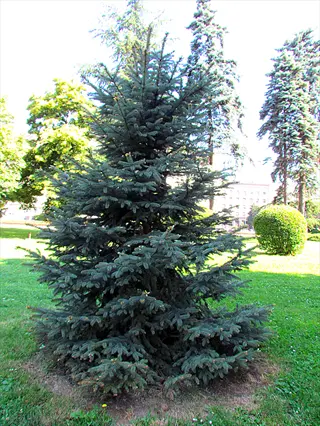
Fat Albert
- Form: A broad, dense pyramid that grows to a manageable 10 to 15 feet (3 to 4.5 meters) in many yards over time.
- Color: Holds a strong, even silver-blue color that stays consistent rather than fading on older growth.
- Use: An excellent specimen or accent tree for medium and large landscapes where you want a classic Christmas-tree shape.
- Habit: Naturally symmetrical, so it needs little shaping to keep its tidy pyramidal outline.
- Growth: Slow to moderate, like the species, so it will not outgrow a mid-size yard quickly.
- Why pick it: One of the most reliable blue cultivars for color and form, which is why it is a long-time favorite.
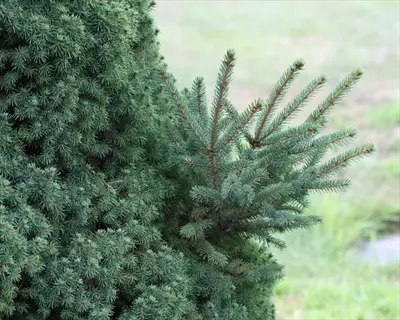
Glauca Globosa Dwarf Spruce
- Form: A compact, rounded dwarf that stays roughly 3 to 5 feet (1 to 1.5 meters) tall and wide for decades.
- Color: Bright blue-silver needles packed densely over a mounded shape.
- Use: Ideal for small yards, foundation beds, rock gardens, and large containers where a full-size spruce will not fit.
- Maintenance: Very low; its slow, tidy growth means almost no pruning is required.
- Placement: Works well as a focal point in a mixed border or beside an entryway.
- Why pick it: Delivers the signature blue color in a space-saving package for gardeners short on room.
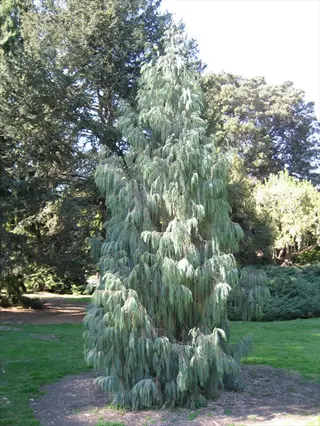
Glauca Pendula Weeping Spruce
- Form: A dramatic weeping cultivar with cascading branches whose height depends on how it is staked and trained.
- Color: The same prized silver-blue foliage as the full-size species, draped along trailing limbs.
- Use: A living sculpture for entryways, courtyards, and small modern gardens that need a striking focal point.
- Training: Its shape is highly variable and can be staked upright or allowed to spill over a wall or slope.
- Space: Takes up little ground area, making it suitable for tighter spots than a standard spruce.
- Why pick it: Offers an architectural, one-of-a-kind look that a standard pyramidal spruce cannot match.
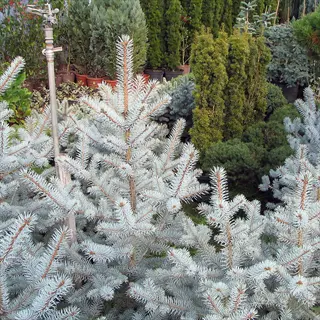
Baby Blue Eyes
- Form: A semi-dwarf, neatly conical tree that reaches a moderate 15 to 20 feet (4.5 to 6 meters) over many years.
- Color: Soft, consistent blue color that holds well across the whole tree.
- Use: A good middle-ground choice for yards too small for a 60 foot (18 meter) spruce but wanting more presence than a dwarf.
- Habit: Dense and uniform, giving a polished look with minimal shaping.
- Growth: Slow and predictable, so it stays in scale with a typical suburban lot.
- Why pick it: Bridges the gap between dwarf cultivars and towering specimens for everyday landscapes.
Short on room? Reach for a dwarf blue spruce like Glauca Globosa, which holds its rounded shape at 3 to 5 feet (1 to 1.5 meters) for decades. It fits a foundation bed or a large pot where the full species never could. The color is just as blue, only on a scale that suits a tight yard.
Want something with more drama? A weeping blue spruce such as Glauca Pendula reads more like sculpture than a hedge. You can stake it tall or let it spill over a wall, and no two plants grow the same way. Pick the form first, the spot second, and the blue will take care of itself.
Growth Rate, Size, and Lifespan
Most guides answer how fast does blue spruce grow with one flat word: slow. That hides the real numbers you need before you plant. This is a slow growing tree, and the data tells you exactly how slow. Iowa State reports a blue spruce reaches about 30 to 50 feet (9 to 15 meters) in 35 to 50 years. USDA puts average yearly trunk growth at under 0.2 inches (0.5 centimeters) wide. So a tree with just a 4 to 5 inch (10 to 13 centimeter) trunk may already be 125 to 135 years old.
So plan for blue spruce mature size, not next summer's screen. In a yard, the tree usually tops out at 30 to 60 feet (9 to 18 meters) tall and 10 to 20 feet (3 to 6 meters) wide. In the wild it grows far bigger. Native trees reach 70 to 115 feet (21 to 35 meters), and the largest one on record stood at 126 feet (38 meters). Your landscape blue spruce height will land in the lower range, but it still needs real room.
Think of this tree as a long investment, not a quick fix. A blue spruce you plant today is a tree your grandkids may sit under. The timeline below shows what to expect decade by decade, from the slow first years to a century and beyond.
One honest catch on blue spruce lifespan. That 600 year record comes from cool, dry wild ground in the Rockies. In a humid yard the story is shorter. USDA notes these trees often turn open and dingy in old age, and disease pulls many down well before middle age. Treat a healthy 30 to 50 year specimen as a strong result in most home landscapes.
Years 1 to 5
A slow establishment phase; the young tree needs steady moisture and gains height gradually as its shallow roots spread.
Years 5 to 20
Steady slow growth, adding less than 0.2 inches (0.5 centimeters) of trunk width per year and filling into its pyramidal shape.
Years 35 to 50
Reaches roughly 30 to 50 feet (9 to 15 meters) tall, approaching its mature landscape size of 30 to 60 feet (9 to 18 meters).
100 plus years
In the wild, trees can reach 70 to 115 feet (21 to 35 meters) and live for centuries, with records up to 600 years.
Blue spruce is apparently a long-lived tree, surviving up to 600 years or more.
5 Common Myths
Blue spruce grows fast, so you will get a tall privacy screen within just a few short years of planting it.
It is a slow grower, adding less than 0.2 inches of trunk width yearly and taking 35 to 50 years to reach 30 to 50 feet.
Blue spruce thrives anywhere in the country because it is famously tough, cold hardy, and highly adaptable to any climate.
It cannot tolerate heat and humidity, so it struggles and gets diseased outside its cool, dry native Rocky Mountain range.
If a blue spruce starts browning from the bottom, you can simply spray a fungicide and quickly cure the damaged needles.
Fungicides only protect new growth from Rhizosphaera; they cannot cure already infected needles, and timing must be precise to work.
Blue spruce needs constant heavy watering forever because it is a thirsty evergreen that always demands rich, very moist soil.
Young trees need steady moisture, but mature blue spruce becomes more drought tolerant than any other spruce as it ages.
You should plant a blue spruce close to the house because its shallow roots are weak and cannot damage anything nearby.
Its wide 10 to 20 foot spread and need for airflow make close planting a problem, even though roots stay shallow and windfirm.
Conclusion
A blue spruce is one of the toughest evergreens you can plant, yet it stays picky about where it lives. It shrugs off cold down to minus 40 degrees and can live for centuries, but it sulks the moment you put it in the wrong yard. Get the site right and it rewards you. Get it wrong and it slowly turns brown from the bottom up.
Keep the core numbers in your head before you dig. A landscape tree reaches 30 to 60 feet (9 to 18 meters) tall and thrives in hardiness zones 2 to 7. Space each one 12 to 24 feet (3.7 to 7.3 meters) from the next so air moves freely between them. And go in knowing this is a slow tree, since most take 35 to 50 years to hit full size.
Here is the one rule that prevents most trouble. Match the tree to a cool, dry-enough blue spruce climate, then give it full sun, well-drained soil, and steady airflow. That single set of choices stops most disease and decline before it ever starts. The bulk of good blue spruce care happens in the first hour, when you pick the spot, not in the years of fussing that follow a bad one.
There are at least 38 named cultivars to pick from. They run from 3 foot (1 meter) dwarfs to 60 foot (18 meter) giants. So there is a fit for almost any cool-climate yard. Choose the size your space can hold and plant it with care. A healthy blue spruce then gives you a multi-decade run of silver-blue color. It is a slow, patient tree, and your yard will still be growing into it long after planting day fades.
Glossary
- cultivar
- A plant variety bred and selected by growers for specific traits like color, size, or shape.
- Cytospora canker
- A fungal disease that kills a blue spruce's lower branches and causes sticky resin to ooze on the trunk.
- evergreen conifer
- A cone-bearing tree that keeps its needles year-round instead of shedding them in fall.
- Glaucous
- Covered in a fine, waxy bluish coating, which is what gives blue spruce needles their silver-blue color.
- Hardiness zone
- A USDA region rating based on average winter cold that tells gardeners which plants can survive there.
- hardiness zones
- The USDA system that maps regions by their average lowest winter temperature so you know which plants survive your local cold.
- Picea pungens
- The botanical name for blue spruce, meaning sharp-pointed spruce after its stiff, prickly needles.
- Rhizosphaera needle cast
- A fungal disease that browns a blue spruce's inner needles from the bottom up, leaving the tree thin and see-through.
External Sources
Frequently Asked Questions
Can you plant a blue spruce next to your house?
It is usually a poor idea. A blue spruce spreads 10 to 20 feet wide and needs airflow, so plant it at least 15 to 20 feet from the house.
Where is the best place to plant a blue spruce?
Best spots are:
- Full sun with six or more hours of direct light
- Well-drained, slightly acidic soil
- An open area with strong air circulation
- Room for a 30 to 60 foot tree, 12 to 24 feet from other plants
What is the lifespan of a blue spruce?
USDA records show wild blue spruce can live up to 600 years, though landscape trees in humid regions often decline far sooner from disease.
How long does it take for a blue spruce to fully mature?
Blue spruce is a slow grower, reaching 30 to 50 feet in roughly 35 to 50 years and gaining less than 0.2 inches of trunk width per year.
Why is my blue spruce turning brown and losing needles?
The usual causes are:
- Rhizosphaera needle cast, which browns inner needles from the bottom up
- Cytospora canker, which kills lower branches and oozes resin
- Heat, humidity, and poor airflow that stress the tree
Are coffee grounds good for blue spruce?
Coffee grounds add a little organic matter and mild acidity, which suits the slightly acidic soil blue spruce prefers, but they are not a real fertilizer.
What is another name for blue spruce?
Common names include:
- Colorado blue spruce
- Colorado spruce
- Silver spruce
- Picea pungens (the botanical name)
Do blue spruce trees smell good?
Blue spruce has a fresh evergreen scent, but it is milder and sometimes sharper than the sweet aroma of firs and balsams.
Is a blue spruce a good Christmas tree?
Yes. Its stiff branches hold heavy ornaments well and it keeps its needles longer than many cut evergreens, though the needles are sharp.
What is blue spruce good for?
Blue spruce is used as:
- A striking specimen or accent tree
- A windbreak or privacy screen
- Winter cover and shelter for wildlife
- A living or cut Christmas tree