Ornamental · Brassicaceae
Sweet Alyssum
Lobularia maritima
Low mounds smothered in tiny, honey-scented flowers of white, pink, and purple from spring to fall.
Full sun
42–56 days
USDA 5–9
3–10 in · 8–25 cm
Overview
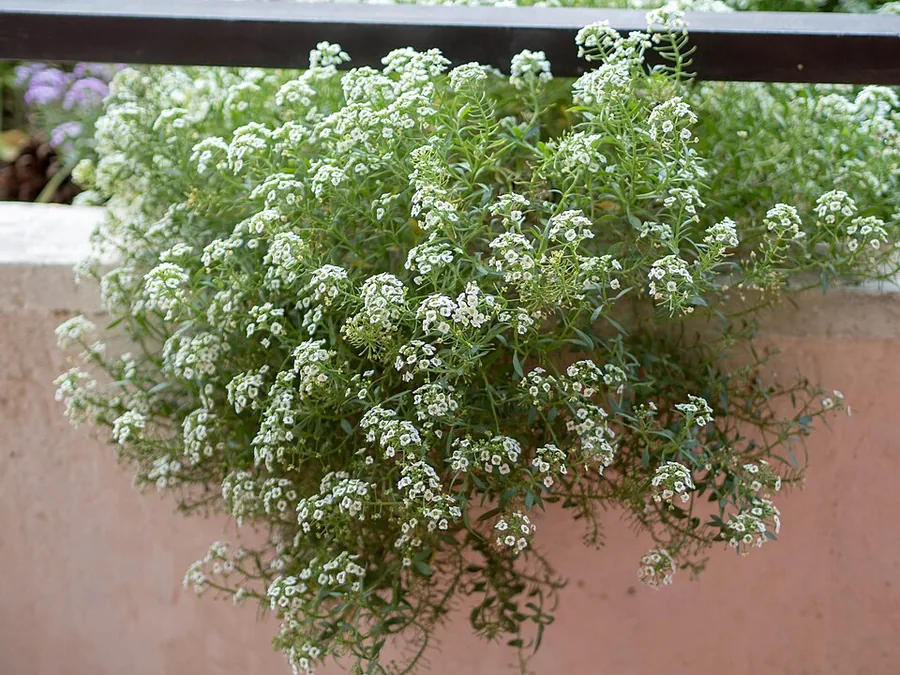
Sweet alyssum grows as a low, spreading mound so thick with bloom that the foliage all but vanishes beneath it. The flowers are tiny, packed into rounded clusters that give the plant a soft, frothy surface, and they carry a sweet, honey-like scent. Their color runs white, pink, or purple, and the bloom keeps coming from spring through fall. It is a member of the cabbage family.
As a cool-season annual, it flushes heavily in the mild days of spring and fall, then thins and slows in peak summer heat before filling back in as the air cools. The plants stay low, most under 10 inches tall and a foot wide, their stems fanning outward into a dense, ground-hugging mat rather than standing upright. Up close the effect is a fine carpet of countless small blossoms.
Those tiny flowers are more than a pretty surface. They offer nectar that draws hoverflies and parasitic wasps, and their young feed on aphids, so the same little blooms that soften the ground double as a lure for helpful insects.
Care
The short version: full sun, average soil with sharp drainage, and a light hand with water and feed. When summer heat thins the flowers, shear the mound back and it fills in again come fall.
Light
Sweet alyssum opens the most flowers in full sun, and the dense, pale carpet looks fullest where the light is strong. A little afternoon shade helps in hot summers, and bright spring and fall sun packs the blooms in tighter.
Water
Water it regularly while it roots in, then ease off, since it turns drought tolerant once established. It will not sit in standing water, so let the soil dry between drinks to keep the mound firm and healthy.
Soil
Average, well-drained soil is enough, and it holds up in poor, thin ground. What it must have is sharp drainage, since soggy soil rots the stems at the crown.
Humidity
Ordinary outdoor air suits it, so there is no level to watch. Airflow counts for more, because a crowded, damp mound invites the fuzzy growth of downy mildew across its leaves.
Feeding
Feed lightly through the growing season, about once a month. Too much fertilizer swells the leaves and thins the flowers, so a light feed keeps the surface dense with bloom.
Pruning
Deadhead the spent flowers to keep fresh ones opening across the mound, and pull away any browned or diseased growth. When summer heat leaves the plant ragged, a hard shear resets it for a clean fall flush.
Size & spacing
The plant stays low and wide, 3 to 10 inches (8 to 25 cm) tall and 6 to 12 inches (15 to 30 cm) across, its stems spreading into a flat mat. Set plants close enough that the mounds merge into one carpet, with a little air between them.
When to plant
Sweet alyssum runs on the cool ends of the year. Sow seeds indoors 6 to 8 weeks before the last frost, or scatter them outdoors a few weeks before that date, and the tiny flowers open from spring through fall with a thin spell in the summer heat. In mild climates, a fall sowing works too.
Northern hemisphere
Southern hemisphere
Typical months for a temperate climate: start earlier in warm zones, later where spring frosts linger.
- Sow: 6 to 8 weeks before the last spring frost
- Plant: A few weeks before to around the last spring frost; can also sow in fall in mild climates
- Harvest: Spring through fall, flushing in spring and fall and slowing in peak summer heat
Hardiness
USDA hardiness zones: 5–9
Temperature: down to -29°C
Troubleshooting
Most trouble with sweet alyssum shows up first in the look of the plant, and it usually traces to heat or too much water. Watch the color and texture of the foliage and flowers for the early signs below. Match what you see, then act.
Wilting plants with rot at the stem and crown
Waterlogged ground is the cause. Stem and crown rot softens the base when soil stays wet or water pools there, and the whole plant wilts even as its roots sit drowning. Pull the affected plants, fix the drainage, and cut back the watering.
Fix:
- Improve soil drainage
- Avoid overwatering and standing water
- Remove affected plants
Yellow leaves with fuzzy growth on the undersides
A soft, fuzzy layer on the undersides of the leaves, with yellowing showing through above, is downy mildew. It settles in during cool, wet spells that keep the foliage damp. Open the mound for airflow, water at the base instead of overhead, and clear away the infected debris.
Fix:
- Improve air circulation
- Avoid overhead watering
- Remove and discard infected plant debris
Flowers thin and the mound browns in midsummer heat
The browning is heat stress, not death. Sweet alyssum is a cool-season annual, so its growth and flowering slow once summer turns hot, and the once-dense mound looks tired and sparse. Shear the plants back by about half, water and feed lightly, and fresh growth fills in as fall cools.
Fix:
- Shear plants back by about one-half
- Water and lightly fertilize to encourage a new flush
- Allow plants to rebound in cooler fall weather
Toxicity
For homes with animals, sweet alyssum is non-toxic. Cats, dogs, and the rest can brush against its soft mounds or nibble a flower without harm. The honey-scented blooms are safe in the hands of curious children too.
Safe for
People · Cats · Dogs · Horses · Rabbits · Livestock · Birds
Cats None
Cats are safe with it, and a curious bite of the leaves or flowers will not cause poisoning.
Dogs None
Dogs are safe too, since the plant is non-toxic and a stray mouthful does no harm.
Horses Safe
Horses can graze near it without harm, as it carries no toxins that affect them.
Rabbits Safe
Rabbits can nibble the leaves and flowers safely, though any new green is best offered in small amounts.
Livestock Safe
Cattle, goats, and sheep are in no danger from it, with nothing in the plant to trouble grazing animals.
Birds Safe
Birds are safe around it, and the flowers draw the bees and butterflies that birds may hunt in turn.
People Safe
People are unharmed by it, and the honey-scented flowers are safe for children to handle.
Varieties
A handful of named selections stand out mostly by the color and size of their flowers and by how well the bloom holds through heat.
Carpet of Snow
A compact, low-spreading selection buried under pure white flowers, holding around 3 to 4 inches tall.
Royal Carpet
A 1953 All-America Selections winner in deep violet-purple, holding to about 3 inches tall.
Snow Princess
A vigorous sterile hybrid in clean white whose flowers keep opening through heat far longer than the older types.
Snow Crystals
A tetraploid with noticeably larger white flowers and improved heat tolerance.
Easter Bonnet
An early-blooming series sold as a mix of flower colors.
Companions
Sweet alyssum earns its place beside vegetables by drawing in the insects that hunt aphids, which is why it's grown in flower strips next to crops like lettuce.
Plant near
Lettuce: Planted as insectary flower strips, sweet alyssum attracts hoverflies (syrphid flies) and parasitic wasps whose larvae prey on aphids, providing biological aphid control in lettuce and other vegetable crops
How to propagate
Sweet alyssum keeps itself going with little help, whether you sow the fine seed or root cuttings from a favorite hybrid.
SeedEasy
Direct sow several weeks before the last spring frost, or start indoors 6 to 8 weeks before transplanting; can also sow in fall in mild climates · Blooms about 6 to 8 weeks from seed
Seed is the simple route, and the seed is fine and small. Scatter it on the surface and barely cover it, since it needs light to germinate, either outdoors a few weeks before the last frost or indoors 6 to 8 weeks before planting out. The first tiny flowers open in about 6 to 8 weeks, and settled plants self-sow freely.
Stem cuttingsModerate
During active growth · A few weeks to root
Cuttings carry on the sterile hybrids, since cultivars like Snow Princess set little or no seed. Take them during active growth and they root in a few weeks into plants that match the parent flower for flower.
Myths
A sweet alyssum whose mound browns and stops flowering in summer has died.
It has usually only slowed, a cool-season annual thinning out in the heat. Shear it back, keep it watered, and the cooler days of fall fill the mound with flowers again. A ragged midsummer plant is resting, not dead.
Sweet alyssum needs heavy feeding to flower well.
Heavy feeding puffs up the leaves and leaves you with few flowers. A light feed gives far more bloom, since this plant flowers best when it is not pushed.