Ornamental · Brassicaceae
Stock
Matthiola incana
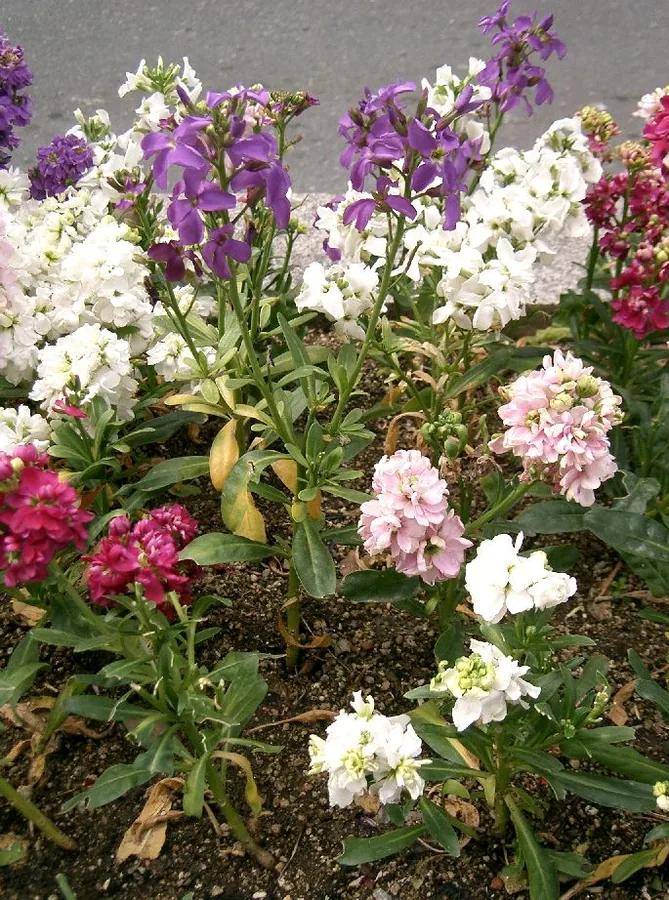
Stock stacks clove-scented bloom up tall, upright spikes in pink, purple, cream, and white.
Full sun
Every 3–7 days
80–100 days
USDA 6–10
Overview
Up close, stock reads as a column of packed bloom. Flowers crowd tightly along an upright spike, and the whole plant gives off a clove-sweet scent that hangs in cool air. It sits in the cabbage family, Brassicaceae, and grows as a cool-season annual, densest and most fragrant in the mild weather of spring and fall.
The color runs soft: pink, purple, cream, and clean white, often several tones across a planting. Each stem rises 1 to 3 feet (30 to 91 cm), and the tallest carry long, fragrant spikes firm enough to hold in a vase. Plants sit 9 to 18 inches (23 to 46 cm) across, a compact base under all that vertical bloom.
What defines stock physically is that dense, upright flower spike, and it only forms fully after a cool spell early in the plant's life. Grown in cool weather with even moisture and full sun, the spikes pack tight and hold their scent for weeks. Grown into heat, the flowers thin and the plant collapses before the spike fills.
Care
The short version: stock builds its dense, fragrant spikes in full sun and cool weather, with even moisture in fertile, well-drained, non-acidic soil, and it needs an early start so the flowers form before summer heat.
Light
Stock builds its thickest stems and fullest spikes in full sun. It takes light partial shade where spring warms early, but in deep shade the stems stretch thin and weak and set only a scatter of flowers.
Water
Stock holds its bloom when the soil stays evenly moist, and it wilts if it dries out through cool-season growth. Water about every 3 to 7 days, more in dry weather, and lay the water at the base so the stems and lower leaves stay dry and mold-free.
Soil
The roots run best in fertile, well-drained loam, sand, or clay laced with organic matter. A pH of 6.0 to 8.0 suits stock, slightly alkaline rather than acidic, and sour, acidic ground leaves it struggling.
Temperature
Stock is built for cool air. It takes light frost without damage and firms up in the chill of spring or fall, comfortable across about 28°F to 81°F (-2°C to 27°C), then wilting fast once heat climbs past the top of that band.
Humidity
Plain outdoor humidity leaves stock unbothered, so no reading applies. What shows on the plant is the effect of still, damp air on crowded stems, which is where the white, cottony mold takes hold.
Feeding
A balanced, general-purpose fertilizer dug into the bed at planting, then renewed about monthly, keeps the spikes filling out. Steady feeding thickens the flower stems without turning the growth soft and floppy.
Pruning
Stock needs almost no cutting. Spent spikes are pinched or snipped away to keep the plant clean, and cutting stems is a matter of taking them fresh for the vase. As a short-lived annual, it needs nothing else.
Size & spacing
Each plant stands 1 to 3 feet (30 to 91 cm) tall on a base spreading 9 to 18 inches (23 to 46 cm) wide. Spacing to that width leaves air moving around the stems and keeps mold off them.
When to plant
Stock forms its best spikes in cool weather, so timing shapes the whole plant. Seed starts indoors in late winter, seedlings move out in early spring while the air stays cold, and the tight, scented spikes rise from late spring into early summer before heat thins them.
Northern hemisphere
Southern hemisphere
Typical months for a temperate climate: start earlier in warm zones, later where spring frosts linger.
- Sow: 6 to 8 weeks before the last spring frost; seed germinates in 7 to 14 days at 65 to 75°F (18 to 24°C)
- Plant: Transplant in early spring while weather is still cool; plants tolerate light frost. In mild-winter regions plant in fall or late winter.
- Harvest: Blooms May through July under cool conditions; cool exposure near 50 to 55°F (10 to 13°C) is needed to trigger flowering
Hardiness
USDA hardiness zones: 6–10
Temperature: down to -23°C
Troubleshooting
The signs of trouble in stock show on the plant itself: a cottony film on the stems, spikes tipped flat, or lush leaves with no bloom at all. Reading those physical cues early lets you correct spacing, support, or timing before the planting is lost.
Cottony white mold on soft stems
The white, fluffy film on the stems is white mold, the fungus Sclerotinia, which spreads in the mild, wet, humid weather stock grows through. The stem tissue beneath it turns water-soaked and collapses, so pull and bin any plant showing that cottony growth and rot. Spacing the rest, watering at the base, and moving the air keep the spores off damp stems.
Fix:
- Remove and discard affected plants
- Improve air circulation by proper spacing
- Avoid overhead watering and excess moisture
Blooms thinning as the heat builds
Stock is a cool-season flower, and heat breaks it down. Past 80°F (27°C) the spikes stop forming and the whole plant wilts and dies quickly, with no recovery once it is heat-struck. Growing through spring or fall and cutting the spikes before the hot weather arrives is the only reliable path.
Fix:
- Grow as a cool-season crop and harvest before summer heat
- Time plantings for spring or fall cool periods
Green leaves and no spike at all
A stock plant that stays leafy and green with no spike rising never met the cool spell that starts the flower. Young plants need a stretch near 50°F to 55°F (10°C to 13°C) while small for the bloom to set. Give them that cool conditioning at the right leaf stage, or grow early varieties that flower on a shorter cool window.
Fix:
- Expose young plants to cool temperatures near 50 to 55°F (10 to 13°C)
- Choose early varieties for short cool windows
Tall spikes bent flat to the ground
This flattening is lodging, not disease. The spikes grow tall and top-heavy, and a gust of wind or a heavy watering tips them over or lays them flat. A layer of horizontal netting at planting, with room between plants, holds the stems upright as they push through the mesh.
Fix:
- Install a layer of horizontal support netting
- Provide even moisture and avoid overcrowding
Toxicity
For all its dense, fragrant bloom, stock carries nothing harmful. The ASPCA lists it among the non-toxic flowers, so it is safe around cats, dogs, and other animals, and the scented petals are even edible.
Safe for
People · Cats · Dogs · Horses · Rabbits · Livestock · Birds
Cats None
Safe for cats. The ASPCA lists stock among its non-toxic flowers, so a bitten leaf or petal does no harm.
Dogs None
Safe for dogs. Stock holds no known toxin, though a dog that eats a large mouthful of any plant may have a brief upset stomach.
Horses Safe
Horses graze near stock without harm, since nothing in its leaves or stems is toxic to them.
Rabbits Safe
Rabbits can browse the leaves and flowers of stock with no ill effect.
Livestock Safe
Cattle, goats, and sheep take no harm from stock within reach.
Birds Safe
Birds pick at the plant and its seeds without any harm.
People Safe
Stock is safe for people, and its sweetly scented flowers can be eaten as a garnish.
Varieties
The strains of stock differ in how fast the spikes form and how much cold the plants take. Three stand out.
Harmony Series
This series, which carries shades like Harmony Cherry Blossom and Harmony Purple, was bred to keep flowering in warmer climates such as Florida.
Brompton Stock
A biennial-type strain gardeners overwinter so its spikes come on strong the following spring.
Ten Weeks Stock
A fast annual whose spikes open roughly ten weeks after sowing, the trait behind its name.
How to propagate
Stock starts as seed, and the spike you see later depends on one thing: the cool spell that shifts the plant from leaf to flower.
SeedModerate
Sow indoors 6 to 8 weeks before the last frost, or in seedling trays for transplanting; germinates in 7 to 14 days at 65 to 75°F (18 to 24°C) · 30 to 50 days to reach transplant size
Stock begins as seed. Sow it indoors 6 to 8 weeks before the last frost, and the seed sprouts in 7 to 14 days at 65°F to 75°F (18°C to 24°C), then spends another 30 to 50 days filling out to transplant size. Sow a fresh batch every couple of weeks for a run of spikes, and give the young plants a cool spell so the flowers form.
Myths
Stock flowers are toxic and dangerous near cats and dogs.
Those fragrant petals hold no poison. The ASPCA lists stock (Matthiola incana) among its non-toxic flowers, the kind that goes safely into a bouquet. It is not poisonous to cats or dogs, so the plant and its cut spikes are safe indoors.
Given enough sun, stock will bloom in any season.
Sunlight alone leaves you with leaves, not spikes. Stock is a cool-season plant that needs a cool spell to form its flowers, and it falls apart once heat passes about 80°F (27°C). The spikes only fill in spring or fall.