Shrub · Rosaceae
Rugosa Rose
Rosa rugosa
Crinkled leaves, prickle-thick canes, and summer flowers that give way to fat red-orange hips define the rugosa rose.
Full sun
Every 7–14 days
USDA 2–7
4–6 ft · 1.2–1.8 m
Overview
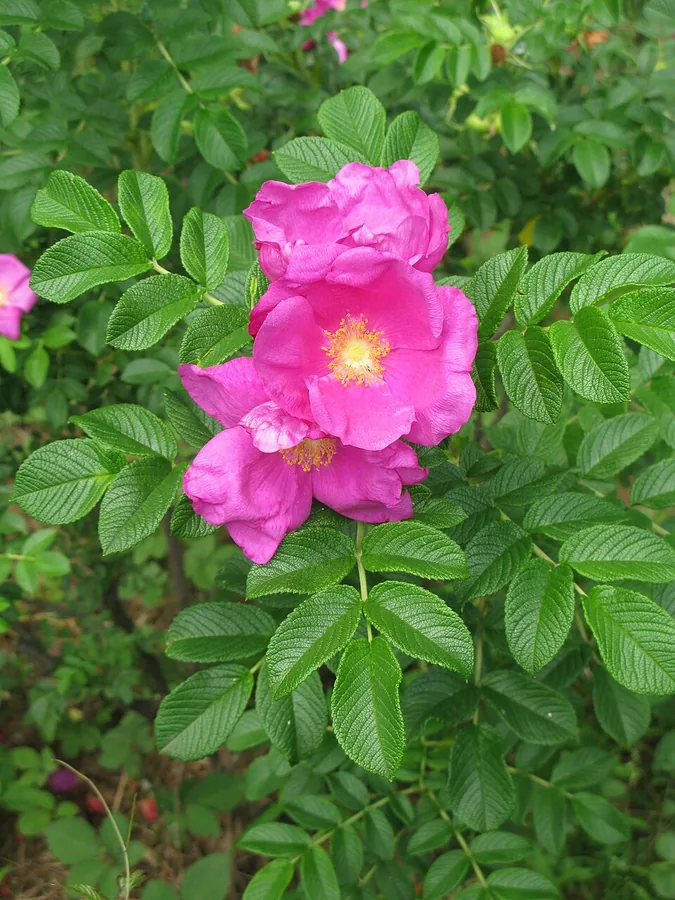
Up close, the rugosa rose is all texture. The leaves are deeply wrinkled and leathery, crinkled so thoroughly that few lie flat, and the canes run thick with sharp, needle-like prickles from base to tip. It comes from the coasts of eastern Asia, the origin of its beach rose name, and it looks nothing like the smooth-caned garden roses nearby. Each stem feels stiff and armored under the hand.
The flowers open wide and simple or full and double, and their color runs from clean white through soft pink to a deep, saturated reddish purple. Each bloom gives off a strong perfume you can catch before you reach it. As the petals drop, they leave behind rounded red-orange hips that swell fat and glossy along the canes, bright against the coarse foliage.
Below the soil, the plant pushes up fresh canes well away from the crown, thickening into a low, bristling mound of prickled stems. The whole shrub carries a rugged, untamed look, coarse wrinkled leaves and thorny wood layered close together. When the hips ripen they hang along the branches like small red-orange fruits, edible and full of vitamin C.
Care
The short version: the rugosa rose wants full sun and takes nearly any soil, down to bare sand or salty coastal grit. Give it deep water while it roots, then very little, feed it lightly, and prune the thorny, prickle-lined canes in late winter to shape the shrub and cut back its wandering suckers.
Light
In full sun the shrub flowers thickest and the wrinkled leaves stay clean and firm. It will hold on in partial shade, but a shaded, crowded spot keeps the foliage damp, and that is when spots and blistering start to mar the leaves.
Water
Water deeply and often while the roots take, then taper off, since a settled rugosa is drought tolerant and shrugs off dry spells. Aim the water at the base in the morning, not over the canopy, so the crinkled foliage dries fast and stays free of disease.
Soil
The roots take to almost any ground, from loose sand and gravel to heavy clay and thin coastal dirt. The plant leans toward moist, well-drained, slightly acidic loam at a pH of 6.0 to 7.5, but it holds no strong demands.
Temperature
The canes are hardy to a startling degree, standing from -51°F to 86°F (-46°C to 30°C). That deep tolerance for cold is what carries the shrub through winters in the far north that would kill a softer rose.
Humidity
Plain outdoor air suits the plant, so no reading matters. What the leaves want is moving air around them, because still, packed foliage stays wet and lets fungal spots settle onto the surface.
Feeding
This rose grows lean and asks for very little. A single spring feed of balanced or rose fertilizer covers it, and heavy feeding does more harm than good.
Pruning
In late winter to early spring, cut the shrub back to shape and clear out the dead or weak canes, easy to spot among the live wood. Dig out the suckers in the same pass, the new stems rising at the plant's edges, or the thicket keeps widening.
Repotting
A rugosa rarely lives in a pot, so repotting seldom comes up. In a container, move it up when the roots wind around the base or poke through the drainage holes, or when the shrub wilts soon after each watering.
Size & spacing
The shrub fills out into a rounded, prickly mound of 4 to 6 feet (120 to 180 cm) in height and spread. Leave it that room, and a little beyond, since the suckering roots keep sending up stems past the original edge.
When to plant
Planted in spring or fall, the rugosa rose takes hold fast. The wide, fragrant flowers open in late spring and keep coming through summer, and as they fade the rounded hips ripen to a glossy red-orange, clinging to the bare canes well into winter.
Northern hemisphere
Southern hemisphere
Typical months for a temperate climate: start earlier in warm zones, later where spring frosts linger.
- Plant: Spring or fall
- Harvest: Blooms late May to July with intermittent rebloom until frost; showy red-orange hips ripen August into winter.
Hardiness
USDA hardiness zones: 2–7
Temperature: down to -46°C
Troubleshooting
Most of what goes wrong with a rugosa shows on the plant itself, in shoots straying from the clump or in spots marking the leaves, and the tough shrub rarely suffers worse. The notes below describe what each sign looks like so you can spot it early.
A red, warped broom stiff with extra prickles
A dense broom of twisted red shoots studded with far too many prickles is the mark of rose rosette disease, a virus carried by tiny eriophyid mites that cannot be cured once it sets in. Dig the affected plant out and destroy it quickly to spare the roses around it. Milder knots of stressed, clustered growth are usually aphids, scale, thrips, or spider mites, which a hard blast of water or the cut of the worst canes clears.
Fix:
- Promptly remove and destroy plants showing rose rosette symptoms to protect nearby roses
- Treat heavy insect infestations with a strong water spray or appropriate control
- Remove and dispose of badly infested canes
New prickled stems rising at the plant's edges
Those fresh canes standing away from the main clump grow straight from the rugosa rose's suckering habit, the engine of its thicket-forming spread. Shallow roots push the new stems up well past the crown, so cut and dig each one as it shows, or ring the plant with a root barrier from the start. Near dunes or wild ground, a tidy named cultivar keeps the growth contained.
Fix:
- Cut and dig out suckers as they appear
- Install a root barrier or plant in a contained bed
- Choose a better-behaved named cultivar instead of the straight species
Orange-blistered, spotted leaves dropping early
The wrinkled leaves usually stay clean, but rust, black spot, and powdery mildew can raise orange pustules, dark spots, or a white film on them in damp, shaded, crowded air. Pick off the marked leaves and rake up the fallen ones so no spores linger over winter. Thin the canes to move air through and water low at the base in the morning to keep the foliage dry.
Fix:
- Remove and dispose of affected leaves and fallen debris
- Improve air circulation by thinning canes
- Water at the base in the morning rather than overhead
Toxicity
There is nothing poisonous to find here. Every part of the rugosa rose is non-toxic to cats, dogs, horses, and people, and the fat red hips are edible and full of vitamin C. The only thing that can hurt is the wood itself, armored in sharp, needle-like prickles, so handle the canes with gloves.
Safe for
People · Cats · Dogs · Horses · Rabbits · Livestock · Birds
Cats None
No toxic compound sits anywhere in the plant, so a cat nosing at a petal or leaf comes to no harm. The one thing to watch is the sharp prickles, which can scratch a paw or mouth.
Dogs None
A dog can chew the leaves, flowers, or ripe hips with no poisoning at all. Keep it off the thorny canes, though, because a bristling stem can scratch and prick.
Horses None
Horses graze the foliage and hips with no ill effect. The catch is the dense prickles, which can jab a soft muzzle pushed in among the stems.
Rabbits None
Rabbits nibble the leaves and stems safely, and the hips make a good treat. No part of the plant is poisonous to them.
Livestock None
Cattle, goats, and sheep graze the shrub without harm. The thorny canes turn them away more than they wound, a prickled wall around the leaves.
Birds None
Birds strip the red hips and scatter the seed far and wide, part of how the rose spreads on its own. Eating any part of it does them no harm.
People None
The hips are edible and rich in vitamin C, good in teas, jams, and syrups, and the petals are edible too. Handle the canes with gloves, since the sharp prickles are the only part that draws blood.
Stems are densely covered in sharp, needle-like prickles that can cause scratches and puncture wounds; wear gloves and long sleeves when handling or pruning.
Varieties
Almost every rugosa rose you meet is a named cultivar, each with its own flower shape, color, and scent. Their looks vary more than you might expect, and these are the ones you will see most.
Hansa
Hansa carries full, double flowers in a deep reddish purple, heavily scented, that give way to large red hips.
Blanc Double de Coubert
Blanc Double de Coubert opens semi-double, pure white blooms of intense fragrance on a tough, disease-resistant shrub.
Frau Dagmar Hastrup
Frau Dagmar Hastrup stays compact and bears single, silvery-pink flowers that ripen into a heavy crop of large red hips.
F.J. Grootendorst
F.J. Grootendorst shows small red flowers with petals fringed like a carnation, packed into clusters in nearly nonstop bloom.
How to propagate
The rugosa rose gives you three physical starting points: a rooted sucker lifted from the edge of the clump, a green summer cutting, or the small hard seeds packed inside a ripe hip.
DivisionEasy
Late winter to early spring or fall · 1 to 2 seasons
Because rugosa grows on its own roots and throws up suckers freely, the easiest increase is to slice a rooted sucker from the parent and set it back in the ground in late winter to early spring or in fall. Give the young stem a season or two to root down, and it grows on as a copy of the original.
Stem cuttingsModerate
Summer (softwood or semi-hardwood) · Several weeks to root, then 1 to 2 seasons to establish
Nurseries take cuttings in summer, cut from healthy current-season growth while it is still soft or just firming as softwood or semi-hardwood. The bare stems root over several weeks, then fill out over a season or two into a solid, prickled shrub.
SeedModerate
Sow cleaned seed from ripe hips in fall, or stratify and sow in spring · 1 or more years
Split a ripe hip open and you find 20 to 120 seeds packed inside, so seed is never scarce. Sow the cleaned seed in fall, or cold-stratify it and sow in spring, then wait through slow, uneven sprouting and a year or more before the seedlings bulk up.
Myths
The rugosa rose is a well-behaved native you can plant anywhere along the coast.
It is native to eastern Asia, not North America, and it has escaped gardens to spread invasively along the coasts of New England, Virginia, and parts of Canada. There its thorny stems knit into dense thickets that crowd out the native dune plants, which is why it sits on Maine's advisory list and belongs away from wild ground.
Because roses are non-toxic, the whole plant is completely safe to handle.
The leaves, flowers, and hips are safe to eat and harmless to pets, so nothing about it will poison you. The danger is in the wood, since the canes bristle with sharp, needle-like prickles that scratch skin and drive in like splinters, so gloves and long sleeves belong on before you prune.