Shrub · Rosaceae
Cotoneaster
Cotoneaster
Small-leaved and arch-stemmed, studded with red berries through winter, cotoneaster carries its color long after the frost.
Full sun
Every 7–14 days
USDA 5–7
2–3 ft · 0.6–0.9 m
Overview
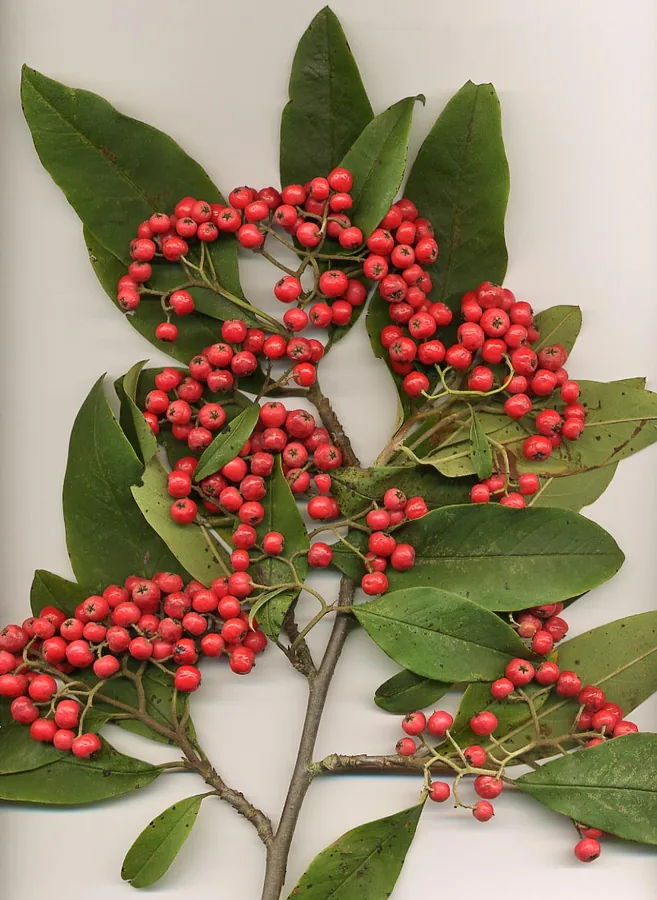
Cotoneaster is a hardy shrub in the rose family, built from arching stems lined with small, neat leaves and hung with red berries that cling to the branches long after other plants have shed their foliage. The forms run from low, flat groundcovers whose stems press against a slope to upright shrubs that rise taller than a person, so the plant takes many physical shapes. In late spring the stems carry small white-to-pink flowers, and bees work over them closely.
The plant's strength shows in how little it needs. Its roots take hold in poor, rocky, and dry soil, the wood rides out cold down to -20°F (-29°C), and once established it draws little water. That hardy build suits it to banks, hedges, and the awkward corners where softer plants fail.
Two flaws mark the plant. Cotoneaster is very prone to fire blight, and the berries, carried off and dropped by birds, have let some species seed themselves beyond gardens in mild regions. Those two traits aside, the shrub holds its red color year after year.
Care
The short version: cotoneaster takes full sun to part shade and any well-drained soil, wants water through its first season to settle the roots, and after that needs only a light prune to shape the branches.
Light
Cotoneaster colors up best in full sun, where the stems set the heaviest flowers and the densest load of red berries, though it still grows in partial shade and partial sun. The more sun the leaves catch, the fuller the berry display on the branches.
Water
Cotoneaster needs steady water through its first growing season while the roots reach down and take hold. After that the plant runs genuinely drought tolerant and draws little extra. Wet, poorly drained ground is the one thing the roots will not stand.
Soil
Cotoneaster sinks its roots into almost any well-drained soil, taking hold in clay, sand, and the poor or rocky ground that stops other shrubs. The roots prefer a pH of 6.0 to 7.5. Soggy soil is what rots them, so drainage counts for far more than rich ground.
Temperature
The wood and stems are cold-hardy, holding firm from about -20°F to 100°F (-29°C to 38°C). That broad span lets the plant grow across many climates, which is part of why it is seen so widely.
Humidity
Cotoneaster needs no set humidity, since ordinary outdoor air keeps the leaves in good shape. Good airflow does matter around the stems, because crowded, still growth favors fire blight and other troubles that mark the foliage.
Feeding
Cotoneaster is a tough shrub that usually needs little to no feeding in average soil. Pale, weak growth calls for a balanced general-purpose fertilizer in early spring, and nothing more. A light hand is best, since soft, lush new shoots are exactly what fire blight attacks.
Pruning
Cotoneaster needs only minimal pruning. The stems are shaped after flowering or in late winter, with dead or crossing branches taken out and the spread of the low growth checked. Any fire-blighted wood is cut out the moment its blackening shows, with tools disinfected between cuts.
Repotting
Cotoneaster is rarely repotted, and most plants spend their whole life with their roots in open ground. A containerized shrub moves up a size when roots circle the pot or push from the drainage holes, water runs straight through, or the growth on the stems slows.
Size & spacing
Size follows the form, but this one rises about 2 to 3 feet (61 to 91 cm) tall on its stems and spreads a wide 6 to 8 feet (183 to 244 cm) of low branches. It needs room for that sprawl, since packed stems cut the airflow and invite disease onto the leaves.
When to plant
Cotoneaster is set in once and kept for years, not timed like a crop. New plants go out in spring or fall while the soil is workable, then small flowers open in late spring and the red berries color up from late summer, clinging to the bare stems through fall and into winter.
Northern hemisphere
Southern hemisphere
Typical months for a temperate climate: start earlier in warm zones, later where spring frosts linger.
- Plant: spring or fall
- Harvest: Flowers in late spring; red berries ripen in late summer and persist into fall and winter
Hardiness
USDA hardiness zones: 5–7
Temperature: down to -29°C
Troubleshooting
Cotoneaster is easy, but a few problems leave marks you can read straight off the plant, and the worst one spreads fast. The earliest changes show on the slim new shoots and the small leaves, so look there first. Match the look of the damage to the cases below and move quickly on anything resembling blight.
Shoots blacken and curl into a shepherd's crook
This is fire blight, a bacterial disease cotoneaster catches easily that kills new growth from the tip down. The affected shoots turn black, hook over into a curled tip, and may weep an ooze along the stem. Cut well below the blackening into clean wood, wipe tools between cuts, and burn or bin the prunings rather than compost them.
Fix:
- Prune out infected branches well below visible damage (at least 20-30 cm into healthy wood)
- Disinfect pruning tools between every cut
- Remove and destroy all infected prunings; do not compost
- Avoid heavy nitrogen fertilizing, which encourages susceptible succulent growth
Leaves go stippled and bronzed with dark specks beneath
Two pests leave the leaves stippled, yellowed, and bronzed like this. Lace bugs scatter shiny black droppings across the leaf undersides, while spider mites arrive in hot, dry spells and string fine webbing between the leaves. A hard spray of water knocks the mites off, then insecticidal soap or horticultural oil on the undersides, repeated through the season, clears them.
Fix:
- Hose down foliage to dislodge mites
- Apply insecticidal soap or horticultural oil to affected foliage, especially leaf undersides
- Repeat applications as needed during the season
Leaves bound in silk and stripped to the veins
This is the cotoneaster webworm, whose caterpillars feed hidden inside the silk they spin among the branches, leaving the leaves webbed together and chewed back to the veins. Snip out and destroy the webbed branch tips the moment the silk shows. While the larvae are still small, Bacillus thuringiensis or another suitable insecticide brings them under control.
Fix:
- Prune out and destroy webbed branch tips
- Apply Bacillus thuringiensis (Bt) or an appropriate insecticide while larvae are small
Toxicity
Cotoneaster is a plant to keep out of mouths. Every part of it, from the small leaves to the glossy red berries, holds cyanogenic glycosides that release small amounts of cyanide. A single berry tends to bring only mild stomach upset, but a large helping can be genuinely dangerous, so keep the fallen fruit picked up and steer pets, livestock, and young children away.
Toxic to
Cats · Dogs · Horses · Rabbits · Livestock · Birds · People
Cats Caution
In cats, a nibbled berry or leaf usually brings on drooling and a bout of vomiting. A big mouthful is the worry, since a large helping can push into cyanide territory with weakness and labored breathing.
Dogs Caution
Most dogs that grab a few berries get away with an upset stomach and some vomiting. A large quantity is where the trouble lies, since it can trigger the same cyanide effects and warrants a call to the vet.
Horses Toxic
Horses graze in bulk, which makes them more vulnerable here. Enough leaves or berries can release dangerous cyanide, showing as rapid breathing, staggering, and collapse, so they are best kept clear of the shrub.
Rabbits Toxic
The cyanogenic compounds in the foliage and berries make cotoneaster a poor and risky choice for a rabbit. No part of it should be offered, and it is best fenced off where rabbits roam.
Livestock Toxic
Cattle, sheep, and goats can browse enough greenery or fruit to release a harmful dose of cyanide. The signs are sudden distress, gasping, and weakness, so the plant belongs well out of their pasture and reach.
Birds Caution
Wild birds eat the ripe berries and spread the seed without harm, but caged pet birds are smaller and far more sensitive. Keep cotoneaster away from companion birds, since even a little can be too much for them.
People Caution
No part of cotoneaster is food, and the bright berries only look tempting. A stray berry or two tends to cause mild stomach upset at most, but eating a real quantity can bring on cyanide symptoms, so keep the fruit away from young children.
Keep fallen berries picked up and discourage pets and children from eating berries or chewing foliage.
Helpline numbers

United States
ASPCA Animal Poison Control: (888) 426-4435 (fee applies)
Poison Control: (800) 222-1222



Canada
Poison Centres: 1-844-764-7669
Varieties
Cotoneaster takes many physical forms, from flat mats of fine-leaved stems to tall shrubs with long arching branches. These are the kinds you are most likely to see up close.
Cotoneaster horizontalis (Rockspray Cotoneaster)
A low spreader that rises only 2 to 3 feet but runs 6 to 8 feet wide, its flat branches laid out in the herringbone fishbone pattern that names it.
Cotoneaster franchetii (Orange/Gray Cotoneaster)
An upright, mostly evergreen shrub reaching 6 to 10 feet, hung with orange-red berries, and inclined to seed beyond gardens in mild-winter regions.
Cotoneaster salicifolius (Willowleaf Cotoneaster)
A larger, arching shrub marked out by its long, narrow willow-like leaves and the heavy clusters of red berries weighing down its branches.
Cotoneaster dammeri (Bearberry Cotoneaster)
A flat-growing evergreen whose creeping stems strike roots where they touch the ground, which lets it sheet across slopes and bind the soil in place.
How to propagate
Cotoneaster offers three easy ways to make more, and one of them needs no help at all. Pick the method that fits how soon you want a plant and how much hands-on work you want to do.
Stem cuttingsModerate
Summer · Several weeks to root; one or more seasons to establish
Semi-hardwood cuttings are taken in summer and rooted somewhere warm and humid. Roots form along the cut stems over several weeks, but a young plant needs a season or more before it is truly settled in.
SeedModerate
Fall · One or more seasons; seed needs stratification and germination is slow
Birds do most of the work, eating the red berries and dropping the seed far and wide. Deliberate sowing happens in fall, with a cold spell given to the seed, since stratification is what breaks its dormancy. The seed is slow to sprout, and a seedling needs a season or more to make its first real growth.
LayeringEasy
Spring to summer · One season or more to root where stems touch the soil
This is the hands-off route. The low, spreading stems strike roots on their own wherever they press against moist soil, so from spring through summer a stem can be pinned down and left to take hold over a season or more before it is cut free.
Myths
Cotoneaster berries are deadly, and a single one will seriously harm a pet.
The small red berries are only mildly toxic. A cat or dog that eats a few usually gets nothing worse than a sour stomach, and it takes a real mouthful before the cyanide compounds reach a dangerous level. The danger is in the quantity, not the single berry.
Cotoneaster is pest- and disease-free, so it never runs into serious trouble.
Cotoneaster earns its easy name, but the plant is far from untouchable. It is very prone to fire blight, and lace bugs, webworm, spider mites, leaf spot, and canker all leave their mark on it.