Shrub · Rosaceae
Flowering Quince
Chaenomeles speciosa
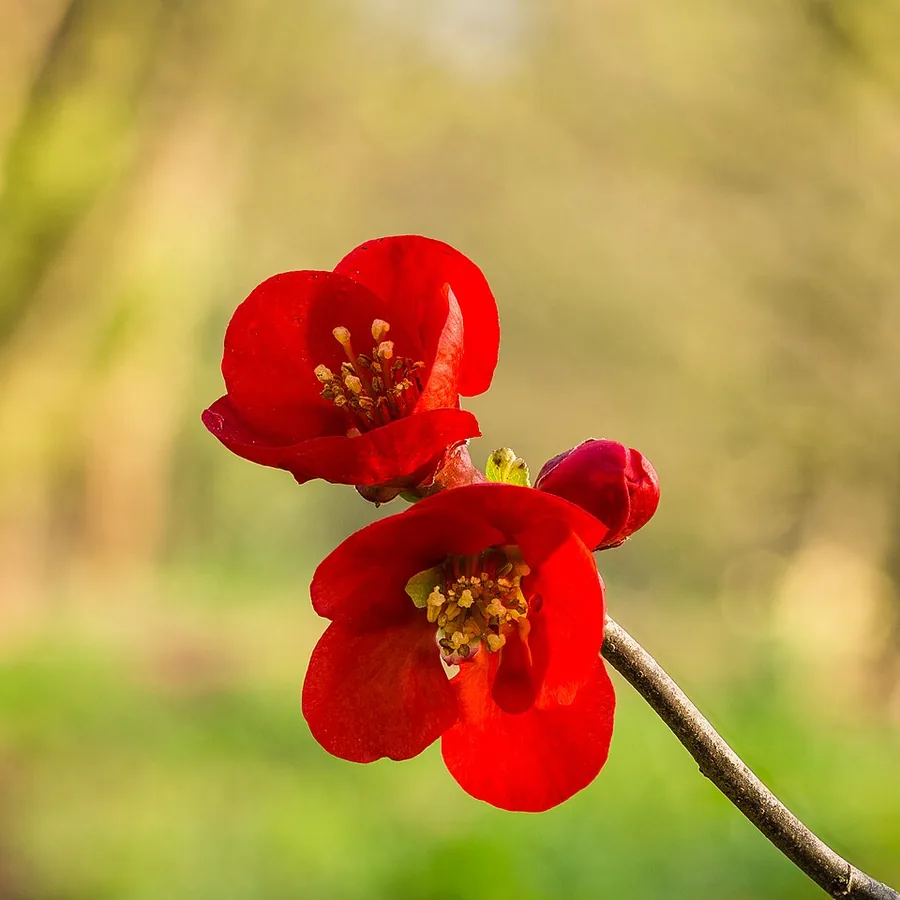
It is among the first shrubs to bloom each spring, scattering bright flowers along bare, leafless branches.
Full sun
Every 7–14 days
USDA 4–8
6–12 ft · 1.8–3.7 m
Overview
Flowering quince is a tough, deciduous shrub in the rose family, and its early spring flowers open straight onto bare wood, often before a single leaf unfurls. The five-petaled blooms come in red, pink, orange, and white, clustered tight against stiff stems that bristle with thorns and have held their color through cold down to -29°F (-34°C). After the petals drop, small, hard, apple-like fruits swell and ripen to a yellow-green through the fall.
Up close, the plant reads as all angles and density. The stems tangle and crisscross into a dense, 6 to 12 foot (1.8 to 3.7 m) mound, each branch armed with sharp spines, and the toothed green leaves fill in once the flowers fade. It grows at a moderate pace and shrugs off dry spells, rooting into clay, sand, or rocky ground, though alkaline soil washes the new leaves pale and yellow as iron locks away.
The thorns are the plant's defining texture, short and stiff and set close along the wood, which is why they make flowering quince a thicket-like barrier hedge and a tangle that nesting birds slip into. Give the stems room to arch and spread, set back from paths, and the only blade they ask for is a yearly trim once the last flower has fallen.
Care
The short version: full sun to part shade, well-drained soil that leans acidic to neutral, and water only through long dry spells once it is established. Prune right after the flowers fall, since next year's blooms form on this year's old wood.
Light
Give it full sun for the densest flush of bloom along the stems, though it takes partial sun or partial shade without much complaint. The more sun the wood catches, the more flowers crowd it come spring.
Water
Water a young plant every 7 to 14 days at medium soil moisture while the roots take hold. Once established it grows mildly drought tolerant, asking for water only through a long dry spell.
Soil
Plant it in well-drained loam, though the roots take to clay, sand, and rocky ground all the same. Keep the pH between 5.5 and 7.0, acidic to neutral, because alkaline soil bleaches the new leaves yellow and starves them of iron.
Temperature
This is a cold-hardy shrub that holds from -29°F to 95°F (-34°C to 35°C). Winter barely marks the wood, which is part of why the bare stems break into flower so early each spring.
Humidity
Ordinary outdoor air is all it needs, so there is no number to chase. Good airflow matters more, since crowded, damp branches give leaf spot and scab the moist surface they need.
Feeding
Feed it in early spring with a balanced slow-release shrub fertilizer or a layer of compost, once a season. Go light, since too much nitrogen pushes soft, sappy new shoots that fire blight and aphids both work over.
Pruning
Prune it right after flowering, because the blooms form on old wood and a later cut takes next year's flowers off the stem. Cut out dead, diseased, or crossing branches, shape the tangle lightly, and pull root suckers promptly to keep the thicket in check.
Repotting
An in-ground shrub never needs repotting, and even container plants are stepped up only rarely. Move to a larger pot when roots circle the drainage holes, water runs straight through, or a potted plant stops putting on growth.
Size & spacing
Expect a mature mound of stems 6 to 12 feet (1.8 to 3.7 m) tall and 6 to 10 feet (1.8 to 3 m) wide. Give it that full spread so air slips through the dense, thorny growth and disease stays down.
When to plant
Flowering quince sets its buds on old wood, so its whole year turns on that one fact. Plant it in spring or fall, watch the flowers open in early spring along bare stems before the leaves, and prune in the short window right after the petals drop. The hard, knobby fruit follows and ripens through the fall.
Northern hemisphere
Southern hemisphere
Typical months for a temperate climate: start earlier in warm zones, later where spring frosts linger.
- Plant: Spring or fall
- Harvest: Blooms early spring (roughly March to April), often before leaves emerge; hard apple-like fruit ripens in fall
Hardiness
USDA hardiness zones: 4–8
Temperature: down to -34°C
Troubleshooting
Most flowering quince trouble shows up in spring, when wet weather feeds disease and the soft, tender new shoots draw pests. Learn the early marks on leaf and stem below and you can step in before they spread. Match what you see, then act while it still helps.
Scorched shoot tips curved like a shepherd's staff
This is fire blight, a bacterial disease that runs through the rose family and slips in through the open flowers in spring. The shoot tips wilt, turn black, and hook over into the shape of a shepherd's crook while the dark dieback creeps down the stem. In dry weather, cut the blighted wood well below the damage, wipe your tools with bleach or alcohol between cuts, and burn or bin the prunings rather than composting them.
Fix:
- Prune out blighted wood 8 to 12 inches below visible damage during dry weather
- Disinfect pruning tools between cuts with 10 percent bleach or 70 percent alcohol
- Remove and destroy infected prunings; do not compost
Yellowed young leaves crossed by still-green veins
When the newest leaves pale to yellow while their veins stay a sharp green, the plant cannot draw up iron, and the usual cause is alkaline soil. Flowering quince simply will not tolerate a high pH. Test the soil, and if it reads alkaline, work the pH down toward neutral with organic matter and elemental sulfur over time. A dose of chelated iron greens the leaves back up while that slower fix takes hold.
Fix:
- Test and lower soil pH toward acidic to neutral
- Apply chelated iron as a short-term correction
- Amend with organic matter and elemental sulfur over time
Inky leaf spots with rough, corky patches over the fruit
Wet springs bring on fungal leaf spot and apple scab, which freckle the leaves with dark circles and roughen the fruit skin into corky, scabbed lesions. Bad cases shed leaves early. Rake up the fallen leaves and fruit, thin the crowded branches after flowering so air moves through, and reach for a labeled fungicide only when the infection runs heavy.
Fix:
- Rake up and dispose of fallen infected leaves and fruit
- Improve air circulation by thinning crowded branches after flowering
- Apply a labeled fungicide in spring if infection is severe
Warped soft shoots glazed in honeydew and flecked with insects
Soft, curling new shoots draw clusters of aphids, and bumpy scale can grip the stems and twigs as hard, immobile lumps. Both leave a sticky honeydew that blackens into sooty mold over the leaves. Blast the aphids off with a jet of water, coat the leaf undersides with insecticidal soap or horticultural oil, and treat stubborn scale with oil again. Stressed, over-fed plants take the worst of it, so keep the shrub healthy.
Fix:
- Spray off aphids with a strong jet of water
- Apply insecticidal soap or horticultural oil, covering leaf undersides
- Treat persistent scale with horticultural oil
Toxicity
There is nothing toxic to worry about here. Flowering quince appears on no pet poison list, and even the hard fruit is safe to eat once cooked. The only real hazard is physical, the sharp thorns that stud the stems and can scratch people and pets, so wear gloves to handle it and keep it clear of paths and play areas.
Safe for
People · Cats · Dogs · Horses · Rabbits · Livestock · Birds
Cats None
Nothing here threatens a cat. Flowering quince is not on the ASPCA toxic list, so a curious cat that bats at the leaves will not be poisoned. The only real risk is a scratch from the stiff thorns.
Dogs None
A dog that chews a leaf or a fallen fruit faces no poison from this shrub. Keep an eye on the sharp thorns instead, since those points can prick a nose or a paw.
Horses None
Nothing in the leaves, stems, or fruit poses a poisoning threat to a horse grazing nearby. The rigid thorns studding the branches are the sole concern, since they can rake a velvety muzzle.
Rabbits None
Rabbits can chew the foliage without any toxic effect. Around such thin-skinned little animals, the stiff spines on the woody stems are the single hazard worth watching.
Livestock None
Sheep, goats, and cattle take no poison from any part of the plant when they graze close by. Its tangle of spiny, tightly packed branches is the one reason to keep grazing animals back.
Birds None
Birds come to no harm from the plant or its fruit, and the thorny tangle even makes good nesting cover. There is no toxic part to keep them away from.
People None
Straight off the branch the fruit is rock-firm and puckering, yet cooking softens it into jelly or preserves with no risk of poisoning anyone. What can actually hurt you are the stiff spines along the stems, so cover your hands and forearms whenever you cut the plant back.
Stems bear sharp thorns and spines that can scratch or puncture skin, so wear gloves and long sleeves when pruning or handling, and site away from walkways and pet or play areas.
Varieties
A handful of cultivars stand out by the look of their flowers, from the classic multicolor bloom to modern thornless types that skip the fruit. These are the ones worth knowing by name.
'Toyo-Nishiki'
It opens red, pink, and white flowers at the same time, sometimes all three crowded onto one branch.
Double Take 'Pink Storm'
A thornless, fruitless type whose full double pink flowers, packed with 29 to 40 petals, look almost like camellias.
Double Take 'Scarlet Storm'
Another thornless, fruitless cultivar, this one set with rich double scarlet-red blooms.
Double Take 'Orange Storm'
It carries the same thornless, fruitless habit with double flowers in a deep, warm orange.
How to propagate
Flowering quince is easy to multiply, and you have three good routes, depending on how much patience you have and what the stems and roots give you to work with.
Stem cuttingsModerate
Mid-July to early fall for semi-hardwood cuttings · Several weeks to root, then transplant the following season
Take firm semi-hardwood cuttings of the current season's growth from mid-July into early fall, when the wood has stiffened but not gone fully hard, and dip the cut ends in rooting hormone to lift your odds. They root over several weeks, then settle in to be moved out the following season.
LayeringEasy
Spring through summer · Roots form over a season; ready to separate the following autumn or spring
Mound layering suits this low-stemmed, densely branched shrub, and you can start it anytime from spring through summer by burying the low stems. They root over a full season, ready to cut free and replant the following autumn or spring.
DivisionModerate
Dormant season (late fall to early spring) · One season to reestablish
This shrub throws up rooted suckers from its base, and during the dormant season, late fall to early spring, you can dig and split those off into new plants. Each division takes about a season to reestablish.
Myths
The foliage and stems of flowering quince are poisonous to pets.
Chaenomeles speciosa never appears on the ASPCA toxic-plant lists, and it is treated as non-toxic to both cats and dogs. The real household danger is the thorns, not poison. A pet that brushes against the spined stems can get scratched, but one that nibbles a leaf will be fine.
A fruit that hard and that puckering must be poisonous.
Raw, the fruit is rock-hard under the skin and mouth-puckeringly sour, which is exactly why people assume it is off-limits. It is perfectly edible once cooked, softening down into excellent jams, jellies, and preserves.