Vegetable · Brassicaceae
Romanesco
Brassica oleracea var. botrytis
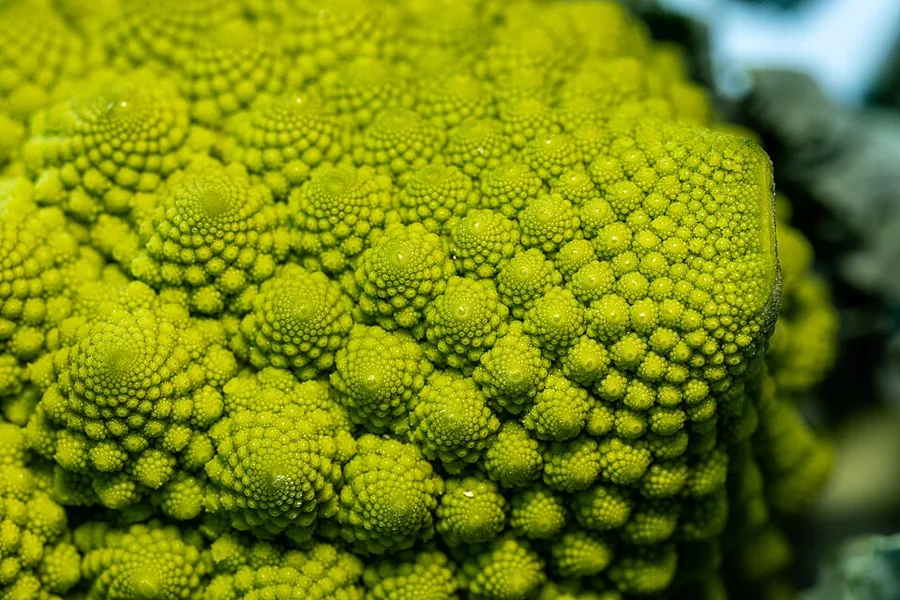
Each chartreuse head climbs in a spiral of pointed cones, one repeating inside the next.
Full sun
Every 5–7 days
50–70°F · 10–21°C
75–100 days
Overview
Up close, a Romanesco head is a spiral of pointed lime-green cones, and each cone is built from smaller cones that repeat down to the finest tip. The color runs a bright chartreuse across the whole head. It sits in the cabbage family beside cauliflower and broccoli, and on the tongue it carries a firm, sweet, nutty taste close to cauliflower. Broad outer leaves frame the head on every side.
The head is the whole show, and it forms cleanly only when the plant grows without a stall. It is the most demanding brassica for exactly this reason. Steady moisture, rich soil, and cool air let the curds knit into a tight, firm dome. Heat undoes that structure, spreading the cones apart into a loose, grainy surface, so the plant is grown as a fall crop to keep the head cool and compact while it forms.
A ready head feels solid and dense under the hand, the spiral packed tight before the cones begin to separate. It takes full sun on the curds to hold that clear green, since shade drains the color. Cut it while the surface is still smooth and closed, and what comes off the stalk is a head of pure geometry, sharp cones stacked into a living spiral.
Care
The short version: full sun on the curds, rich and evenly moist soil, and a feed every couple of weeks, all timed so the head fills into a tight green spiral in cool fall weather rather than summer heat.
Light
Romanesco needs full sun striking the curds, because that light is what pulls the head to its clear chartreuse. A little partial shade is tolerated, but the leaves are never tied over the curds as they are for white cauliflower. Shaded, the green fades toward a dull, washed tone.
Water
The soil is kept evenly moist, close to an inch of water a week, so the head never checks its growth. Let it dry and the surface buttons and roughens instead of filling smooth. Water reaches the ground in the morning so the broad leaves dry off and disease finds no damp footing.
Soil
Romanesco roots into fertile, well-drained soil dark with compost or well-rotted manure, moist but never sodden. A pH between 6.0 and 7.0 suits it. Toward the near-neutral end, that same soil holds back the clubroot that swells and distorts the roots.
Temperature
Cool air is written into the head itself. Between 50°F and 70°F (10°C to 21°C) the cones pack into a tight, firm spiral. Past the mid-80s the structure loosens, the cones drift apart, and the surface turns coarse and grainy.
Humidity
Plain outdoor air is enough, with no humidity level to meet. Air moving through the leaves counts for more, since a crowded, damp canopy of broad leaves grows the diseases brassicas carry. Space opens that canopy up.
Feeding
This is a heavy feeder that builds a large head. A feed every two weeks of a balanced or low-phosphorus fertilizer, set by a soil test, keeps it growing. Once the plants stand about 4 inches tall, a side-dressing of nitrogen such as calcium nitrate drives the leafy growth that fills the head.
Pruning
The head needs no cutting or shaping. It stays open to the sun so the curds hold their color, and only the outer leaves that go diseased or ragged with pest damage come off. The spiral itself is left whole until harvest.
Size & spacing
A plant stands 2 to 3 feet (60 to 90 cm) tall and spreads 18 to 30 inches (45 to 75 cm) across, its broad outer leaves reaching wide around the central head. Spaced to that full width, the leaves have room to spread and dry, and disease finds less purchase.
When to plant
The tight, closed spiral only forms in cool air, so timing shapes the whole head. Sow indoors 6 to 8 weeks ahead, then set plants out in cool early spring or, better, in mid to late summer so the cones pack together as fall cools the days.
Northern hemisphere
Southern hemisphere
Typical months for a temperate climate: start earlier in warm zones, later where spring frosts linger.
- Sow: Start seed indoors 6-8 weeks before the intended transplant date.
- Plant: Transplant in cool early spring, or (preferred) in mid- to late summer for a fall harvest; Romanesco is best grown as a fall crop.
- Harvest: Cut the head when it is full-sized, firm and tight, before the fractal spiral curds begin to separate or loosen.
Hardiness
USDA hardiness zones: 3–10
Temperature: down to -40°C
Troubleshooting
Trouble tends to write itself across the head and the leaves, in loosened cones, chewed holes, or browned curds. Those surfaces are the first place a problem shows. Match what you see below and act before the head loses its tight form.
No firm head, or one that opens into a loose, ricey curd
Heat pulls the cones apart, and once daytime temperatures pass 86°F (30°C) during heading the curd separates into a loose, grainy surface. A boron shortage adds brown flecks and keeps the curds from closing tight. A head timed for cool fall weather forms clean, and boron is corrected only where a soil test shows a lack.
Fix:
- Time the crop so heads mature during cool weather
- Correct boron deficiency per soil test
Wilting, stunted plants with swollen, distorted roots
Below a wilting plant, clubroot swells the roots into thick, misshapen clubs, or cabbage maggots tunnel pale channels through the root zone. A plant with either cannot recover and is pulled and destroyed. Soil brought toward neutral pH holds clubroot down, and a long rotation away from brassicas keeps it from massing in the ground.
Fix:
- Remove and destroy affected plants
- Raise soil pH toward neutral to suppress clubroot
A small, tight head forms early on an undersized plant
That miniature head is buttoning, a curd that forms too soon after almost any check to growth, from transplant shock to hunger to a dry spell. Old or cold-stressed seedlings set out too early are the common trigger. Even moisture, steady feeding, and well-timed transplanting keep the plant growing so the head waits until the plant is full.
Fix:
- Maintain even moisture and adequate fertility
- Avoid transplanting overgrown or cold-stressed seedlings
Chewed holes across the leaves with green caterpillars feeding
The holes are the work of velvety green cabbageworms and cabbage loopers grazing the leaf surface, while tiny flea beetles pit young seedlings with pinprick shot holes. Handpicking the caterpillars and draping floating row covers early keep the leaves whole. A heavy run of caterpillars falls to Bacillus thuringiensis, which spares everything else.
Fix:
- Handpick caterpillars
- Use floating row covers
- Apply Bacillus thuringiensis for caterpillars if needed
Toxicity
Every part of Romanesco is safe to eat, from the broad outer leaves to the spiraling head. Nothing in the leaves, stems, or curds is toxic to people or pets, so it is fine around cats, dogs, rabbits, and chickens. The only mild note is that a lot of raw brassica can leave some animals gassy.
Safe for
People · Cats · Dogs · Horses · Rabbits · Livestock · Birds
Cats None
For cats there is nothing toxic in the broad leaves, the stem, or the spiraled head. A nibble on a leaf brings, at most, a little gas.
Dogs None
Dogs face no toxin in any part of the plant. A few plain cooked florets, snapped from the head, make a fine treat, though a large helping of raw brassica can leave a dog gassy.
Horses Safe
The plant is not poisonous to horses. Brassicas sit outside their natural diet, so only small amounts of leaf or head suit them without an upset stomach.
Rabbits Safe
Rabbits can eat the leaves and the green florets safely, and both make a good green. A slow introduction lets the gut adjust to them.
Livestock Safe
As forage it carries no toxin. The single watch-point is heavy, steady grazing of brassicas, since the natural goitrogens build up in the body over time.
Birds Safe
Backyard poultry pick freely at the leaves and the curds with no harm. No part of the plant, leaf or head, puts them at risk.
People Safe
For people the whole plant eats well, the tight head and the tender leaves alike, raw or cooked. It is a nutritious vegetable with nothing to guard against.
Safe to handle and grow around pets and children. Note that brassica glucosinolate goitrogens are mainly a concern for heavily-grazed livestock, not household pets.
Varieties
Two Romanesco types reach most seed catalogs, and each shows the pointed, spiraling head. Their differences are set out here.
Veronica
A hybrid that forms even, uniform heads in bright lime-green, their spirals sharp and cleanly cut.
Romanesco Italia
An open-pollinated heirloom with pointed apple-green spirals on tall plants, carried over a long season.
How to propagate
A Romanesco plant only comes from seed, never from a cutting. Each spiraling head traces back to a single seed started in a tray indoors.
SeedModerate
Sow indoors 6-8 weeks before transplanting; transplant when seedlings have 4-5 true leaves. · About 4 weeks from sowing to transplant-ready seedling, then 75-100 days to a mature head.
A Romanesco head grows only from seed, never from a home cutting, so each spiral begins as a seed in a tray. Seed goes indoors 6 to 8 weeks before transplanting, and the seedlings move out once they show 4 to 5 true leaves, about 4 weeks on. The head then takes a long 75 to 100 days to swell into a full, tight spiral ready to cut.
Myths
Romanesco heads must be blanched by tying the leaves over them like white cauliflower.
White cauliflower is blanched because it stays pale only in shade, and Romanesco behaves in the reverse. Its chartreuse curds need full sun to color up, so the leaves stay untied and the spiral stays open to the light. Cover it and the green only dulls.
Romanesco is a genetically engineered cross of broccoli and cauliflower.
The head is a traditional Italian cultivar of Brassica oleracea, sitting in the same cauliflower and broccoli group as those crops. It is an old heirloom, not a GMO, and its spiraled form has been grown for generations.