Shrub · Rosaceae
Raspberry
Rubus idaeus
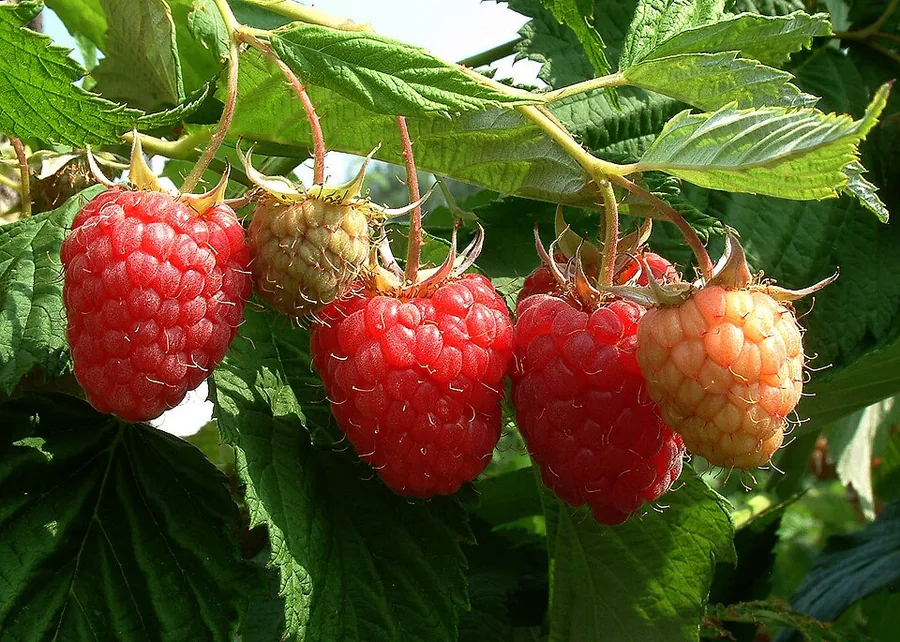
Upright, prickle-studded canes hang heavy with red raspberries once full sun and a yearly prune have done their work.
Full sun
Every 3–7 days
59–77°F · 15–25°C
USDA 3–8
Overview
Seen up close, the raspberry is all upright canes, tall stems that rise 3 to 6 feet (90 to 180 cm) in a crowded stand and carry rows of sharp prickles down their length. It is a rose-family shrub from the cooler parts of the world, hardy from zone 3 through zone 8. Fresh shoots keep rising from the soil around the base, so the clump grows denser and broader each year.
Look at the canes and you can read the plant's two forms. On summer-bearing raspberries the red fruit hangs from year-old wood, the floricanes, ripening early to midsummer. On everbearing types the berries load onto this season's new canes, the primocanes, coloring up from late summer into fall.
The fruit ripens to red and comes away from the cane in the hand, soft enough that an overripe berry turns to mush at a touch. The leaves are green and clearly veined, quick to yellow between those veins when something is off in the soil. Every stem, meanwhile, is guarded by sharp prickles that make bare-handed picking a scratchy business.
Care
The short version: give the canes full sun, deep and faintly acidic soil worked with compost, and about an inch of water a week. Prune to the cane type yearly, and either pen the spreading roots in or leave them room, so the red-fruited stand holds its ground.
Light
Set in full sun, six hours or more of direct light a day, the canes stand stout and upright and set a heavy crop. Starved of light in shade, they draw up thin and leggy and carry far fewer berries.
Water
The canes drink about an inch of water a week, more as the berries swell and color. Kept evenly moist the fruit stays firm; left in waterlogged ground the roots rot and the berries turn soft and slack.
Soil
Sink the roots into deep, well-drained loam dark with organic matter. The plant reads the chemistry in its leaves: at a pH of 5.6 to 6.5 the new foliage stays green, but let the soil turn alkaline and those young leaves pale to yellow.
Temperature
Cool to mild air, 59°F to 77°F (15°C to 25°C), keeps the canes and fruit in good form. The bare winter canes take hard cold down to zone 3, while a blast of summer heat wilts the plants and scorches the ripening berries.
Humidity
Humidity sits easily at 40% to 70%, nothing you would notice on the plant. Airflow shows itself more plainly, since dead, damp air trapped in a thicket of canes lets fuzzy gray mold bloom on the fruit.
Feeding
A single early-spring feed as the buds stir, a balanced fertilizer such as 10-10-10 or a dark layer of aged compost or manure, colors the canes up for the year. That one feeding is all a full crop asks for.
Pruning
Which canes you cut depends on the type. On summer-bearing plants the fruited floricanes are cleared away after harvest and the fresh primocanes thinned; everbearing types are cut flat to the ground in late winter, leaving bare soil that sends up new canes for one fall crop.
Repotting
Raspberries are ground plants, their roots ranging too far for a pot, so repotting rarely comes up. A container-grown one shows when it has had enough: roots circling the inside and soil that dries out almost as fast as you wet it.
Size & spacing
A mature clump runs 3 to 6 feet (90 to 180 cm) of upright cane and fans 2 to 4 feet (60 to 120 cm) wide at the base. Set the rows apart and tie the canes to a trellis, both to move air through the stand and to hold those prickled stems off your arms.
When to plant
Raspberries go in as bare, dormant canes, leafless sticks set out before the buds break in spring. Planted in early spring, those sticks leaf out and, by the type, hang with red fruit from early summer into fall.
Northern hemisphere
Southern hemisphere
Typical months for a temperate climate: start earlier in warm zones, later where spring frosts linger.
- Plant: Early spring while plants are still dormant
- Harvest: Summer-bearing types ripen early to midsummer; everbearing types crop late summer into fall
Hardiness
USDA hardiness zones: 3–8
Temperature: down to -40°C
Troubleshooting
Raspberry trouble is a visible thing, written on the fruit, the canes, or the youngest leaves. A furred berry, a ringed cane, a leaf gone yellow between its veins, each has a clear look and a quick fix. Match the picture below, then act before it spreads down the row.
Berries gone soft under gray fur
A berry that caves in soft under a coat of fuzzy gray growth has gray mold, the fungus Botrytis cinerea, thriving in wet air among packed canes. The gray-brown spores powder over the fruit and race from berry to berry once it is picked, so soft ones are pulled off and binned. Thinning the canes opens the air, and watering at the base keeps the fruit dry.
Fix:
- Remove and discard infected berries promptly
- Harvest frequently and keep fruit dry
- Improve air circulation by thinning canes
Wilting tips above a pair of scars
A cane tip that droops above two neat rings scored around the stem marks the raspberry cane borer; dark, sunken patches at the nodes read instead as a cane disease like spur blight. The scarred cane is cut well below the marks and destroyed, and wild brambles nearby are pulled out. A yearly clearing of old and infected canes, with the rows kept narrow, keeps both off the stems.
Fix:
- Cut and destroy affected canes below the damage
- Remove all wild brambles nearby
- Maintain open, thinned plantings
Newest leaves pale, veins still green
When the youngest leaves fade to yellow while a green net of veins stays sharp against them, the plant is showing iron chlorosis from soil gone too alkaline. A soil test names the high pH, and chelated iron greens the leaves back up while the ground is put right. Digging in organic matter and easing the soil to a pH of 5.6 to 6.5 fixes it for good, with less lime.
Fix:
- Test soil and acidify toward pH 5.6 to 6.5
- Apply chelated iron as a short-term correction
- Incorporate organic matter
Toxicity
Nothing on the raspberry carries a toxin, from the red fruit to the green leaves to the woody canes, so an eaten berry or leaf does no harm to animals or people. The single hazard is one you can see and feel: the sharp prickles that stud the canes and catch at skin.
Safe for
People · Cats · Dogs · Horses · Rabbits · Livestock · Birds
Cats None
Not a part of the raspberry is poisonous to a cat, so a leaf chewed or a red berry stolen does nothing. The prickles are all there is to mind, sharp enough to score a curious nose.
Dogs None
A dog may swallow the ripe red berries without any harm, and the leaves and woody canes are just as safe. The sharp prickles on the canes are the one real hazard.
Horses None
A horse can crop the leaves and red fruit safely, with no toxin anywhere in the plant. The thorny canes are worth a fence so their points miss a soft muzzle.
Rabbits None
Rabbits work through the leaves and berries without harm, and many go for the green foliage first. The prickly stems are the lone thing to keep them off.
Livestock None
Cattle, goats, and sheep can strip the leaves and fruit safely, since no part of the plant holds a toxin. Only the prickles are worth watching.
Birds None
Birds strip the ripe red berries fast and drop the seeds far across the ground. Nothing on the plant can harm them.
People None
People eat the red berries fresh and can take the whole plant safely, leaves and all. The prickles ranked along the canes are the only thing to guard against, so gloves help at pruning and picking.
Most raspberry canes are armed with sharp prickles/thorns that can scratch or puncture skin; wear gloves and long sleeves when pruning or harvesting.
Varieties
Of the hundreds of raspberries grown, a few hardy reds show up again and again, red-fruited and cold-tough. These are the ones to know by sight and name.
Heritage
An everbearing red whose first-year canes color up with a dependable fall crop.
Latham
A summer-bearing red heirloom, hardy through cold winters and grown for generations.
Boyne
A summer-bearing red so cold-hardy its canes fruit in the far northern zones.
Caroline
A vigorous everbearing red hung with large, full-flavored berries deep into fall.
Companions
Raspberries do best beside aromatic plants that push pests away, and worst near their nightshade neighbors, which trade soilborne wilt back and forth.
Plant near
Garlic: Aromatic alliums may help deter some pests around the planting.
Marigold: Often interplanted to discourage nematodes and some insect pests.
How to propagate
Raspberries make more of themselves in plain view: red types shove up rooted suckers around the crown, while the black and purple kinds bow their long cane tips down to the ground to root.
DivisionEasy
Early spring or fall while dormant · One growing season
The plainest increase is by the suckers: rooted shoots that spring up around the crown, dug out in early spring or fall while the plant is leafless and dormant. Replanted, the offsets take root and fill out within one growing season.
LayeringModerate
Late summer · One season to root
The black and purple kinds root from their own cane tips. In late summer a long, arching cane is drawn to the ground and its tip buried, and over the season that buried tip grows roots and becomes a new plant to cut away.
Stem cuttingsModerate
Spring to early summer · Several weeks to root
Root cuttings and softwood cuttings will also take, lifted from spring into early summer and striking roots in several weeks. Few bother, though, when the suckers hand over ready-rooted plants for far less work.
Myths
Raspberries are toxic to dogs and cats.
Nothing about the plant is poisonous, from the red berries to the leaves to the canes, so cats and dogs can take a mouthful with no harm. The only real hazard is the prickles, the sharp points on the canes that can score a nose or paw.
Every raspberry cane should be cut down each winter.
That suits the everbearing types, whose fruit rides on first-year canes that can be mowed flat. Summer-bearing types fruit on second-year canes, though, so cutting every stem down strips away the berries the next summer would have carried.