Shrub · Rosaceae
Shrubby Cinquefoil
Potentilla fruticosa
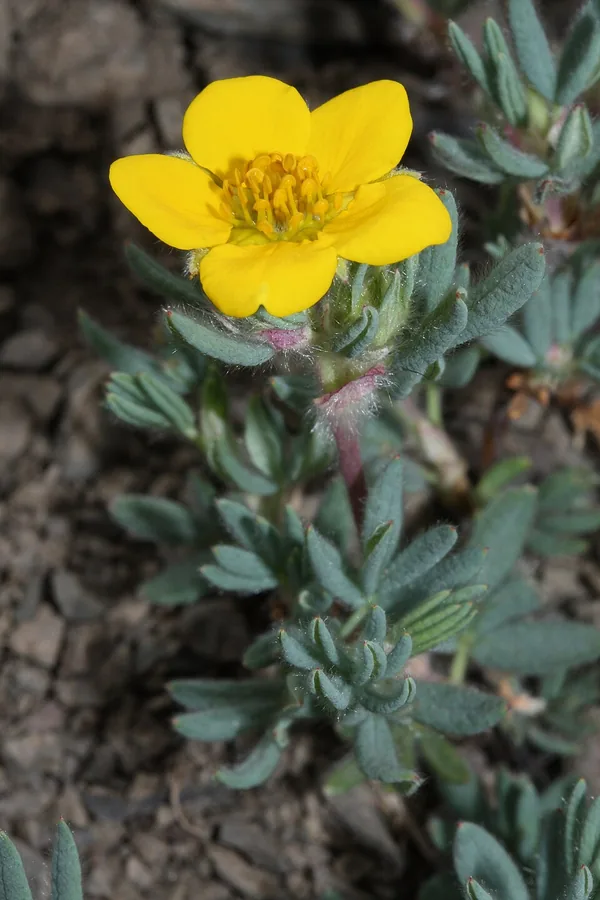
Simple five-petaled flowers in buttery yellow scatter across the fine foliage of shrubby cinquefoil from June to September.
Full sun
Every 7–14 days
USDA 2–7
2–4 ft · 0.6–1.2 m
Overview
Shrubby cinquefoil is a small, rounded deciduous shrub, and up close the appeal sits in the details. Its flowers are simple and open-faced, each formed of five buttery-yellow petals, and they scatter across the fine-textured foliage from June through September. The plant itself is fine and low, a rounded dome of woody stems that reaches only 2 to 4 feet (61 to 122 cm) tall.
Look past the flowers and the foliage carries its own quiet texture, fine and small-leaved across the whole rounded mass. The stems are woody, and they build a dome that spreads wider than it stands. Cold-hardy to USDA zone 2, it wears the same fine, dense character whether it grows in poor, sandy, alkaline, or clay ground. In cultivars the petals shift from the classic yellow into white, pink, and orange, though the plain five-petaled shape stays the same.
The color is the part most sensitive to its surroundings. In a hot summer the yellow washes pale and the flowers lose their depth, while cool-summer air keeps the petals saturated and clean. Given full sun, the flowers open thickest across the fine canopy, and a hard spring cut keeps that canopy tight and full.
Care
The short version: full sun, average well-drained soil, and a hard cut in late winter or early spring keep the rounded, fine-textured shrub at its best. It needs little feeding, tolerates drought once established, and a cool summer keeps the petals deep and clean for months.
Light
In full sun the flowers open thickest, studding the fine canopy from top to sides. Under partial shade or partial sun the blooms grow sparse and the woody stems stretch and loosen, opening gaps in the once-dense dome.
Water
Young plants need steady moisture while the fine root system takes hold. Once settled, the shrub turns notably drought tolerant, drawing through long dry spells with the foliage still fine and intact, and wants water only when the top half of the soil has dried.
Soil
The plant holds its fine, rounded form across almost any footing. Average, well-drained soil suits it, and it keeps the same dense character in clay, loam, sand, and poor or alkaline ground, across a pH from 5.5 to 8.0.
Temperature
The woody frame endures cold from -49°F (-45°C) to about 86°F (30°C) without visible harm. Heat shows instead in the petals: a long hot spell drains the color from the flowers, so cool-summer air keeps them deepest.
Humidity
The fine foliage stays cleanest in dry, moving air. Low humidity with good airflow keeps the small leaves unmarked, while humid, stagnant air leaves them open to the spotting of leaf spot and the white film of mildew.
Feeding
The plant flowers freely without much feeding. A balanced general-purpose fertilizer or a little compost in early spring keeps the foliage full, and even on lean soil the fine canopy still fills with bloom.
Pruning
The flowers form on fresh new wood, so a hard cut or shear in late winter to early spring clears the old woody stems and pushes a dense flush of new growth. That fresh growth carries the bloom and holds the rounded, compact dome, with any leggy or ragged stems taken out in the same cut.
Repotting
In the ground the woody roots never need repotting, and in a container they rarely do. A larger pot is due only when roots circle the sides, water runs straight through, or the fine top growth stalls.
Size & spacing
The mature shrub forms a rounded dome about 2 to 4 feet (61 to 122 cm) tall and noticeably wider, spreading to 3 to 5 feet (91 to 152 cm) across. Given that width, the fine, dense canopy closes into a full, even mound.
When to plant
This cold-hardy shrub fills a long northern season with fine foliage and small flowers. Set young plants out in spring after frost, or in early fall, then cut the woody stems back hard in late winter so a dense new canopy carries the flowers from June into September.
Northern hemisphere
Southern hemisphere
Typical months for a temperate climate: start earlier in warm zones, later where spring frosts linger.
- Sow: Late winter (stratified seed), 8-10 weeks before last frost
- Plant: Spring after last frost, or early fall
- Harvest: June to September
Hardiness
USDA hardiness zones: 2–7
Temperature: down to -46°C
Troubleshooting
Most of what shows up on shrubby cinquefoil is written on the plant itself, in the color of the leaves and the shape of the flowers. The trouble usually traces to heat, humidity, or a missed spring cut. Match the look of the foliage or blooms below, then act while it still helps.
Stippled, bronze-tinted leaves under fine webbing
The fine leaves turn stippled and bronze-tinted, veiled in a thin webbing, which is the signature of spider mites feeding in hot, dry, stagnant air and pulling the color from the foliage. Tap a stem over white paper and the tiny specks show as moving dots. A hard jet of water across the leaf undersides and better airflow knock them back, with insecticidal soap or horticultural oil held for a heavy infestation.
Fix:
- Spray foliage with a strong jet of water, focusing on leaf undersides
- Improve air movement and avoid hot, stagnant, dry locations
- Apply insecticidal soap or horticultural oil if infestation is heavy
Dark speckling or a white bloom across the leaves
Discrete dark specks across the leaves mark fungal leaf spot, while a dry white bloom dusting the surface is powdery mildew, both settling on the fine foliage in humid, still air. Strip the marked leaves and discard them, keep water off the surface, and thin the stems so air moves through, and the foliage clears.
Fix:
- Remove and dispose of affected foliage
- Avoid overhead watering and wetting foliage
- Thin or prune to improve air circulation
Pale, thin flowers over a bare, woody base
The petals turn pale and thin while the base of the shrub grows woody and open, a look driven by summer heat bleaching the flower color and a spring cut that was skipped. A hard shear in late winter to early spring renews the flowering wood and refills the canopy. On pink and red cultivars the color holds far deeper where summers stay cool.
Fix:
- Shear or prune hard in late winter to early spring to renew flowering wood
- Site in cooler, sunny locations; pink and red cultivars hold color better in cool climates
Toxicity
Behind its fine looks, this shrub carries nothing harmful. The ASPCA lists cinquefoil as non-toxic to cats, dogs, and horses, and no part of the plant, leaf, stem, or flower, poses a hazard to other animals or people. It can be grown anywhere in the garden.
Safe for
People · Cats · Dogs · Horses · Rabbits · Livestock · Birds
Cats None
A cat that nibbles a leaf or petal meets no toxin and comes to no harm.
Dogs None
A dog can chew the stems or brush the foliage with no risk of poisoning.
Horses None
Horses can graze beside it unharmed, as the ASPCA lists cinquefoil non-toxic to them.
Rabbits Safe
Rabbits can browse the fine foliage with no toxicity to fear.
Livestock Safe
Cattle, goats, and sheep can crop the plant safely.
Birds Safe
Birds picking through the stems face no danger from it.
People Safe
Safe to handle leaf, stem, and flower, and safe around children, though it is grown to look at rather than to eat.
No special handling precautions for toxicity; wear gloves if desired when pruning woody stems.
Varieties
The classic five-petaled yellow is only the start, and the named cultivars carry the same simple flower shape in a wider set of colors. These are the ones you will meet most often.
'Abbotswood'
Its pure white petals stand out sharply against distinctly cool blue-green leaves.
'Goldfinger'
Large, deep golden-yellow blooms crowd the compact mound over a long stretch.
CHEESEHEAD ('SMPFMY')
Bright yellow flowers sit over a tight, rounded mound of fine foliage.
Happy Face Pink Paradise
Soft pink petals that keep their color far deeper through cooler summers.
How to propagate
More of this fine-stemmed shrub is easy to raise, whether you strike a cutting, split a woody clump, or grow seed and watch the seedlings vary.
Stem cuttingsEasy
Softwood cuttings in late spring to summer · 4-8 weeks to root
Cuttings root the most readily. Take softwood or semi-hardwood pieces in late spring to summer, hold them under humidity, and fine new roots form in about 4 to 8 weeks.
SeedModerate
Sow stratified seed in late winter to early spring · Several weeks to germinate; cultivars do not come true from seed
Seed is slower and less certain. After a cold stratification, sow in late winter to early spring and the seedlings emerge over several weeks, but named cultivars do not come true from seed, so their flowers vary from the parent.
DivisionEasy
Spring or early fall · One growing season
A woody clump can be divided in spring or early fall. Lift the plant or a rooted sucker, pull a section free with its roots, and replant it to knit in over one growing season.
Myths
Those bright open flowers must mean shrubby cinquefoil is toxic to pets, like many blooming shrubs.
The flowers are as harmless as they are pretty. The ASPCA lists cinquefoil, Potentilla spp., as non-toxic to cats, dogs, and horses, so no petal, leaf, or stem holds a toxin, and a curious nibble does no harm.
Prune potentilla right after the flowers fade, the way spring-blooming shrubs are cut.
Cutting then strips away next year's flowers, because the blooms form on new wood. A hard shear in late winter to early spring instead fills the fresh canopy with the densest flowering.