Ornamental · Solanaceae
Nicotiana
Nicotiana alata
Grown for the night-scented flowers, slim trumpets that open at dusk across the summer garden.
Full sun
Every 3–7 days
50–86°F · 10–30°C
55–75 days
Overview
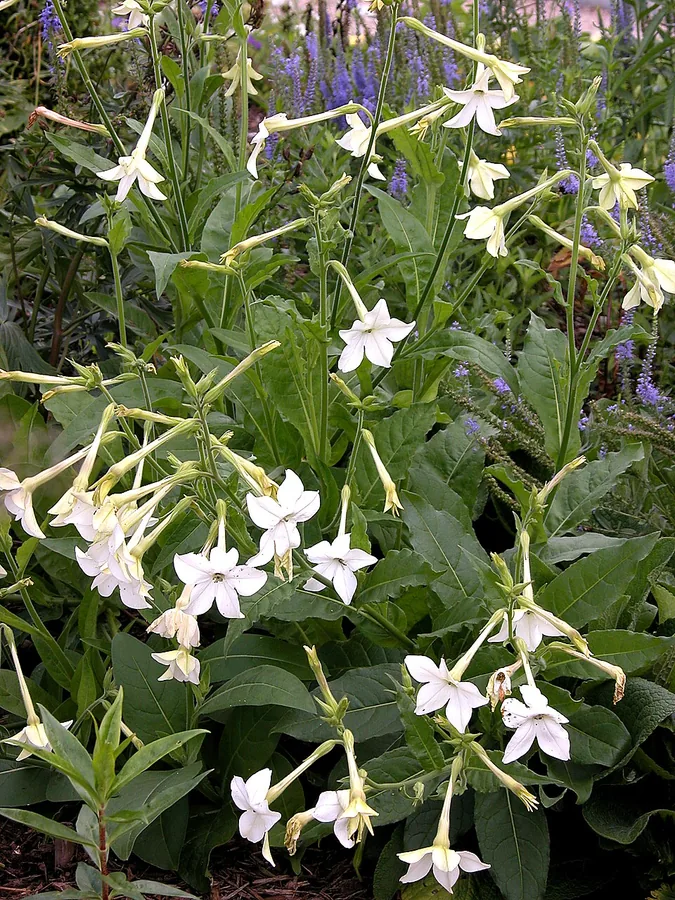
Nicotiana, better known as flowering tobacco, is a fast-growing garden annual in the nightshade family and a relative of the tomato and pepper. Its long, slender tubular flowers stay closed through the day and swing open at dusk, when they pour out a sweet, jasmine-like scent. The perfume settles over the plant once the sun goes down and the trumpets flare wide.
It stands tall and upright, reaching 3 to 5 feet (91 to 152 cm) in the heirloom forms, its airy clusters of white, lime-green, and colored trumpets held aloft over broad, sticky leaves that catch on the fingers. Warm zones let it persist as a tender perennial, though most gardens raise it as an annual from fresh seed each spring. Left alone, it often self-seeds and pushes up again on its own.
For all the beauty of those flared trumpets, flowering tobacco carries a real warning. Every leaf, stem, and flower holds nicotine and related alkaloids, which makes the whole plant toxic to people, pets, and grazing animals. It rewards a close look and a deep breath of its scent, and never a taste.
Care
The short version: full sun to a little afternoon shade, steady moisture in rich soil, and a monthly feed through the season, with spent flowers deadheaded to keep the bloom coming.
Light
Nicotiana grows sturdiest and flowers thickest in full sun, its stems standing straight and dense with buds. It takes partial shade as well, and afternoon shade helps where summers are hot, since the broad leaves fade and scorch fast under baking sun.
Water
The soil stays evenly moist, watered once the top begins to dry, usually every 3 to 7 days. Drought tolerance is low, so the leaves go limp and the plant stalls in a dry spell when it bakes out between waterings.
Soil
It roots into organically rich, well-drained soil that holds moisture without turning soggy. A slightly acidic pH of 5.5 to 6.5 suits it, and a good helping of compost feeds the fine roots that anchor the tall stems.
Temperature
Flowering tobacco grows across a wide band, roughly 50°F to 86°F (10°C to 30°C). It is tender, so frost blackens and ends it, and the foliage tends to slump and decline once the height of summer heat sets in.
Humidity
Ordinary outdoor humidity is enough, so there is no target to hit. What matters more is steady soil moisture and open airflow moving around those broad, sticky leaves.
Feeding
It feeds monthly through the growing season on a balanced fertilizer made for flowering annuals. That regular boost keeps a fast grower like this one throwing up fresh green shoots and new buds rather than running out of steam.
Pruning
Deadheading the spent trumpets keeps new ones opening, and pinching young plants makes the stems branch and fill out bushy. A leggy plant, or one flagging in midsummer heat, cut back hard, usually pushes out fresh growth.
Size & spacing
Plants reach 3 to 5 feet (91 to 152 cm) tall and spread 12 to 24 inches (30 to 61 cm) wide, broad-leaved and upright. That much room per plant lets air move through the foliage and gives the tall stems space to stand straight.
When to plant
Nicotiana is a frost-tender annual, so the calendar matters. The seed starts indoors in late winter, the young plants move out only after the last frost passes and the soil warms, and the trumpets open from early summer right through to the first frost of fall.
Northern hemisphere
Southern hemisphere
Typical months for a temperate climate: start earlier in warm zones, later where spring frosts linger.
- Sow: 6 to 8 weeks before the last spring frost; seed needs light and should be surface sown
- Plant: After all danger of frost has passed and soil has warmed in late spring
- Harvest: Blooms from early summer (June) until first fall frost; fragrant tubular flowers open at night
Hardiness
USDA hardiness zones: 10–11
Temperature: down to -1°C
Troubleshooting
Most trouble with flowering tobacco writes itself onto the leaves, whether from a virus, chewing insects, or heat, showing up as mottling, holes, or a limp droop. Reading those early marks lets you act before the damage spreads across the plant. Match what you see below, then treat it while it still helps.
Mottled mosaic patterning across shrunken leaves
Leaves marbled in light and dark green, puckered along the surface and locked at a stunted size, carry tobacco mosaic virus, which travels in from nearby nightshade vegetables or on hands that touched them. No cure reverses that mottling, so an affected plant is pulled and destroyed. Hands and tools are washed, and new plantings are set well clear of tomatoes and peppers.
Fix:
- Remove and destroy infected plants
- Wash hands and disinfect tools after handling
- Avoid planting near tomatoes, peppers and other Solanaceae
Ragged chewed holes torn through leaves and flowers
Irregular holes bitten clean through the broad leaves and the tubular flowers mark the feeding of beetles and other chewing insects, which are busiest in warm weather. Picking them off the foliage by hand clears them at the source. A labeled insecticide comes into play only when the chewing turns heavy.
Fix:
- Handpick beetles
- Use an appropriate labeled insecticide or insecticidal control if infestation is heavy
Leaves and stems drooping and fading in the heat
The broad leaves go limp and the tall stems bow when drought and intense summer heat take hold, since nicotiana carries little tolerance for either. Even soil moisture keeps the foliage turgid, and a layer of mulch holds that water at the roots. In hot southern gardens, afternoon shade spares the leaves from scorching.
Fix:
- Keep soil consistently moist
- Provide afternoon shade in hot southern climates
- Mulch to conserve soil moisture
Sticky sheen over insect-crowded new growth
Tiny soft-bodied insects packed tight over the buds and along the leaf undersides are aphids, and the glossy film they leave is honeydew. A hard spray of water strips most of them from the stems. Insecticidal soap or horticultural oil clears any that crawl back over the new growth.
Fix:
- Wash aphids off with a strong spray of water
- Apply insecticidal soap or horticultural oil if needed
Toxicity
This plant belongs out of reach. Every leaf, stem, and flower of flowering tobacco holds nicotine and related alkaloids, and eating any of it can poison cats, dogs, horses, rabbits, birds, livestock, and people alike. The usual signs are drooling, vomiting, and tremors, with dangerous effects on the heart and breathing when a lot goes down, so keep it well away from pets, grazing animals, and small children.
Toxic to
Cats · Dogs · Horses · Rabbits · Livestock · Birds · People
Cats Severe
A cat that bites into the sticky leaves or a flower may turn jittery and then sink into a slump, with drooling, vomiting, and an unsteady walk. Larger amounts move on to tremors, a racing heart, weakness, and, at the worst, collapse.
Dogs Severe
Dogs tear at the broad leaves and stems, and the nicotine acts quickly once they do. Drooling, vomiting, a wobbly gait, and tremors come first, and a large mouthful can bring on a pounding heartbeat, weakness, and even paralysis.
Horses Severe
A horse that grazes the foliage may grow agitated before turning dull and weak. Vomiting, stumbling, and muscle trembling follow, and a heavy dose is genuinely dangerous.
Rabbits Toxic
The nicotine that saturates every leaf and stem is unsafe for rabbits. Even a small nibble can leave one drooling, off its food, and shaky, so flowering tobacco stays entirely out of reach.
Livestock Severe
Cattle, sheep, and goats poisoned by the nicotine and anabasine show weakness, tremors, and a staggering gait, and severe cases end in respiratory failure. Pregnant animals are at added risk, since the alkaloids can twist developing limbs into crooked-calf deformities.
Birds Toxic
The alkaloids that load every leaf, stem, and seed reach birds as well. A bird that pecks the foliage or seed can grow weak, lose its balance, and struggle to breathe, so flock and pet birds stay away from it.
People Caution
No part of flowering tobacco is edible, and swallowing the leaves, flowers, or seed delivers a real dose of nicotine. Nausea, vomiting, and drooling follow, with tremors and dangerous effects on the heart and breathing if more goes down, so curious children stay well clear.
Keep all plant parts away from pets, children, and grazing animals; wash hands after handling.
Helpline numbers

United States
ASPCA Animal Poison Control: (888) 426-4435 (fee applies)
Poison Control: (800) 222-1222



Canada
Poison Centres: 1-844-764-7669
Varieties
Flowering tobacco comes in several distinct strains, their trumpets ranging from towering night-scented white heirlooms to compact day-blooming hybrids in mixed colors. These are the ones most often found.
Lime Green
Its blooms glow an unusual chartreuse to yellow-green, a cool acid shade that florists slip into arrangements.
Grandiflora
A tall heirloom whose very fragrant white flowers unfurl once darkness falls.
Nicki Series
A compact hybrid of about 1 to 2 feet, its flowers spanning a wide range of colors and holding open through the day.
How to propagate
Nicotiana rises almost entirely from its fine seed, and it scatters enough of it that plants often reappear on their own the following year.
SeedModerate
Start indoors 6 to 8 weeks before the last frost or direct sow after frost; surface sow because seed needs light to germinate · Germination in about 1 to 2 weeks, with blooming plants in roughly 2 to 3 months from sowing
Nicotiana rises easily from seed, which is fine and dustlike. The sowing goes indoors 6 to 8 weeks before the last frost, or straight into warm ground once frost has passed, with the seed left resting on the surface rather than buried, since light triggers germination. Green seedlings break the surface within about 1 to 2 weeks and swell to flowering size in roughly 2 to 3 months, and a settled plant often self-sows, seeding itself back the following year.
Myths
Flowering tobacco is a harmless ornamental because it is not the smoking tobacco plant.
It is a true Nicotiana, and nicotine with related alkaloids runs through every leaf, stem, and flower. Eating any of it can poison people, pets, and livestock, so the bright trumpets warrant the same caution as any toxic plant.
Nicotiana flowers are fragrant and showy all day long.
The slender tubular flowers stay furled by day and swing open at evening, spilling scent across the garden after dark. Each bloom lasts only a single night, though fresh trumpets keep opening through the season.