Shrub · Ericaceae
Lingonberry
Vaccinium vitis-idaea
Give it acidic soil, full sun, and steady moisture, and this low evergreen carpet studs itself with two crops of tart red berries a year.
Full sun
Every 3–5 days
USDA 2–7
4–16 in · 10–40 cm
Overview
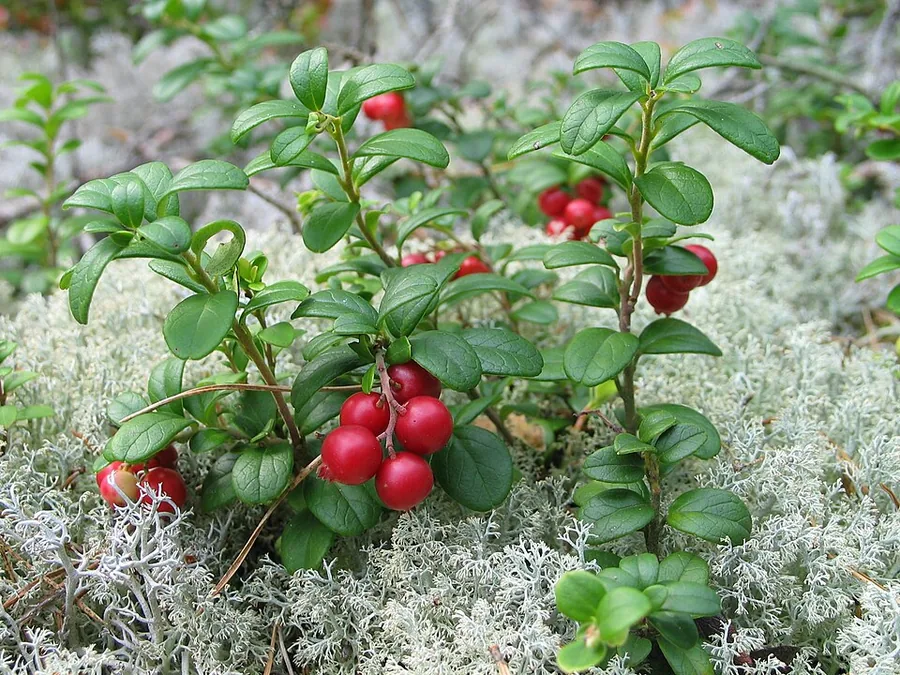
Lingonberry is a low, spreading evergreen from the heath family, kin to blueberries and rhododendrons. It hugs the ground at just 4 to 16 inches (10 to 40 cm) tall, its wiry stems set with small, oval leaves that are firm and leathery, deep green and glossy on top and paler beneath, packed close into a dense mat. Along the stems small bell-shaped flowers open in pale pink to white, then give way to round berries that ripen to a bright, shiny red with a sharp, tart bite that softens in the kitchen.
The plant carries that glossy, evergreen look year-round, holding its firm little leaves right through the cold. These plants only thrive in acidic, well-drained ground, the peaty, sandy kind their wild cousins grow in, and given it they hold their color and firmness even as temperatures fall to -40°F (-40°C).
It builds slowly rather than fast. The pale, running rhizomes creep outward season by season, threading new upright shoots through the bed until the low leaves close over the ground, and on European types the mat sets two crops in a single year, one flush of red berries in late summer and another in fall.
Care
The short version: full sunlight over the glossy mat, acidic, sharply drained soil held at 4.0 to 5.5, and even moisture so the fine shallow roots never bake dry or sit in water, plus only the lightest occasional feed.
Light
The mat fruits best in full sun, where the leaves color deepest and the red berries set thickly, though it takes partial sun and even light shade in stride. In deep shade the low leaves thin out and you trade a heavy crop for a few scattered berries and slow, weak spread.
Water
The fine, thread-like roots sit shallow, so they want steady moisture every 3 to 5 days and never a bed that dries out or stays waterlogged. Where you can, water with rainwater or another low-mineral source, since hard tap water nudges the soil away from the acidity these roots need.
Soil
Soil is what makes or breaks the plant. Lingonberries need acidic, well-drained soil in the 4.0 to 5.5 range, sandy or peaty and rich in organic matter like peat moss and pine bark. That loose, dark, acidic ground is what lets the fine roots feed and the leaves stay a firm green.
Temperature
Few fruiting plants are as tough. The leathery little leaves hold on through cold down to -40°F (-40°C), and the plant grows well up to about 77°F (25°C), suited to the cool northern places it comes from.
Humidity
Average humidity around 40% to 60% is plenty, so there is no need to fuss over the air. Steady soil moisture matters far more to the leaves than what the air is doing.
Feeding
Lingonberries hold their glossy, deep green foliage on very little food. One light spring dose of an ammonium-based acidic fertilizer, the kind blended for rhododendrons or azaleas, carries the plant through the year, and it is easy to overdo. An overfed plant fares worse than one left a little hungry.
Pruning
Lingonberries need almost no pruning. Cut out dead or weak wood as you see it, and every few years shear or mow an old planting in early spring to clear the woody stems and push fresh rhizome shoots and new fruiting wood.
Repotting
Grown in a container, the plant benefits from a roomier pot and new acidic potting mix every 2 to 3 years. Fine roots winding in circles at the pot wall, growth that has stalled, and mix that turns dry almost as soon as it is watered all show the old pot is full.
Size & spacing
The plants stay low, just 4 to 16 inches (10 to 40 cm) tall, but their creeping stems spread by rhizome to 12 to 24 inches (30 to 60 cm) across. Give each one room to run, since its low leaves steadily fill the gaps into a dense, glossy mat.
When to plant
Lingonberries are hardy and unhurried. Set young plants out in spring as soon as the soil can be worked, watch for blooms in spring with a second flush in midsummer on European types, and pick the ripe red berries in late summer and again in fall.
Northern hemisphere
Southern hemisphere
Typical months for a temperate climate: start earlier in warm zones, later where spring frosts linger.
- Plant: Spring as soon as soil can be worked (about April to May); early fall in mild regions
- Harvest: Blooms in spring, and again in midsummer on European types; harvest late summer and again in fall (two crops per year on European types)
Hardiness
USDA hardiness zones: 2–7
Temperature: down to -46°C
Troubleshooting
Most lingonberry trouble shows first on the small leaves and the shallow roots, tracing back to soil that is too sweet or too wet, or a spot that is too shady. Read the change in leaf color and firmness early and you can correct course before the plant suffers. Match what you see below, then act while it still helps.
Fresh plantings that wilt and die back in soggy ground
The fine, thread-like roots sit shallow, and in soggy, heavy soil they turn dark and soft as root rot moves in before the plant can anchor. Above ground you see the low stems slump and the little leaves lose their firmness and die back. Set the plants into a raised bed cut with peat and gritty sand, fix the drainage first, and hold back the water.
Fix:
- Plant in raised beds amended with peat and sand
- Improve drainage before planting
- Avoid overwatering
Leaf blades yellowing while the veins stay green
When the small glossy leaves turn a pale, sickly yellow but their fine veins stay a firm green, you are looking at chlorosis. The color splits like that because, once the soil climbs past pH 5.5, the roots can no longer pull iron from the ground, and the tissue between the veins loses its deep green first. Lower the pH with elemental sulfur or acidic peat, lay down a pine bark mulch, and feed an ammonium-based acidic fertilizer to bring the leaf color back.
Fix:
- Lower pH with elemental sulfur or acidic peat
- Mulch with acidic peat moss or pine bark
- Switch to an ammonium-based acidic fertilizer
Scant flowers and berries, with a plant slow to spread
When only a scattered handful of the little bell-shaped flowers appear and few red berries follow, the plant is short on light. Sitting in deep shade, it opens few blooms, sets little fruit, and its low mat barely widens across the ground. Give it full sun or only light shade and clear back whatever leans over the top, and the flowering and fruit fill back in.
Fix:
- Site in full sun to only light shade
- Thin overhanging vegetation
Toxicity
Good news on this one: the whole plant is safe, from the glossy leaves to the red fruit. The tart berries are a long-standing kitchen staple, and nothing in the leaves or stems is toxic to people, pets, or livestock. A nibbling pet is no cause for worry.
Safe for
People · Cats · Dogs · Horses · Rabbits · Livestock · Birds
Cats None
Nothing in the glossy leaves or red berries is toxic to cats. A quick taste does no harm, and even a full mouthful of foliage brings at most a passing stomach upset that settles by itself.
Dogs None
A dog is safe with it. A few of the firm red berries snatched from the low stems do no harm, and the leathery little leaves hold no toxin worth worrying about.
Horses Safe
Horses grazing over it are in no danger. Neither the small evergreen leaves nor the round red fruit carry anything that would trouble them.
Rabbits Safe
Rabbits can crop the low foliage safely. The leaves and berries alike are harmless, so a chewed stem needs no response.
Livestock Safe
Cattle, goats, and sheep can graze the mat freely. Lingonberry carries no toxin that affects ruminants.
Birds Safe
Birds pick the shiny red berries in the wild and carry the seed off, so backyard hens and wild birds alike are perfectly safe around it.
People Safe
The small, tart red berries are a kitchen favorite, eaten raw, cooked into sauce, or baked. Every part of the plant is safe to handle, and the firm fruit is good to eat.
No special handling needed; ripe berries are edible and safe.
Varieties
Nearly every named lingonberry in the trade is a European selection, picked out for plumper red fruit and a reliable double harvest. The kinds listed here appear most often in catalogs.
Koralle
The most widely grown European type, a dependable heavy cropper that sets two flushes of bright red berries a year.
Red Pearl
A vigorous Dutch selection prized for its large, plump fruit and strong, healthy growth.
Sussi
A Swedish cultivar that hangs unusually large berries on neat, compact, close-set plants.
Regal
A University of Wisconsin selection with a more upright, taller habit and reliably good yields.
Companions
Lingonberries do best beside other acid-loving plants that share their soil, and worst beside anything that competes for nutrients or wants sweeter ground.
Plant near
Blueberry (Vaccinium): Shares the same acidic, well-drained soil and moisture requirements
Rhododendron and azalea: Acid-loving ericaceous plants with similar culture
Keep apart
Lawn grasses: Compete for nutrients and prefer higher pH that harms lingonberry
How to propagate
Lingonberries spread on their own by underground rhizomes, which makes the easy methods very easy. You can divide an established clump, let a low stem layer itself, root cuttings, or, with far more patience, start from seed.
DivisionEasy
Early spring before new growth · One season to establish
The simplest way to make more plants is to lift a clump in early spring, before the fresh shoots break, and pull it into rooted sections of pale, cord-like rhizome. Each piece is an exact copy of the parent and takes hold in its new spot within a single season. The one catch is that division can carry disease along with the roots, so only split clean, healthy plants.
LayeringEasy
Spring to summer · One season
Lingonberries layer themselves as they creep. From spring through summer the low, wiry stems and running rhizomes strike roots wherever they press against moist ground, so you can pin a stem down, keep it damp, and lift a rooted plant in about a season.
Stem cuttingsModerate
Softwood in spring or semi-hardwood in late summer to fall · About 8-12 weeks to root; 2-3 years to fruit
Take soft, green cuttings in spring or firmer, semi-hardwood ones from late summer into fall. They push roots in roughly 8 to 12 weeks, but the wait is longer for fruit, since a cutting takes 2 to 3 years to bear and spreads by rhizome more slowly than a divided plant, with lighter early yields.
SeedDemanding
After cold stratification · Several years to fruit
Growing from seed is the slow road and seldom worth it. The tiny seed needs a cold spell to break dormancy, the seedlings creep along for several years before fruiting, and they do not come true to the parent plant.
Myths
The lingonberry and the cranberry are one and the same species.
They are close cousins but two distinct species. Lingonberry is Vaccinium vitis-idaea, a low evergreen subshrub with small leathery leaves, while the American cranberry is Vaccinium macrocarpon, a sprawling bog plant. Set the two side by side and their form and growth look nothing alike.
The acid in the soil is something lingonberries crave for its own sake.
The acid on its own is not what they are after. Their fine roots and the fungi partnered with them only draw nutrients within the 4.0 to 5.5 range, so once the pH rises the plant starves and its leaves pale to yellow even with food in the ground. The pH is what keeps the foliage deep green and fed.