Shrub · Rosaceae
Knock Out Rose
Rosa
In full sun with one spring prune, the Knock Out throws cherry-red blooms from June to frost.
Full sun
Every 7–14 days
USDA 5–9
3–4 ft · 0.9–1.2 m
Overview
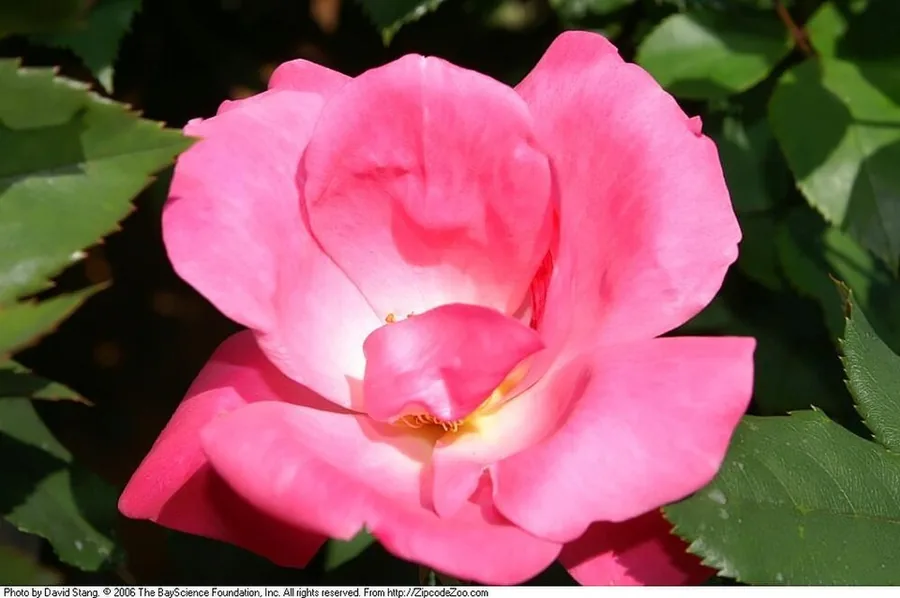
The Knock Out rose reads as a rounded, twiggy shrub hung with wide-open cherry-red blooms. Breeder William Radler set out to raise a rose that would flower all season without the constant spraying older roses demand, and the original 'Radrazz' arrived in 1999. It belongs to the rose family and grows as a dense, low-care landscape shrub, its thorned canes packed close and its flowers held out singly along the stems.
Up close, the plant shows why it needs so little tending. The spent flowers brown and drop on their own, so the shrub is self-cleaning, and it keeps setting fresh red blooms from June through frost with no deadheading. Its leaves hold a clean green through the season, resisting the black spot and powdery mildew that mottle and yellow the foliage of older roses, and an established plant stays firm through dry weather.
The whole shrub keeps a tight, rounded outline, a mound of 3 to 4 feet (91 to 122 cm) in most gardens with canes that arch out and fill in evenly. That form sits well against a foundation, as a low hedge, or in a large container, its red flowers carried across the surface through summer and fall.
Care
The short version: full sun, well-drained loam, and a deep drink while it settles in, then water only in dry stretches once established. Mulch the root zone, feed in spring, and cut back about a third of the oldest canes each spring to keep the shrub open and blooming.
Light
The reddest, most crowded flowering comes in full sun, six to eight hours a day. In partial shade the shrub carries on but sets fewer blooms and stretches into a looser, leggier frame of thinner canes.
Water
Water deeply and often right after planting until the roots take hold, then ease off, since the plant is drought tolerant once established. A soak every 7 to 14 days in a dry spell is enough, and about 3 inches of mulch banked back from the woody stem keeps the soil beneath from drying out.
Soil
The shrub roots into well-drained loam with a pH between 6.0 and 7.0. It is not fussy about soil, but drainage matters most, so heavy clay loosened with compost before planting gives the roots an easier hold.
Temperature
This is a cold-hardy rose whose canes take winter lows near -20°F (-29°C) and summer heat up to 100°F (38°C). That span covers most temperate gardens with no special protection.
Humidity
Ordinary outdoor humidity suits the foliage fine, so there is no number to hit. Open air around the leaves matters more, since crowded, still growth is where the odd fungal spot marks the leaf surface.
Feeding
A single spring feeding with a balanced rose or general-purpose fertilizer drives that first flush of red-tipped new growth. A seasonal feeding through the year keeps the blooms forming, and this undemanding shrub needs no more.
Pruning
Pruning needs stay low. In spring, the renewal method cuts about one-third of the oldest, woodiest canes right down to the soil line to open the shrub and draw up fresh green canes. Deadheading is optional, since the browned blooms drop themselves, though snipping them can speed the next flush.
Repotting
In a container the rose rarely needs moving, but the signs to watch are roots circling or breaking out the drainage holes, water running straight through, and stalled growth. Any of those points to a larger pot.
Size & spacing
The shrub fills out into a rounded mound of 3 to 4 feet (91 to 122 cm) tall and about as wide, its canes arching to meet. Each plant wants that same 3 to 4 feet (91 to 122 cm) of room so air moves through the foliage and the canes never crowd.
When to plant
This is a cold-hardy shrub whose canes ride out winters down to -20°F (-29°C), so it stands in the garden year-round across zones 5 through 9. Set it out in spring once the last frost has passed, and its red blooms then repeat from June until frost blackens the last of them.
Northern hemisphere
Southern hemisphere
Typical months for a temperate climate: start earlier in warm zones, later where spring frosts linger.
- Plant: spring after last frost
- Harvest: June to frost (repeat blooming spring through fall)
Hardiness
USDA hardiness zones: 5–9
Temperature: down to -29°C
Troubleshooting
Knock Out roses shrug off most of the trouble that scars other roses, so damage is rare. The one exception is rose rosette disease, which is fatal and shows itself in the growth, so it pays to spot early. Match what you see below before you act.
Flushed red shoots knotted into a broom and studded with soft thorns
The tell here is rose rosette disease, a virus a mite too small to see carries to the plant, and it is the one problem that can kill a Knock Out. Fresh canes flush an unnatural bright red and crowd together into a dense, broom-shaped tuft, their surface furred with soft, pliable thorns, while the small leaves come out dwarfed and twisted and the buds deform. No cure exists, so the entire plant, roots included, is dug up, bagged, and taken away before the mite spreads to nearby roses.
Fix:
- There is no cure; infected plants cannot be saved and the virus is systemic so it cannot be pruned out
- Promptly remove and bag the entire infected plant including roots and dispose of it
- Do not replant a rose in the same spot until remaining roots are gone
Green leaves fretted into lace and petals gnawed ragged in summer
Japanese beetles leave the clearest mark of all, eating the soft green tissue from between the veins until each leaf hangs as a lacy skeleton, and gnawing the open petals into ragged edges. Tipped into a jar of soapy water in the cool of the morning, when they are sluggish, they come off easily. The shrub carries light chewing without visible harm, so closer attention is due only when aphids, thrips, or mites also mass on the soft new growth.
Fix:
- Hand-pick Japanese beetles into soapy water
- Tolerate minor feeding on this vigorous shrub
- Manage aphids with a strong spray of water or appropriate controls as needed
Blackened flecks dotting the foliage, yellowing then dropping
These are the marks of black spot, a fungus that surfaces in warm, wet weather, though the Knock Out series was bred to resist it and a heavy case is rare. Round black blotches with feathery, fringed edges spread across the upper leaf surface, and the leaf around them yellows and drops soon after. The fallen leaves are gathered and binned, the shrub is opened for better airflow, and water goes to the base so the foliage stays dry.
Fix:
- Remove and dispose of fallen infected leaves
- Improve air circulation and avoid wetting foliage when watering
Toxicity
For homes with pets or children, true roses carry no poison. Every part of this rose is non-toxic to cats, dogs, horses, and people, and the soft petals and rounded hips are even edible. The only real hazard is the thorns, the stiff points along the canes that can scratch a curious nose or prick a bare hand at pruning time.
Safe for
People · Cats · Dogs · Horses · Rabbits · Livestock · Birds
Cats None
No part of this rose will poison a cat. The sharp thorns along the canes are the only real danger, ready to scratch a curious nose or paw, and a cat that swallows a mouthful of the woody stem may end up with an upset stomach.
Dogs None
A dog runs no poisoning risk from this rose. The hard, pointed thorns are the thing to watch, since a dog that chews the canes can prick its mouth on them, and a large mass of fibrous stem is hard to digest.
Horses None
The ASPCA lists the rose as non-toxic to horses, so cropping the leaves or petals causes no harm. The stiff thorns studding the canes are the single thing to keep in mind.
Rabbits None
The green leaves and soft petals are safe for a rabbit to nibble. A thorn can still draw a scratch, so a smooth, thornless length of stem makes the gentler browse.
Livestock None
Cattle, goats, and sheep can browse the foliage with no poisoning. The thorns bristling along the canes are the only catch, and most animals crop around them.
Birds None
Nothing on this rose will poison a bird, and the dense, thorny canes offer sheltered cover. The rounded hips that follow the flowers ripen into a winter food.
People None
The rose is safe around people, and both the petals and the ripened hips are edible. The thorns are the only hazard, so gloves guard the hands at pruning time.
Although non-toxic, the canes bear thorns that can cause mechanical injury (mouth or paw trauma); ingesting large amounts of stem material could pose a foreign-body obstruction risk.
Varieties
Knock Out is not one rose but a small family, its selections shifting the color of the petals, the number packed into each bloom, and the size of the shrub. These are the ones you will meet most.
Knock Out (Rosa 'Radrazz')
This is the original 1999 to 2000 introduction from breeder William Radler, opening single, five-petaled cherry-red blooms, and the parent from which the whole series grew.
Double Knock Out
A double-flowered form within the group whose blooms pack in far more petals for a fuller, rounder flower.
Pink Knock Out
The pink-flowered selection of the series, its petals a softer clear pink in place of the original deep red.
Rainbow Knock Out
A smaller selection whose coral-pink petals radiate out from a bright yellow eye at the center of each bloom.
Petite Knock Out
The compact, miniature-scale form, its whole frame and flowers scaled down for small beds, edges, and containers.
How to propagate
Cuttings root readily enough from the shrub's pliable young stems, but a legal detail is worth knowing before you raise a new plant from one you already own.
Stem cuttingsModerate
Late spring to summer from softwood or semi-hardwood growth · Several weeks to root, established over a season
Cuttings pulled from the pliable softwood or firmer semi-hardwood growth in late spring through summer will push roots over several weeks and knit in across a full season. One catch sits above the method itself. This cultivar is patented under US Plant Patent PP#11836, so propagating it to sell or give away is legally restricted while the patent stands.
Myths
Knock Out roses stand untouched by disease, never showing a blemish.
They hold up well against black spot and powdery mildew, keeping the clean, healthy foliage that older roses often lose to those fungi. Immune, though, they are not. Rose rosette disease, a fatal virus with no cure, strikes them like any other rose, and the bright red, broom-like tuft of new growth is the visible sign of it.
Knock Out roses hold their bloom only if deadheaded.
The shrub is self-cleaning, letting the browned, spent blooms fall away on their own and pushing fresh flowers from spring to frost with no help. Pinching off the faded blooms only hurries the next wave of buds along, so it is a choice, not a chore.