Shrub · Rosaceae
Japanese Kerria
Kerria japonica
In dappled shade and well-drained soil, Japanese kerria opens golden flowers along slender, bright green stems.
Partial shade
Every 5–10 days
USDA 4–9
3–7 ft · 0.9–2.2 m
Overview
Japanese kerria is an easy deciduous shrub whose golden-yellow flowers open in loose ranks along thin, arching branches through spring. It sits in the rose family yet stands alone as the only species in its genus. The stems themselves are a striking bright green, and they keep that green through winter, so bare of leaves the whole shrub reads as a fountain of slim green canes.
The branches are long and pliant, bending outward and down in a fine green spray rather than standing stiff and upright. It grows in partial shade and takes cold to zone 4, asking little once its roots are set. From the base it throws up fresh suckers, slender green shoots that knit into a thicket if they are left to run.
The single flowers are small, five-petaled, and clear buttery yellow, scattered thick along the wood in April and May with a lighter scatter again through summer. Between the green stems and the yellow bloom the plant carries color in two layers at once. Kept out of harsh afternoon sun, which pales the petals, and off soggy ground, it holds that fresh green-and-gold look with little help.
Care
The short version: partial shade, loamy soil that drains well, and steady water until it establishes, after which it stands up to drought on its own. Prune right after the yellow flowers fade, and lift suckers as they rise.
Light
Kerria colors best in partial shade, and it will hold in full shade too. Strong direct sun bleaches the buttery yellow out of the flowers and thins the scatter of bloom.
Water
A new plant wants steady, medium moisture as its roots take, watered every 5 to 10 days as the top inch dries. Once set it stands up to drought, so water at the base and keep the green leaves dry to head off blight.
Soil
Kerria roots best in loamy, well-drained soil of medium fertility. A pH from 5.5 to 7.5 suits it, and heavy, soggy clay is the one soil to avoid, since wet roots turn dark and rot.
Temperature
This is a tough, cold-hardy shrub whose green stems ride out winters down to about -29°F (-34°C) and summers up to 100°F (38°C). That span carries it through most temperate gardens with no special protection.
Humidity
Ordinary outdoor humidity suits it, so there is no figure to chase. What counts more is air moving through the slim, crowded stems, since still, damp air trapped in the branches is what blight favors.
Feeding
Kerria feeds lightly. A light spring application of balanced slow-release fertilizer once a season is plenty, and overfeeding only pushes soft green growth at the cost of flowers.
Pruning
Prune right after the flowers fade, since the yellow blooms form on last year's green wood and a late cut takes off next spring's flowers. Lift unwanted suckers as they rise, and cut tired, overgrown canes to the ground to send up fresh green stems.
Repotting
As a garden shrub, kerria rarely needs a pot. A container plant moves up a size when roots start circling or escaping the pot or growth stalls.
Size & spacing
A mature shrub stands about 3 to 7 feet (90 to 215 cm) tall and spreads wider, near 6 to 9 feet (180 to 275 cm), in a broad green fountain. Give it that room to arch and reach, with extra space for the slim suckers that rise beyond the main clump.
When to plant
Kerria moves through the year in a clear sequence. New plants set out in spring or fall while the weather is mild, the slim stems flush with buttery yellow flowers across April and May, and a thinner scatter of bloom follows through summer. Any cut waits until right after the spring flowers drop, since next year's buds form on this year's green wood.
Northern hemisphere
Southern hemisphere
Typical months for a temperate climate: start earlier in warm zones, later where spring frosts linger.
- Plant: Spring or fall
- Harvest: April to May with sporadic rebloom in summer
Hardiness
USDA hardiness zones: 4–9
Temperature: down to -34°C
Troubleshooting
Kerria stays healthy with little fuss, but a few problems surface in wet weather or wet ground. They show first as marks on the leaves, changes in the flowers, or dark, soft roots, so read the close-up signs below and act before they spread through the stems.
Wilting stems and dieback over dark, rotted roots
When a kerria wilts and dies back in soggy ground, the trouble is root rot hidden underground. Lift the soil at the base and the roots read dark and mushy to the touch instead of firm and pale. The cure is drainage, so open heavy soil with compost, water less, and keep the shrub off any low ground that stays soaked.
Fix:
- Improve drainage by amending soil with compost
- Reduce watering frequency
- Avoid planting in heavy clay or low wet spots
Purple-rimmed leaf spots and dark cankers marking the stems
The red-brown spots with purple rims are kerria twig and leaf blight, a fungus that rises in wet weather and runs from the leaf blades into the wood. On the stems it shows as long purple-brown cankers, and once one wraps a stem it kills every shoot above it. Cut out the marked wood, gather the spotted leaves off the ground so they cannot reinfect, and keep the foliage dry with a soaker hose rather than a spray.
Fix:
- Prune out and dispose of diseased stems
- Rake and dispose of fallen infected foliage
- Apply a labeled fungicide such as chlorothalonil on a bi-weekly schedule during wet summer weather
- Switch to soaker hose or drip irrigation to keep foliage dry
Bleached petals and a thin scatter of flowers
Flowers that come pale and few give away two things. Strong sun scorches the color out of the petals, so shade dappled by taller growth keeps the yellow deep and saturated. The other cause is a badly timed cut, and since the buds sit on last year's wood, the shears should wait until the spring flowers have dropped.
Fix:
- Site the plant in partial shade
- Prune only immediately after flowering since it blooms on previous year's wood
Toxicity
For homes with pets or children, kerria is reassuring: it is not toxic. It does not appear on the ASPCA's poison lists and is safe around cats, dogs, and the rest of the household. A chewed leaf might bring a passing stomach grumble, as any plant can, but the green tissue holds nothing that poisons.
Safe for
People · Cats · Dogs · Horses · Rabbits · Livestock · Birds
Cats None
Kerria holds no poison for cats, so a bitten leaf does no harm. Chewing the thin green foliage might bring a brief stomach upset, the same as any plant, and it fades on its own.
Dogs None
No part of this shrub poisons a dog, right down to the stems and leaves. A hard chewer gets nothing worse than a passing bout of stomach grumbling.
Horses None
The leaves and stems of kerria hold nothing that harms horses. A horse that strips a few of the toothed green leaves comes away none the worse.
Rabbits None
Rabbits take no poison from kerria's foliage. They may nibble the soft green leaves like any garden plant, with no cause for concern.
Livestock None
Cattle, goats, and sheep can browse the leaves and green stems of kerria in safety, since it carries no compounds known to harm them.
Birds None
Birds come to no harm among the slender green stems. They can perch and forage over the branches with nothing toxic in the plant.
People None
Kerria is not poisonous to people and is fine in a family garden. No part is worth eating, but a child who tastes a leaf is in no real danger.
No special handling required; wear gloves for routine pruning to avoid scratches.
Varieties
A few named kerrias reach garden centers, set apart by the shape and color of their flowers, their leaf markings, and their size. These are the ones worth knowing by name.
Pleniflora
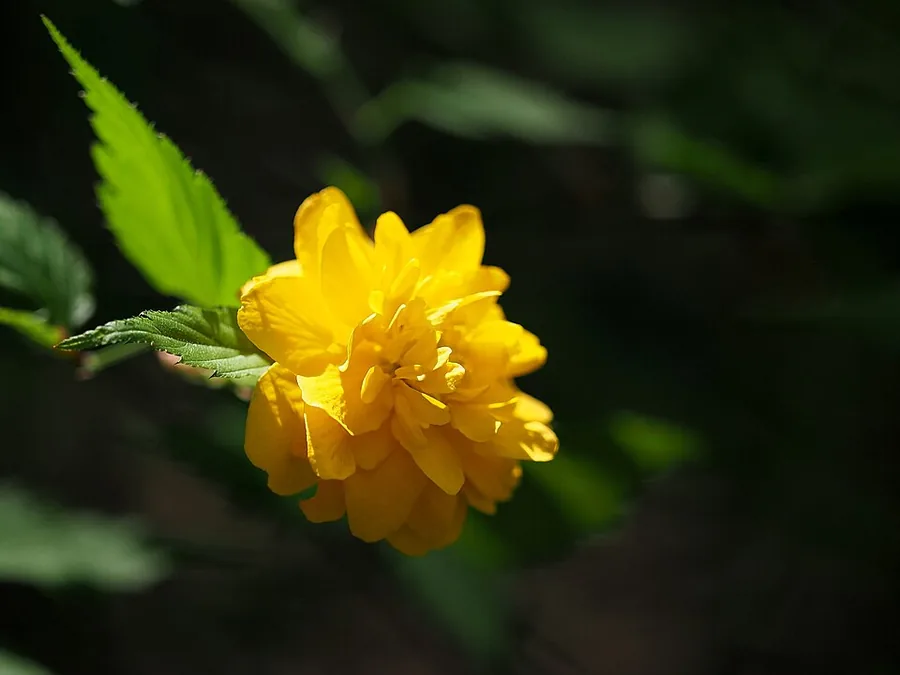
A vigorous form climbing to around 8 to 10 feet, hung with fat double, ball-shaped yellow pompons in place of the flat single blooms.
Golden Guinea
Bears broad single flowers up to about 2.5 inches across, wide and open-faced, over a notably long bloom period.
Picta
Carries slim green leaves rimmed in creamy white and grows slowly, though it can throw plain all-green shoots and revert if those are left.
Albescens
A compact 4 to 5 foot form whose soft creamy pale-yellow flowers, about 2 inches across, sit paler than the usual bright gold.
How to propagate
Kerria multiplies almost on its own, which makes it one of the simplest shrubs to increase. Its slim suckers divide cleanly, soft green tips root as cuttings, and the low arching stems layer themselves where they touch the soil.
DivisionEasy
Spring or fall · One growing season
The simplest increase comes from the young suckers that push up around the clump, each a slim green shoot ready to lift and replant. Divide in spring or fall, and a separated sucker roots and takes hold within a single growing season.
Stem cuttingsModerate
May to July · Several weeks to root
Cuttings start from soft green terminal tips taken from May through July, their bases dipped in an IBA rooting hormone to draw out new roots. Held warm and evenly moist, the tips root over the course of several weeks.
LayeringEasy
Spring to summer · One growing season
Kerria layers itself where its long, low, arching green stems bow down and press against moist soil, from spring into summer. Roots form at the contact point, and after a growing season the rooted stem can be cut free and moved as a new plant.
Myths
Japanese kerria is a true rose because of its common name.
The name only echoes the rose-like shape and yellow of its flowers, not its botany. The shrub does sit in the rose family, Rosaceae, yet it stands alone as the single species in the genus Kerria and is not a true Rosa at all.