Shrub · Rosaceae
Groundcover Rose
Rosa
Given full sun and open air, a groundcover rose spreads a low carpet of bloom from spring to frost.
Full sun
Every 3–7 days
USDA 5–9
12–35 in · 30–90 cm
Overview
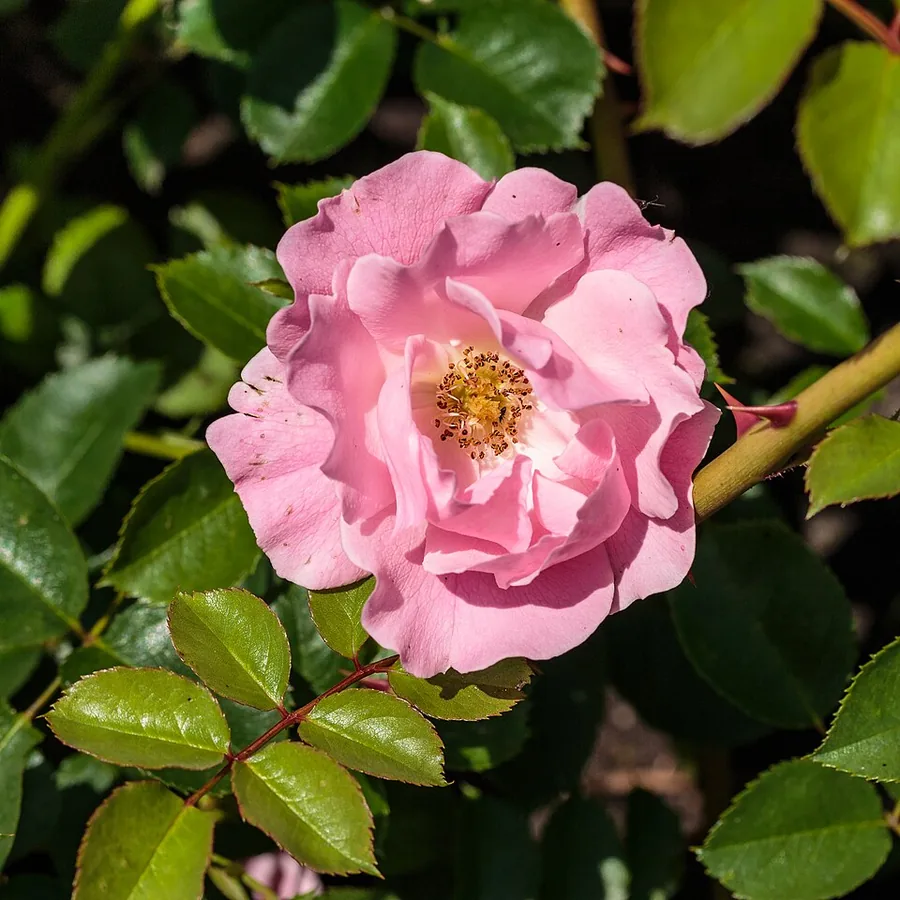
A groundcover rose is a true rose whose canes arch outward and hug the ground rather than climbing upright, laying its stems flat across the soil. It belongs to the genus Rosa in the rose family, and its low, wide-running form replaces the tall, stiff frame of a hybrid tea. Most of these plants hold under 3 feet (90 cm) in height while their canes reach far wider, so a small group knits into a continuous low mat.
The flowers open in repeated flushes from late spring through to frost, often small and clustered and shedding cleanly on their own without deadheading, and the tougher strains keep their leaves clean where taller roses spot and yellow. On the strongest selections the foliage is glossy and deep green, a dense low sheet studded with color.
The canes themselves run long and pliant, bristling with sharp prickles and easy to bend flat to the earth. Set the plant in full sun with open air around those canes and keep the leaves dry, and the growth stays firm and heavy with bloom. Leave it crowded in damp shade and the leaves catch black spot and mildew instead.
Care
The short version: full sun, fertile and well-drained soil, a deep soak about twice a week at the base rather than overhead, a light prune in late winter, and room for air to move around the low canes.
Light
A groundcover rose wants full sun, at least six hours a day, which fills the low mat with bloom and keeps the leaves firm and clean. It holds on in partial sun or light shade, but the flowers thin out and the damp, shaded leaves grow more prone to disease.
Water
Water it deeply and regularly, roughly twice a week according to soil and weather, and lay the water down in the morning. Pour it at the base of the canes, since droplets clinging to the leaves are how black spot and mildew begin.
Soil
Set it in fertile, well-drained soil worked full of dark organic matter. These roses are easy about pH and take anything from acidic to neutral, with a range of 6.0 to 7.0 suiting them well.
Temperature
Groundcover roses endure a wide swing of cold and heat, hardy from about -20°F to 100°F (-29°C to 38°C). That deep cold hardiness is what carries the woody canes through winter in zones 5 to 9 with little fuss.
Humidity
Ordinary outdoor humidity poses no problem, so there's no number to track. Moving air counts for far more than the moisture in it, since still, crowded air pooling around the low canes is what lets leaf diseases settle in.
Feeding
Feed with a slow-release nitrogen fertilizer in spring and again in fall, at about a pound of nitrogen per 1,000 square feet across the two applications. Steady, moderate feeding keeps the bloom coming without swelling the soft, sappy shoots that aphids crowd onto.
Pruning
These roses skip the heavy, precise pruning a hybrid tea demands. Shear or shape the low canes lightly in late winter to early spring for a denser, bushier mat, cut out any dead or diseased canes, and give the oldest stems a harder rejuvenation cut every 2 to 3 years to keep them vigorous.
Repotting
Groundcover roses grow in the open ground as landscape shrubs and rarely sit in a pot. Where one is kept in a container, repot it once roots circle the inside or push out the drainage holes.
Size & spacing
Plants stand about 12 to 35 inches (30 to 90 cm) tall while their canes spread wider than they rise, around 2 to 4 feet (60 to 120 cm) across. Give each one room to fill out so air moves freely and the low leaves stay dry.
When to plant
Groundcover roses are hardy across zones 5 to 9 and their low woody framework lives on for years once rooted. Set them out in spring after the last frost, shear them lightly in late winter as the buds swell, and watch the bloom run from late spring until frost.
Northern hemisphere
Southern hemisphere
Typical months for a temperate climate: start earlier in warm zones, later where spring frosts linger.
- Plant: spring after the last frost
- Harvest: Continuous bloom from late spring or early summer through fall (May to frost)
Hardiness
USDA hardiness zones: 5–9
Temperature: down to -29°C
Troubleshooting
Most of what goes wrong on a groundcover rose shows on the leaves, spelled out in spots, powdery films, and curling, and it traces back to wet foliage or crowded, still air low to the ground. Catching those first marks and clearing them keeps a small blemish from overrunning the plant. Match what you see below, then act while it still helps.
Red spiny shoots massed into warped brooms
Shoots that shoot up red and elongated, bristling with far more thorns than normal and bunching into warped, broom-like clusters, are the mark of rose rosette disease, a virus that eriophyid mites too small to see carry from plant to plant. Nothing brings a stricken plant back once those deformed brooms take over. Lift the whole plant with its roots, seal it in a bag for the trash rather than the compost, and pull out any wild multiflora roses close by that keep the virus alive.
Fix:
- Remove and destroy infected plants promptly including roots
- Do not compost infected material
- Replace with resistant plants and avoid planting roses in the same spot immediately
Inky black spots rimmed with yellow on the leaves
Those inky blotches with fringed edges and a wash of yellow around them are black spot, a fungus that settles in where leaves stay wet and the air hangs still. It creeps up from the lowest leaves, draining their green to yellow before they let go and fall. Pick off every marked leaf, rake the fallen ones clear, and pour the water low at the base each morning so the foliage dries fast.
Fix:
- Remove and discard infected leaves and fallen debris
- Avoid overhead watering and water at the base in the morning
- Improve air circulation and apply a fungicide in humid climates if needed
A chalk-white dust over leaves and swelling buds
A fine white powder, dry as talc, over the leaf surfaces and shoot tips is powdery mildew, and it leaves the tender new growth curled and puckered. It gathers thickest on plants that stand crowded and shaded where the air scarcely stirs. Thin the tangle with a light prune, hold back the nitrogen that swells soft growth, and reach for a fungicide if the white film keeps creeping.
Fix:
- Prune to improve air circulation
- Avoid excess nitrogen that pushes soft growth
- Apply an appropriate fungicide if severe
Soft-bodied specks massed on the tender shoots
The tight knots of soft green, pink, or black specks on the buds and shoot tips are aphids, drawing sap from the softest new growth. They coat the surface with a sticky, glistening honeydew that can darken into sooty mold and pull the young shoots into twisted shapes. Knock them loose with a hard jet of water, wet the survivors with insecticidal soap, and let the lady beetles pick off the rest.
Fix:
- Spray plants with a strong stream of water to dislodge aphids
- Apply insecticidal soap if populations are high
- Encourage natural predators such as lady beetles
Toxicity
For homes with pets or children the plant reads reassuringly: true roses are non-toxic to cats, dogs, horses, and people, so a chewed leaf or a torn petal does no chemical harm. The hazard is purely physical. The hooked prickles studding the canes can scratch or puncture, so wear gloves to prune and keep those low canes clear of where pets and children brush past.
Safe for
People · Cats · Dogs · Horses · Rabbits · Livestock · Birds
Cats None
A true rose is non-toxic to cats, so a nibbled leaf or a torn petal poisons nothing. The sharp, curved prickles along the canes are the sole hazard, and they can rake a curious cat's nose or paws.
Dogs None
A dog can chew the leathery leaves or the petals with no poisoning to fear. The stiff prickles are the worry, since their hooked tips can nick a snout or a soft paw pad.
Horses None
A browsing horse takes no chemical harm from a rose. The rigid, sharp canes are the catch, so the planting sits best where a horse will not press its muzzle into the thorns.
Rabbits None
Rabbits can graze the foliage and green stems with no poisoning risk at all. The prickles studding the canes are the one hazard to weigh around such small, thin-skinned animals.
Livestock None
Cattle, goats, and sheep can browse the foliage safely, since nothing in a true rose is toxic to them. Only the prickly canes threaten, and their sting is no more than a shallow scratch.
Birds None
The leaves, petals, and rounded hips hold no poison for birds. The dense, thorn-studded canes even work in their favor, weaving small birds a sheltered thicket to perch and hide in.
People None
The petals and the plump hips are safe to eat, and the hips carry a well-known store of vitamin C. The hooked thorns are the only real hazard, so gloves belong on any hands pruning or handling the canes.
Thorns and prickles can cause scratches or puncture wounds; wear gloves when pruning or handling and place plants where pets and children will not brush against the canes.
Varieties
Groundcover roses come in several well-known series and named plants, each carrying a slightly different stature, flower color, or leaf toughness. These are the ones most often met at the nursery.
Flower Carpet series
A low, trailing groundcover rose of roughly 2 to 3 feet tall and 3 to 4 feet wide, it lays down bloom after bloom over glossy, deep-green, disease-resistant leaves and needs no deadheading.
Drift series
A compact, low-spreading landscape rose whose small, rounded mound of growth carries the toughness of a groundcover in tight, tidy form.
Red Meidiland
A vigorous, disease-resistant rose whose spreading canes clothe a slope or a rough patch in dense low growth.
Ralph's Creeper
A spreading groundcover rose whose bright orange-red blooms sit low and open close against the soil.
How to propagate
More groundcover roses can be raised from the low canes and stems already in the garden, either by rooting a cutting or by layering a trailing cane straight into the soil.
Stem cuttingsModerate
Softwood cuttings in late spring to summer or hardwood cuttings in fall · Several weeks to a few months to root
Cut lengths of healthy current-season stem, taking soft, green softwood in late spring through summer or firm, woody hardwood in fall, and give them several weeks to a few months to push roots. One catch stands before any resale: many named groundcover roses are patented and cannot legally be reproduced for sale.
LayeringEasy
Spring to summer · One growing season
The long, low canes root of their own accord anywhere they lie pressed against moist soil, which makes layering easy. Pin a trailing cane to the ground in spring or summer, bury a stretch of it, and let a full growing season pass before the rooted length is cut free as a new plant.
Myths
Roses are poisonous to dogs and cats and shouldn't be planted where pets roam.
True roses in the Rosa genus are non-toxic to cats, dogs, and horses per the ASPCA, so a chewed leaf or a mouthful of petals poisons no pet. What draws blood is the hooked thorn, not any toxin in the plant. Watch the lookalikes, though, since a plant like desert rose wears the rose name yet belongs to another genus entirely and can be toxic.
All roses need heavy, complicated yearly pruning at exact bud nodes.
Groundcover and landscape roses ask for none of that node-by-node knifework. A light shear across the top and a cut of any dead or diseased canes is the whole of it, nothing like the heavy, exacting pruning a hybrid tea insists on.