Vegetable · Brassicaceae
Daikon Radish
Raphanus sativus
Sow it in late summer and let the long white taproot do the digging before winter takes the plant.
Full sun
Every 3–7 days
50–60 days
USDA 2–11
Overview
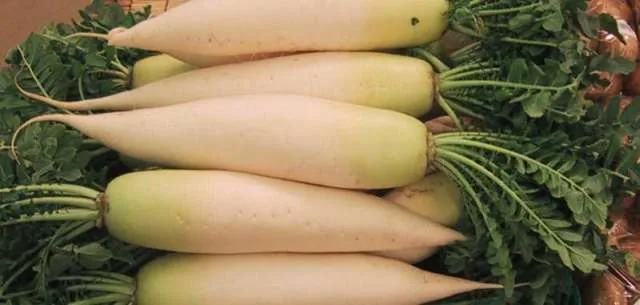
Daikon radish grows the long, smooth, white taproot a cook would know on sight, and the same plant earns its keep in the field as a cover crop. A member of the cabbage family, it grows fast in cool weather, thrusting that pale, tapered root straight down through packed soil while a low rosette of coarse green leaves spreads above. The root is the whole story here, the part driving deep out of sight.
Sown in late summer or early fall, the root thickens and lengthens over about two months, until in cold zones the first hard freeze blackens the tops and ends the plant outright. That winterkill is the point. Through winter the fleshy root softens and rots in place, leaving deep open channels in the ground, hollow shafts that draw water, air, and the next crop's roots far below the old hardpan, with no spring cleanup to do.
Below the surface that same root works as a sponge for leftover nitrogen. A daikon stand pulls up residual soil nitrate that would otherwise wash away, locks it into its swelling tissue through the cold months, and gives it back as the root breaks down. Fast to swell and easy to grow, it asks little beyond steady moisture and a sowing date that lands on time.
Care
The short version: grow daikon in full sun, sown late summer to early fall, in soil kept moist enough to swell the long white root and holding leftover nitrogen for it to draw up.
Light
Daikon swells best under full sun, though it will take a little partial sun. Strong light through the short fall days feeds the coarse green tops and pours growth into the long root beneath them.
Water
The soil stays evenly moist through the growing weeks, since the swelling root drinks steadily as it thickens. It thrives in the cool, damp air of late summer and fall and has no liking for drought, so it should not dry out while the root is filling out.
Soil
Well-drained loam suits it best, the kind of crumbly ground the root can push straight through, though it adapts to most well-drained soils. Keep the pH between 6.0 and 7.5, and let the soil hold enough nitrogen and moisture to plump the root.
Temperature
It grows across a wide range, from about 18°F to 84°F (-8°C to 29°C), and fattens best in cool fall weather. In cold zones a hard freeze blackens the tops and winterkills the stand, which is exactly what the cover crop is meant to do.
Humidity
Plain outdoor humidity suits it, so there is no figure to aim for. What shapes the root far more is steady soil moisture through the fall growing window.
Feeding
Feeding comes once at planting, in late summer to early fall. Daikon fixes no nitrogen of its own; the root instead scavenges leftover soil nitrate, so it swells best where 40 to 60 pounds of nitrogen per acre is on hand or applied.
Pruning
There is nothing to prune. Grown as a short-lived fall cover crop, it winterkills on its own in cold zones, the tops collapsing into easy residue over root channels left open below, with no spring termination needed.
Repotting
none
Size & spacing
Above ground the leafy tops reach roughly 12 to 35 inches (30 to 90 cm) tall, while the thick taproot drives far deeper out of sight. Sown thick as a broadcast or drilled cover crop, the plants stand close rather than spaced like a row vegetable.
When to plant
Daikon swells on the fall calendar, not the spring one. Sow it in late summer to early fall, roughly 4 to 10 weeks before your first frost, and the root thickens fast in the cool weather before a hard freeze blackens the tops and leaves the fleshy root to break down over winter.
Northern hemisphere
Southern hemisphere
Typical months for a temperate climate: start earlier in warm zones, later where spring frosts linger.
- Sow: Not applicable; direct-sown as a cover crop.
- Plant: Sow in late summer to early fall, about 4-10 weeks before the first fall frost.
- Harvest: Grown for its deep taproot and biomass, not flowers; in cold zones it winterkills in late fall to early winter and is not harvested.
Hardiness
USDA hardiness zones: 2–11
Temperature: down to -46°C
Troubleshooting
Daikon is an easy crop, and most of its trouble shows up in the look of the plant rather than in disease, traced back to timing and placement. Watch for the rot smell rising off the spent roots after winterkill, the galled roots that flag disease near cabbage-family crops, and the flower stalks that mark a bolting weed risk. Match what you see below and act before it spreads.
Galled roots and brassica pests in tight rotation
Daikon carries the cabbage family in its bones, and with it the same crowd of attackers as cabbage and broccoli, among them clubroot, flea beetles, and cabbage root maggot. Set it just before or after a cole crop and those troubles pack tighter into the soil. The clearest signal sits underground in the root itself: tissue swollen into lumpy, distorted galls marks clubroot, so field history shows where brassicas have grown of late.
Fix:
- Do NOT rotate forage/tillage radish immediately before or after cabbage-family (brassica) vegetables
- Remove radish from rotations on fields with a clubroot history and grow cruciferous crops elsewhere
- Destroy residue and rotate away from brassicas for several years where clubroot is present
Flower stalks shooting up and scattering seed
Sown too early, perhaps back in July, the plant throws up a flower stalk and ripens seed before winter arrives. The same stalk rises in mild-winter zones, where the radish never freezes out and lives on to bloom the next spring. Cut down any bolting or surviving plants before the seed ripens, by mowing, tillage, or an approved herbicide, taking the stalk while it is still short, before it climbs past about 4 to 5 inches and lets the seed scatter.
Fix:
- Terminate surviving or bolting plants before seed set by mowing, tillage, or an approved herbicide
- Kill plants before the flowering structure exceeds about 4-5 inches tall to prevent seed dispersal
The skunky reek of the fat roots breaking down
Once a hard freeze blackens the tops, the thick fleshy taproots soften and slump, and as they collapse they breathe out the sulfur compounds stored in their glucosinolates, a smell that lands somewhere between skunk and rot. The odor hangs in the air for the nose alone, leaving the soil and the next crop untouched. It bites hardest when a quick freeze gives way to warmth, then thins out over a few days as the spent roots melt down into mush.
Fix:
- Wait it out; the sulfurous smell normally dissipates within a few days as decomposition completes
- Plan no remedial action since this is a temporary nuisance, not a plant health problem
Toxicity
There is nothing here to fear. Daikon is a plain food crop, not a poisonous plant, and it sits nowhere on the ASPCA toxic-plant lists, so both the crisp white root and the green leaves are safe around cats, dogs, livestock, and people. The only thing it gives off is the strong sulfur reek of the roots rotting after winterkill, and that is a nuisance for the nose, not a hazard.
Safe for
People · Cats · Dogs · Horses · Rabbits · Livestock · Birds
Cats None
A cat that bites into a leaf or the pale root comes to no harm, since radish stays off the ASPCA toxic list.
Dogs None
A dog can gnaw the green foliage or a snapped piece of root without harm, and many relish the cool, crisp crunch of the white taproot.
Horses Safe
Horses can graze the leafy tops and the roots safely, this being a food crop rather than a poisonous plant.
Rabbits Safe
Rabbits chew the leaves and root well as one part of a varied diet.
Livestock Safe
Cattle, sheep, and goats graze the leafy forage with no real risk, though an animal that gorges on a heap of any brassica may pass through a brief, mild bout of digestive upset.
Birds Safe
Backyard poultry and wild birds peck at the tender seedlings and the roots without trouble.
People Safe
The crisp white root and the young green leaves eat well raw or cooked, the same as any kitchen radish.
Non-toxic as a food and plant. As a brassica it contains glucosinolates, and like other brassica forages, grazing livestock that eat very large amounts can occasionally have mild digestive upset; this does not affect cats or dogs. Note also that when the roots winterkill and decompose they release a strong sulfurous rotting odor that is a nuisance, not a toxicity hazard.
Varieties
Most daikon falls into a few named types, split between the long white kitchen radish and the cover-crop selections bred from it for their thick, deep roots. These are the ones worth knowing.
Tillage Radish
A daikon-type forage radish selected and trademarked for an unusually large, deep taproot that drives the biological tillage of compacted ground.
GroundHog
A cover-crop radish bred for an aggressive, deep root that bores down hard to break up compaction.
Daikon
The long white culinary radish from which the cover-crop forage types were drawn.
Nitro
A cover-crop radish grown for fast fall growth and heavy nitrogen scavenging.
How to propagate
Daikon grows one way only, from small seed sown straight into the ground, and the method could hardly be simpler.
SeedEasy
Direct-sow in late summer to early fall, about 4-10 weeks before the first fall frost. · Establishes quickly in cool weather, producing substantial growth in about 50-60 days.
Daikon begins as small seed pressed straight into the ground in late summer to early fall, roughly 4 to 10 weeks before the first fall frost. Drilled or scattered shallow, about a quarter to half an inch deep, the seed breaks fast in cool weather and the seedlings swell into real size within 50 to 60 days. Many growers sow it alongside a cereal grain or grass, since radish standing alone leaves the bare soil between plants open to erosion.
Myths
Tillage radish actually tills the soil like a plow.
What it performs is biological tillage, or biodrilling. The living taproot bores downward and fractures compacted layers and plow pans, and once it rots away it leaves wide vertical channels, hollow shafts that let water, air, and the next crop's roots travel deep. It loosens compaction with no machinery pass at all, yet it cannot undo whatever pressed the soil tight in the first place.
Sources
- University of Maryland Extension
- University of Wisconsin-Madison Extension (Crops and Soils)
- USDA NRCS (Plant Guide, oilseed radish)
- Ohio State University Extension (Ohioline ANR-0125)
- Michigan State University Extension
- Ohio State University Extension (Ohioline SAG-5, oilseed radish)
- ASPCA Animal Poison Control
- ASPCA Animal Poison Control