
Introduction
Few trees stop you in your tracks like a weeping willow tree, its long branches sweeping the grass and trailing into the water at the edge of a pond. The beauty is real, and so is the work it asks of you. This guide gives you the honest picture before you dig a single hole.
My first willow went in 12 ft from a buried pipe, and the roots reached it within a few seasons. The repair bill taught me to respect the warning before I read a single study. The weeping willow is Salix babylonica, a fast growing tree that puts on roughly 3 to 4 ft (1 to 1.2 m) of height each year. Give it room and it will reach 30 to 50 ft (9 to 15 m) tall and just as wide. As a deciduous tree, it leafs out first in spring and drops its leaves last in fall.
Two parts of the willow story get rushed in most guides. The first is the invasive roots that can crack pipes and sewer lines. The second is the famous link between willow bark and aspirin. You get both in full here, backed by university sources. The root and siting risks come straight from the research. So does the real story of how this ornamental tree shaped modern medicine.
Here is the honest trade. The weeping willow is loved for its romance and its deep summer shade. But it is not a fit for a small yard or a tight lot near the house. Read this as both an appreciation and a clear buying guide. By the end you will know if this tree belongs on your land or across the fence at the park.
What Makes A Weeping Willow
You know a weeping willow the moment you see one. Long, pendulous branches sweep down from a wide crown and brush the ground like a fountain frozen mid-fall. The whole tree reads as motion even when the air sits still. Up close you find narrow, lance-shaped leaves that flicker silver when a breeze turns them over.
The form comes first, but the name seals it. Plant folks call this tree Salix babylonica, and it sits in the willow family. It is a deciduous tree, so it leafs out early in spring and drops its leaves late in fall. In late winter it pushes out soft catkins. These fuzzy flower clusters feed early bees before much else has woken up.
Despite the species name babylonica, the tree never came from Babylon. It is native to East Asia, and most of the famous ones trace back to China. Linnaeus misnamed it in 1736 after a misreading of Psalm 137, which likely points to poplars and not willows at all. The name stuck anyway, and it has followed this ornamental tree around the world ever since.
That bold shape pulls in more than your eye. The weeping willow is a host plant for the Viceroy butterfly. Its early catkins also feed 11 special Andrena bee species that lean on willows for spring pollen. So the tree feeds local wildlife right when the season is just starting to turn.
People have prized that shape for centuries. A famous row of weeping willows once stood guard over Napoleon's grave on St. Helena, and cuttings from those trees were said to spread far and wide. The story below sums up just how much weight a single willow silhouette can carry.
A celebrated phalanx of weeping willows guard Napoleon's grave on St. Helena. Cuttings from these trees are said to be widely distributed.
Where And How To Plant
I pushed a bare willow cutting into the damp back corner where the lawn met the seasonal drainage ditch. No rooting hormone, no fuss, just a stick in wet ground. Within a few weeks it had rooted on its own and pushed out new leaves. The willow never wanted rich soil. It wanted moist soil and open room.
That is the whole secret to planting weeping willow trees. These trees thrive near water, so a low spot beside a pond, lake, or stream is ideal. They love full sun but handle partial shade fine. They also tolerate clay, loam, and sand, and grow in soil from acidic to alkaline. You do not need to fix your ground first.
The real question of where to plant weeping willow is about distance, not dirt. Keep the tree at least 50 ft (15 m) from any building, septic system, or water line. A mature crown spreads 30 to 50 ft (9 to 15 m) wide, and the roots reach about three times the trunk-to-canopy distance. Give one tree a full 50 ft (15 m) clear circle and you will save yourself trouble later.
This is why willows belong on big rural lots, not tight suburban yards. A lakeside or pondside spot on open acreage suits them best. Transplant timing matters too. Set a young willow or rooted cutting in early spring or late fall, while the tree sits dormant. The steps below get a new willow settled fast.
Choose a large, sunny, low-lying spot near water and at least 50 ft (15 m) from buildings, pipes, and septic fields.
Plant in early spring or late fall while the tree is dormant so roots settle before the stress of summer heat.
Loosen a hole two to three times the root ball width so the spreading roots can move easily into the surrounding soil.
Place the tree level with the surrounding ground, backfill with native soil, and firm it gently to remove air pockets.
Soak the area well, then spread 3 in (8 cm) of mulch in a ring, kept off the trunk, to hold moisture in.
Keep weeping willows well away from underground water, sewer, and septic lines, where invasive roots can cause significant and costly damage.
Care Through The Seasons
A heavy March soaking dumped two inches of rain into the damp back corner of my yard, and my young Niobe golden weeping willow drank it all. Within a week its bare branches showed a green haze while every other tree nearby still stood bare and gray. The maples and the oak waited weeks longer. That early flush ran straight off the water sitting in its soggy patch of ground.
Most care guides split willow advice across light, soil, and water headings, so you never see the full year at a glance. A weeping willow asks for the same two things in every season: full sun and steady moisture. Get those right and this fast growing tree handles the rest of the calendar with very little fuss from you.
Good weeping willow care runs on a simple rhythm tied to the seasons. The calendar below puts spring, summer, fall, and late winter tasks in one place so you know what to do and when. Each season asks for a different kind of care. Heavy watering in the heat, then careful pruning once the leaves drop.
Spring
Water deeply as growth surges, refresh the mulch ring, and watch for early aphids on the fresh, fast-flushing foliage.
Summer
Keep the soil consistently moist through heat and dry spells, since this water-loving tree wilts fast when its roots dry out.
Fall
Rake the heavy leaf litter, ease off the water as growth slows, and plan any major planting before the ground freezes.
Late Winter
Prune while fully dormant to shape the crown and cut out the weak or broken wood before spring growth begins.
Spring and summer are about water. A weeping willow loves wet feet, so soak it deep during dry stretches and it pays you back with rapid growth. Lay a thick mulch ring around the base to lock that moisture in, but keep it a few inches off the trunk. Watch the new leaves for aphids, since soft fresh growth draws them first.
Fall and winter shift the work toward cleanup and shaping. This tree drops a thick mat of leaves and snaps off small twigs all season, so plan to rake often. Overwintering a willow takes almost no effort once it goes dormant, but the wood is brittle and cracks under heavy snow or ice. Save your pruning for late winter, while the crown is bare, and cut out any weak or broken branches before the new season starts.
If you wonder whether a willow goes bare in winter, it does. A weeping willow is deciduous, so it drops every leaf in fall and stands dormant through the cold months. The bare branches often glow a soft golden color against winter skies. They hold that look until the buds break and the tree leafs out again in early spring.
Roots, Risks And Siting
Aggressive, Spreading Roots
- Reach: Roots can spread roughly three times the distance from the trunk to the canopy edge, far beyond the visible crown.
- Surface growth: Shallow surface roots often grow above the soil where they can crack and lift nearby sidewalks and paving.
- Pipe risk: Near leaking water, sewer, or septic lines, the moisture-seeking roots invade joints and cause expensive damage.
Weak, Brittle Wood
- Breakage: The soft, fast-grown wood cracks and breaks under the weight of snow, ice, or strong storm winds.
- Cleanup: Broken limbs and constant twig drop mean frequent cleanup, especially after heavy weather rolls through.
- Safety: Falling branches over patios, driveways, or play areas make placement near busy spaces a real concern.
Heavy Litter And Disease
- Litter: The tree sheds a steady mess of leaves, catkins, and small branches that lands across lawns and water.
- Pests: Aphids, borers, scale, caterpillars, and willow leaf beetles all favor willows through the growing season.
- Disease: Blights, cankers, powdery mildew, leaf spots, and crown gall are common, adding to the maintenance load.
Short Lifespan
- Typical life: University of Florida sources put the usual lifespan at around 30 years, short for a large shade tree.
- Best case: Some references cite 40 to 75 years in ideal, undisturbed conditions, but that is far from guaranteed.
- Planning: Treat a weeping willow as a fast, dramatic, but temporary feature rather than a permanent legacy tree.
The same fast growth that makes this tree so charming also gives it a hard side you need to plan for. Weeping willow roots spread wide and shallow, the soft wood breaks in storms, and the tree is short-lived next to most large shade trees. None of that means you should write it off. It means placement is the whole game.
Let's deal with the invasive roots question head on. Roots do not bore through sound, sealed pipes the way scary stories claim. But these roots chase moisture, so they push into any crack, leak, or loose joint they can reach. The real safeguard is simple distance from your water and sewer lines.
UF/IFAS Extension notes the roots can spread about three times the distance from the trunk to the canopy edge. They often grow right at the surface too. That surface habit is what lifts sidewalks and invades leaking pipes. The risks below are not scare copy. They come straight from university sources, and they all trace back to where you put the tree.
Care should be taken not to locate weeping willows near underground water or sewer lines or close to septic tank drain fields where the roots could cause significant damage.
So here is the honest take. Squeezed beside a house, a patio, or a septic field, a weeping willow is a poor choice, and the root damage, brittle wood, and litter will wear you down. Two universities advise against it on a typical home lot for exactly those reasons.
Give it a large, damp, open property near a pond or stream, and the picture flips. The roots have room to roam, the falling limbs land on grass instead of your car, and you get years of beauty from a tree that is short-lived by design. The problem was never the willow. It was the spot.
Willow Varieties To Know
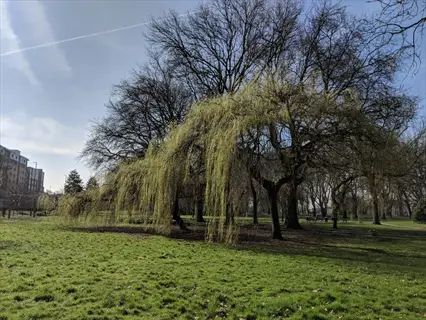
One late winter, I watched my Niobe golden weeping willow light up the damp back corner of the garden. The bare branches glowed bright yellow against a flat gray sky. You could spot the tree from the kitchen window long before anything else woke up. That yellow is why the golden weeping willow still earns its spot over a plain green form.
Not every weeping willow you see is the same tree. Many sold in North America are hybrids or close cousins, not true Salix babylonica. So the cultivar name on the tag matters when you buy. Get the right one and you know the exact shape, color, and size you bring home.
The weeping willow varieties below cover the looks most gardeners want. You get glowing winter stems, twisted branches, and a pint-sized form for pots. Each one pairs the classic sweeping shape with a clear reason to pick it. Here is what each of these cultivars brings to the yard.
Golden Weeping Willow
- Botanical link: Often sold as Salix alba Tristis or the cultivar Niobe, prized for bright yellow winter stems.
- Look: Long, sweeping branches turn a warm golden color that glows on bare winter days against gray skies.
- Size: A full-size tree at 30 to 50 ft (9 to 15 m), so it needs the same open, damp site as the species.
- Best for: Large lakesides and open lawns where the golden curtain of branches has room to hang and sway.
- Care: Wants steady moisture and full sun, with late-winter pruning to keep the weeping shape clean and balanced.
- Note: The winter stem color is the main reason gardeners pick it over a plain green weeping willow form.
Corkscrew Willow
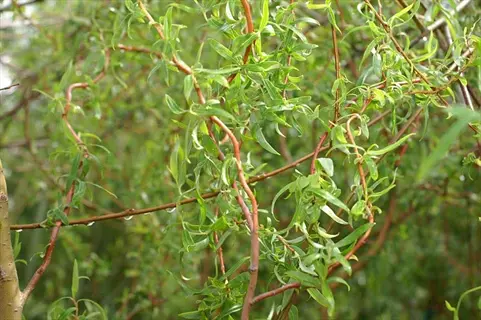
- Botanical link: A contorted willow with curling, twisted stems, often linked to Salix babylonica var. tortuosa.
- Look: Spiraling, corkscrew branches stay interesting even when bare, making it a favorite for cut-stem arrangements.
- Size: Reaches a substantial tree size, so give it room rather than crowding it against fences or buildings.
- Best for: Gardeners who want winter structure and unusual stems as much as the classic weeping silhouette.
- Care: Shares the willow love of moisture and sun, with the same need for careful siting away from pipes.
- Note: The twisted stems are popular with florists and crafters, adding value beyond the living tree itself.
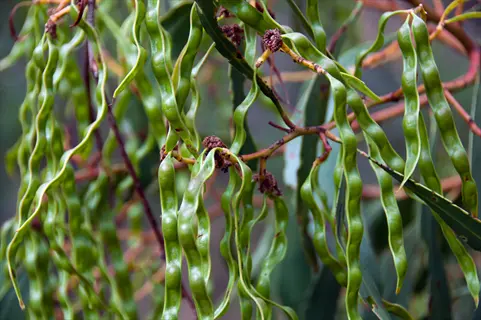
Crispa Or Ram's Horn
- Botanical link: A weeping willow form known as Crispa or Ram's Horn, named for its distinctive curled foliage.
- Look: Leaves roll and curl along the weeping branches, giving the canopy a finer, more textured appearance.
- Size: Grows as a full weeping willow, so plan for the same mature spread as other large willow forms.
- Best for: Collectors and gardeners who want a familiar weeping shape with an unusual leaf texture up close.
- Care: Treat it like any weeping willow, with abundant water, full sun, and dormant-season pruning for shape.
- Note: The curled leaves are the signature feature, setting it apart from smooth-leaved weeping willows.

Dwarf Weeping Willow
- Botanical link: Usually Salix integra Pendula, a compact relative grown for small gardens and large containers.
- Look: A small, cascading head of branches, often grafted on a short standard trunk for a neat mounded shape.
- Size: Stays far smaller than the species, making it the practical choice where a full willow would never fit.
- Best for: Patios, courtyards, and pots where gardeners want the weeping look without the 50 ft (15 m) spread.
- Care: Needs consistent moisture in its container or bed, plus light pruning to keep the rounded form tidy.
- Note: This is the go-to answer for anyone who loves the weeping form but lacks the space or the right site.
No room for a 30 to 50 ft (9 to 15 m) tree? You can still grow the weeping look. Reach for the dwarf weeping willow, sold as Salix integra Pendula. It fits a large pot or a tiny garden bed and keeps the cascading shape on a small frame.
Pick the variety that suits your space and the season you most want to enjoy. The full-size forms reward a big damp site. The compact Salix integra brings the same charm to a patio pot. Match the variety to the spot and the tree all but cares for itself.
Willow Bark And Aspirin
The tree in your yard helped give the world its most common painkiller. The willow bark aspirin story runs back thousands of years. Most plant guides give this angle one quick line, so here is the full story. A peer-reviewed analysis calls it an unbroken line that ran for several thousand years. That makes the weeping willow far more than a pretty face by the pond.
People reached for willow bark to ease pain and bring down fevers long before anyone knew why it worked. Here is one plain fact worth a closer look. Native Americans chewed willow twigs and bark to fight off headaches, a detail backed by NC State and UF research. The bark held a natural compound that did real work, and they trusted it through trial and error.
The key compound here is salicin. Your body turns it into a thing we call salicylic acid. That is the part that fights your pain and your fever. Chemists then made a milder form and gave it a long name, acetylsalicylic acid. We just call it aspirin now. So the willow tree painkiller in your cabinet traces a clean path back to the bark on this tree.
Ancient Times
People across many cultures used willow bark to relieve pain and bring down fevers, long before any chemistry existed.
1763
Rev. Edward Stone reported willow bark's fever-reducing effect to the Royal Society of London after testing it himself.
1829
French chemist Henri Leroux isolated salicin, the active ingredient in willow bark, in pure crystalline form.
1899
Bayer developed and patented acetylsalicylic acid under the name aspirin, completing the path from bark to tablet.
Each step built on the last. Edward Stone ran his own test and brought the results to the Royal Society in 1763. Henri Leroux pulled pure salicin out of the bark in 1829. Then Bayer turned that science into a patented tablet in 1899. A folk remedy became a global drug in under 150 years.
For centuries, people used willow bark to relieve pain and treat fevers.
One clear safety note matters here. This is history, not a home remedy. A modern aspirin tablet gives you an exact, tested dose, but raw willow bark is not standardized at all. The amount of salicin shifts from tree to tree and season to season, so you can never trust the strength. Enjoy the story, and leave the dosing to the pharmacy.
5 Common Myths
The weeping willow comes from ancient Babylon, which is exactly what its scientific name Salix babylonica clearly tells us.
The tree is native to East Asia, mainly China. Linnaeus misnamed it in 1736 after misreading a Bible passage that likely refers to poplars.
Weeping willow roots actively hunt for and break into sound, sealed underground pipes from many feet away just to find water.
Roots do not crack sealed pipes, but they aggressively invade existing leaks and joints, so siting far from water and sewer lines still matters greatly.
A weeping willow is a perfect, low-maintenance shade tree for a small suburban front yard close to the house.
Two university sources advise against planting it on typical home lots because of litter, breakage, disease, and roots; it suits large, open, damp sites.
Because they grow so quickly and look so lush, weeping willows are long-lived trees that will outlast the gardener by far.
Fast growth comes with weak, brittle wood and a short life, often only around 30 years, which is much shorter than many shade trees.
Chewing modern willow bark is the same as taking an aspirin tablet, so it works as a safe and reliable home painkiller.
Willow bark contains salicin, the natural precursor to aspirin, but it is not standardized medicine and should never replace tested, dosed drugs.
Conclusion
Few trees give you the beauty of a weeping willow tree for so little patience. Its fast growth climbs 30 to 50 ft (9 to 15 m) tall, and it can add 3 to 4 ft (1 to 1.2 m) in a single year. The trade for that speed is a short run of about 30 years and a root system that does not forgive a cramped spot.
So the siting verdict stays simple. This tree rewards a large, damp, open site, and best of all right near water where its roots can chase the moisture they crave. Drop it in a small suburban yard and it frustrates you, since you fight the same roots for the life of the tree. Plant it at least 50 ft (15 m) from pipes, septic lines, and buildings, and you skip the costly repairs that turn a dream tree into a regret.
Smart weeping willow care starts before you ever dig the hole. Many willows sold as the true species are hybrids, so confirm the cultivar and pick the site first. Get both right and the rest is easy. The honest answer to should you plant a weeping willow comes down to one thing, and that is the room you can give it.
There is a nice closing thought in all this. The same tree drapes a lakeside in living gold. It is also the tree that gave us the path to aspirin, from willow bark to the pill in your cabinet. That mix of beauty and quiet substance is the willow in a nutshell. Match it to the right ground, and it will earn every bit of the love it gets.
Glossary
- acetylsalicylic acid
- The chemical name for aspirin, the medicine developed from the willow-derived salicylic acid.
- catkins
- The slim, hanging clusters of tiny flowers that willows produce, named for their soft, tail-like shape.
- deciduous
- Describes a tree that drops all of its leaves each year and goes dormant through winter.
- dormant
- A resting state a tree enters in cold weather when growth pauses until spring.
- Salicaceae
- The willow plant family, which includes willows and poplars.
- salicin
- The natural compound in willow bark that is the precursor to salicylic acid and ultimately to aspirin.
- salicylic acid
- The pain-relieving acid derived from willow salicin that leads to the making of aspirin.
- Salix babylonica
- The botanical name for the weeping willow, the species misnamed by Linnaeus after Babylon though it is native to East Asia.
External Sources
Frequently Asked Questions
What is special about a weeping willow?
Its long, ground-sweeping branches, very fast growth, and the salicin in its bark that led to aspirin make it stand out.
What painkiller comes from a willow tree?
Aspirin. Willow bark holds salicin, the natural precursor to salicylic acid and ultimately acetylsalicylic acid, sold as aspirin.
Where is the best place to plant a weeping willow tree?
A large, open, sunny site near water, at least 50 ft (15 m) from buildings, pipes, and septic systems.
Do weeping willows need a lot of water?
Yes. Weeping willows are moisture-loving trees that thrive in damp soil and near ponds, lakes, and streams.
What is the lifespan of a weeping willow?
Often around 30 years. Some sources report 40 to 75 years in ideal conditions, but it is a short-lived tree.
How big is a 5 year old willow tree?
Often 15 to 20 ft (4.5 to 6 m) tall, since weeping willows grow about 3 to 4 ft (1 to 1.2 m) per year.
What happens to weeping willows in winter?
They are deciduous, so they drop their leaves and go dormant. Bare golden branches stay visible through the cold months.
Why do they call it a weeping willow tree?
The name comes from its drooping branches, which look like falling tears, especially when rain drips from the leaves.
What is the superstition about weeping willows?
Folklore links the weeping willow to grief, mourning, and protection, which is why it often appears in cemeteries and poetry.
Why are weeping willows banned in Australia?
They spread aggressively along waterways and are listed as invasive weeds in parts of Australia, leading to control and sale restrictions.