
Introduction
Run your hand across a clump of soft, silver-gray leaves and you will get why the lambs ear plant wins people over fast. The leaves feel like velvet. Kids and adults reach out to pet them without thinking. That woolly silver mat is the whole appeal. This guide gives you the exact, university-sourced numbers to keep it looking its best.
Lamb's ear, or Stachys byzantina, is a silver-leaved perennial in the mint family. It stays green much of the year, so it counts as semi-evergreen. The plant grows 12 to 18 inches (30 to 46 cm) tall and just as wide. It forms a low carpet that spreads on its own. The plant is hardy in USDA zones 4 to 8, and to 9 in some places. Its silver foliage looks good for most of the season. That is why gardeners use it as a tough perennial groundcover along paths and borders.
This plant comes from the rocky hills of Turkey, the Caucasus, Armenia and Iran. That dry, rough homeland tells you a lot about how it acts in your yard. It thrives on lean soil and drought once the roots take hold. It hates wet feet more than almost anything else. Get the drainage right and you have a drought tolerant plant that asks for very little.
This guide to the lamb's ear plant fills two gaps that other care guides tend to dodge. You get a straight answer on pet and child safety, not a vague brush-off. You also get a real rescue plan for humid regions where the leaves turn mushy. From there you will learn care basics, planting, and watering. You will also cover pruning and dividing, the best cultivars, and smart design pairings. Stick with it. That soft silver mat will be the easiest payoff in your garden.
Lamb's Ear Plant Care Basics
Good lamb's ear care starts with a simple truth that most quick guides bury. This plant grows for its silver foliage, not its flowers. You want those soft, woolly leaves to stay thick and bright, so every choice you make should protect the foliage mat first.
The numbers from NC State Extension and the Missouri Botanical Garden give you a precise picture. A lamb's ear plant reaches 12 to 18 inches tall and wide, and the leaves grow 4 to 6 inches long. The foliage forms a mat just 4 to 6 inches off the ground. It thrives in USDA zones 4 to 8, with some references stretching that to zone 9.
Lamb's ear is a popular silver-leaved, semi-evergreen, herbaceous perennial ground cover in the mint family (Lamiaceae).
Light and soil are where this plant earns its reputation as a drought tolerant survivor. Give it full sun, meaning 6 or more hours a day, and well-drained soil that drains fast and stays lean. Think of lamb's ear as a tough desert native dressed in velvet. It is built for dry, sunny, hungry sites, so the kindest thing you can do is hold back rather than fuss.
That restraint matters because the plant's single biggest weakness is excess moisture and humidity. Wet roots and muggy, still air rot the crown and spot the leaves faster than anything else. Keep your patch open and airy, and most of those problems never start.
The payoff is a filler that holds problem spots no other plant will touch. Lamb's ear is deer resistant and rabbit resistant, and it shrugs off the juglone that walnut trees leak into the soil. Plant it where browsers and a hostile walnut have beaten you before, then water it once and step back.
Planting and Growing Conditions
Getting the growing conditions right matters more than any care step you do later. This plant comes from lean, rocky ground in Turkey and the Caucasus, so it wants the same dry, gritty home in your yard. Give it that, and the silver leaves stay dense and upright instead of loose and floppy.
Learning how to plant lamb's ear comes down to two choices you make on day one. Pick a spot with full sun, which means 6 or more hours of direct light each day. In hot, humid summers a bit of afternoon shade helps the leaves stay dry and cool.
The soil part is simple but easy to get wrong. Lamb's ear takes clay, loam, sand, or shallow rocky ground across a wide pH range, and it even shrugs off the toxins from black walnut trees. What it cannot stand is wet feet, so well-drained soil is the one thing you can't skip. Resist the urge to dig in rich compost, since lean dirt keeps the foliage tight and silver.
Here are the steps I follow every time I set out a new patch.
Choose a spot with 6 or more hours of direct sun and fast-draining soil; a slight slope helps in hot, humid regions.
Loosen the bed and improve drainage with grit if needed, but skip rich compost and fertilizer, which lamb's ear dislikes.
Place each plant so the crown sits level with the surrounding soil, never buried, to keep the woolly base dry.
Set plants 12-18 inches (30-46 cm) apart so they knit into a mat with room for air to move between rosettes.
Water once to settle the roots, then water sparingly; established lamb's ear prefers dry conditions to soggy soil.
That spacing of 12 to 18 inches is worth getting right. Set the plants too close and air can't move between the rosettes, which invites rot in damp weather. Give them that gap and they knit into a soft mat over a season or two.
You can also grow it from seed if you want a bigger patch for less money. Start the seed indoors 8 to 10 weeks before your last frost date, and be patient, because germination can take up to a month. Most gardeners still prefer division off an existing clump, since it's faster and gives you a known plant.
One clump in a low, damp corner of my zone 6 garden turned to mush after a wet July. The crown fell into a brown, slimy heap. I lifted it out with two fingers, and the woolly leaves below had rotted flat. That same week, the Big Ears row along my sunny gravel path was thick and dry and silver, soaking up the heat off the stones.
Before planting, fill the hole with water; if it does not drain within a few minutes, raise the bed or add grit, because slow drainage is the fastest route to crown rot.
Watering and Humidity Rescue
The golden rule for watering lamb's ear is simple. It wants its feet dry and its leaves drier. Water at soil level in the morning so the base soaks up what it needs. Never water from above, or the woolly leaves sit wet through the night and start to rot.
That first season is the one time you need to pay close attention. Give a young plant modest water until the roots take hold, and then back off. A mature clump lives on rainfall alone in most climates, so overwatering does far more harm than a dry spell ever will. Drought tolerance only kicks in once the plant settles in.
Texas Tech notes this plant has a low tolerance for humidity and recommends good airflow to keep the leaves dry. UW-Madison warns that too much moisture causes the crown to melt out into a mushy mess. If you garden in the humid Southeast, you face the hardest battle with lamb's ear of anyone. The fix is not avoiding moisture, since you cannot control the weather. The fix is managing how the plant sheds it.
Most guides tell you how to dodge root rot before it starts. Few tell you what to do once a wet week has already left your patch soft and slumped. The steps below walk you through the rescue, during the wet spell and in the days after it breaks.
- Improve airflow: Thin crowded rosettes and remove fallen leaves so air moves freely and the woolly foliage dries fast after rain.
- Cut out rot: Remove any brown, mushy, or collapsed crowns down to firm tissue so the rot does not spread through the mat.
- Water at soil level: Water in the morning at the base only, never over the leaves, so the woolly surface never stays damp overnight.
- Lift and replant: If a center has melted out, lift the healthy outer rosettes and replant them on a slope or raised, grittier ground.
- Hold off all fertilizer, which pushes soft growth that rots even faster in humid air.
Overhead sprinklers and evening watering are the most common cause of failure; wet woolly leaves overnight invite leaf spot, powdery mildew, and crown rot.
One more move pays off long after the rain stops. NC State advises planting on a hill or slope in hot, humid areas so water drains away from the crown instead of pooling around it. Raised, gritty ground does the same job. Get the drainage right once, and you spend far less time fighting powdery mildew and crown rot every soggy season after.
Pruning, Dividing and Propagation
A little upkeep keeps lamb's ear looking its best instead of tired and patchy. The main jobs are simple. You snip the spent flower spikes, tidy the mat in spring, and split crowded clumps every few years.
Deadheading is the first thing to handle once the purplish-pink spikes fade in midsummer. Removing flower spikes sends the plant's energy back into the soft silver leaves you grow it for. It also keeps the mat tidy and cuts down on self-seeding, so you get fewer surprise seedlings the next spring. Cut each spike back to the base of the foliage and toss it.
Give the mat a quick grooming in early spring too. Pull out any leaves that turned brown or mushy over winter so fresh rosettes can fill in. This one pass clears out matted debris and gets more air to the crowns, which lowers your odds of rot.
Dividing lamb's ear every 2 to 4 years keeps the clumps vigorous. Some growers stretch that to 4 to 5 years, or just wait until the center starts to die out. The middle of an old clump thins first. The edges stay strong. Split it in spring or early fall while the weather is cool, so the plant settles in before heat or hard cold.
I was kneeling at the sunny edge of the gravel path, working a fork under a three-year-old Big Ears clump whose middle had gone bare and woody. The whole mat lifted in one shallow slab, roots and all. The outer ring pulled apart in my hands into fist-sized pieces, each one a knot of firm rosettes with white roots still clinging. I reset those rooted outer chunks back along the path. Within a few weeks they had spread into full velvety patches. The dead center went on the compost.
Lift clumps every 2 to 4 years in cool weather, ideally once the center has started to thin or die out.
Dig under the shallow root mat and ease the whole clump out of the ground with a fork or spade.
Separate the clump by hand into smaller pieces, each one with healthy roots and several firm rosettes.
Reset divisions 12 to 18 inches (30 to 46 cm) apart at soil level, water in once, then go back to sparing watering.
Like the species, 'Cotton Boll' has few pests and is not eaten by deer or rabbits.
Division is by far the most reliable way to make new plants. The stems root wherever they touch soil. So the easiest propagation trick is to pull a rooted rosette off the edge of the mat and move it. That beats stem cuttings every time. The new piece already has its own roots, so it barely notices the move.
Best Lamb's Ear Varieties
The foot-long, near-silver leaves of my Big Ears planting line the sunny gravel path. They almost never push up a flower spike. I planted that row myself, and the mat stays tidy all season. I picked it over the flowering species on purpose. The plain lamb's ear throws up tall pink spikes that flop and drop seed, and I wanted a clean front-of-border carpet instead.
That choice points to the real question with lamb's ear varieties. A list of names alone still leaves you guessing which one fits your spot. Pick by your goal and your climate, and the choice gets simple.
Want bold velvety texture with almost no cleanup? Reach for non-blooming cultivars like Big Ears or Silver Carpet. Do muggy summers keep killing the plain species? Cotton Boll is your best bet. It handles humidity better than the species. It also stays sterile, so it will not seed around. Each of the four below works in its own way.
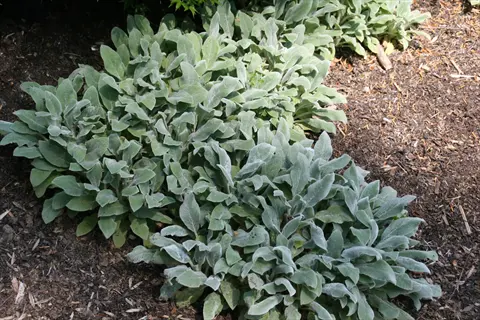
Big Ears (Helene von Stein)
- Best for: Gardeners who want maximum foliage impact and minimal maintenance in a front-of-border or groundcover role.
- Leaves: Oversized leaves up to a foot long, roughly twice the size of the species, in soft silver-green.
- Flowering: Blooms very little, so there is almost no deadheading and little self-seeding to manage.
- Spread: Forms a dense mat that knits together well while staying easy to keep within bounds.
- Climate: A dependable all-rounder across zones 4-8 (to 9 in some references) given good drainage.
- Why choose it: The go-to cultivar when you want bold velvety texture without flower-spike cleanup.

Cotton Boll
- Best for: Humid-climate gardeners who struggle to keep the species healthy through muggy summers.
- Flowering: A sterile cultivar whose flowers are modified into fuzzy cottony clusters on spikes that can flop.
- Humidity: Performs better in humid areas than the species, though it regenerates more slowly after stress.
- Evaluation: Rated 4 out of 5 in a multi-year Chicago Botanic Garden evaluation, matching the species.
- Propagation: Being sterile, it can only be increased by division, never from seed.
- Why choose it: The smart pick where humidity normally defeats lamb's ear and you want controlled spread.

Silver Carpet
- Best for: Edging, pathways, and tight spaces where a low, even silver sheet is the goal.
- Habit: A low, ground-hugging carpet of woolly silver foliage that stays neat and compact.
- Flowering: Generally non-flowering, so it stays tidy with little grooming through the season.
- Use: Excellent as a clean silver edge that mutes and binds bolder colors around it.
- Maintenance: Low upkeep thanks to its shy bloom and dense, weed-suppressing mat.
- Why choose it: The classic choice for a uniform silver border without tall flower stalks.
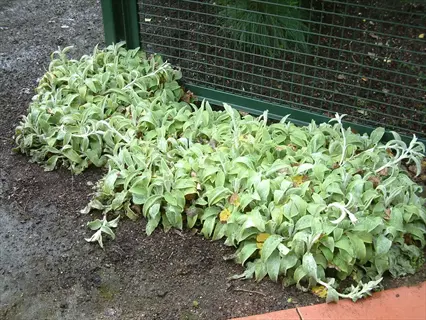
Primrose Heron
- Best for: Gardeners wanting a seasonal color twist on the usual silver foliage.
- Color: New spring growth emerges with a soft yellowish cast before maturing toward silver-gray.
- Texture: Keeps the same soft, woolly, touchable leaf surface the genus is loved for.
- Habit: Forms a spreading mat similar to the species with comparable care needs.
- Climate: Performs best in full sun with sharp drainage like other lamb's ear cultivars.
- Why choose it: A subtle way to add early-season warmth among cooler silver and gray plantings.
Notice the pattern across these picks. The sterile and shy-blooming cultivars are the modern answer to the old worry that lamb's ear takes over a bed. Less flowering means less seed, and less seed means far less spread to pull out later. Match the cultivar to your goal first, then check that it fits your zone. That two-step test points you to the right plant fast.
If spread or flower cleanup worries you, choose a sterile or shy-blooming cultivar such as Cotton Boll or Big Ears; less seeding means far less unwanted spread.
Garden Design and Companions
Silver-gray foliage is the secret weapon most gardeners overlook. It mutes your loud colors and binds them together, so your busy bed reads as calm instead of chaotic. Lamb's ear sits between two bright neighbors like a referee and quiets the whole scene down for you.
Its low, woolly mat also makes a clean edging plant along a path or border front. The leaves spill just over the line and soften that hard edge between bed and lawn. As a ground cover, the same dense mat crowds out weeds and saves you hours of pulling each summer.
Here is the angle nobody talks about. Those silver leaves catch and bounce low evening light, so a mass of lamb's ear seems to glow at dusk. Plant a drift beside your patio or seating area and the bed comes alive again right when the sun drops. That is the heart of a moon garden.
Below are four schemes that put the plant to work for you. Each one names companions that share the same sun and drainage needs, so your whole group stays healthy in lean, dry soil.
Silver edge for hot color
- Role: Use lamb's ear as a low silver ribbon along a border front to cool and unify brighter neighbors.
- Pairings: Set it beside saturated salvia, roses, or daylilies so the gray foliage softens and binds the color.
- Effect: The muted silver acts as a calm visual buffer that keeps a bold bed from feeling busy.
- Care match: All these companions share lamb's ear's love of sun and sharp drainage, keeping the group healthy.
Drought-tolerant gravel and rock garden
- Role: Let lamb's ear spill over rocks and gravel as a soft, weed-suppressing silver mat.
- Pairings: Combine with sedum, catmint, Russian sage, and salvia for a water-wise, sun-loving grouping.
- Effect: The silver foliage reads as a cooling foil against stone and warm-toned succulents.
- Care match: A xeriscape pairing where every plant thrives on lean soil and minimal water once established.
Moon and white garden
- Role: Mass lamb's ear where it catches low evening light so the silver leaves seem to glow at dusk.
- Pairings: Combine with white flowers and other silver foliage near a path, patio, or seating area.
- Effect: The reflective leaves extend the garden's visual life into twilight and moonlit hours.
- Care match: Keep the planting in full sun by day so the foliage stays dense, dry, and brightly silver.
Sensory and children's garden
- Role: Place lamb's ear at the edge of a path where hands naturally reach for the soft, velvety leaves.
- Pairings: Group it with other touchable, fragrant, and safe plants to build a rich tactile experience.
- Effect: The woolly texture invites touch, making it a favorite in children's gardens.
- Care match: Its toughness and pet-and-child-friendly reputation suit busy, well-used family spaces.
The trick is to think in design schemes, not loose lists. Pick one job for the silver foliage, then build the bed around it. A few smart companion plants do far more for the look than a dozen random picks crammed together. In a sensory garden, that one soft, velvety plant at the path edge can become the part visitors talk about most.
Keep companions to other sun-and-drainage lovers such as catmint, sedum, and Russian sage, so the whole grouping shares the same lean, dry, well-drained conditions and stays healthy together.
5 Common Myths
Lamb's ear is a proven medicinal woundwort, so its leaves can be used as a reliable natural bandage for cuts.
The wound-dressing folklore belongs to other Stachys species, not Stachys byzantina specifically; treat it as unverified history, never as medical advice.
Lamb's ear needs frequent watering and rich, fertilized soil to grow into a thick, healthy silver carpet.
It is drought-tolerant and looks best in lean soil with little water; overwatering and feeding cause floppy growth, rot, and disease.
Lamb's ear is grown for its showy flowers, so you should always let the tall bloom spikes fully develop.
It is grown mainly for foliage; many gardeners remove the small purplish-pink spikes to boost vigor and keep the silver mat tidy.
Lamb's ear is hopelessly invasive and will overrun any garden bed it is planted in within a single season.
It spreads steadily but is shallow-rooted and easy to pull; sterile cultivars and division keep it well within bounds in most gardens.
Because the leaves are soft and fuzzy, lamb's ear must be a delicate plant that struggles in tough sites.
It is tough and adaptable, tolerating poor soil, drought, heat, and black walnut; its real weakness is excess moisture, not hardship.
Conclusion
Those soft, woolly leaves are still the reason most people stop and reach out a hand. The lamb's ear plant earns its spot in the garden on touch alone, and the silver foliage keeps that promise from spring straight through fall. Once it settles in, you get a velvety carpet that asks for almost nothing in return.
The numbers worth keeping are short. This plant lives happily in zones 4 to 8, and as far as zone 9 in some references. Each clump grows 12 to 18 inches (30 to 46 cm) tall and wide, wants full sun of 6 hours or more, and needs lean, well-drained soil to thrive. Lift and split your clumps every 2 to 4 years to keep the centers fresh, and that is most of the upkeep right there.
Here is the one fact that decides everything. Too much moisture, not neglect, is what kills lamb's ear. A soggy spot or a humid summer rots the crown faster than any pest ever could. So go easy with the hose, plant on a slope if your air sits heavy, and let the drought tolerant roots do their job. Sharp drainage and a dry touch are the whole game.
Pick a sterile or shy-blooming type like Cotton Boll or Big Ears. Give it sun, and grant it that fast-draining ground. Those few choices solve nearly every common gripe about this plant at once. It rewards a light hand more than a busy one. For a low maintenance silver groundcover that forgives the forgetful gardener, few plants give back this much for so little.
Glossary
- Crown meltout
- The collapse of a plant's dense center into soft, rotted tissue during hot, wet, or humid spells.
- Crown rot
- Decay of the base of a plant where stems meet roots, usually caused by soil that stays too wet.
- Groundcover
- A low, spreading plant used to carpet bare soil and suppress weeds.
- Herbaceous perennial
- A plant that lives for years, with soft non-woody stems that often die back each winter and regrow.
- Powdery mildew
- A fungal disease that coats leaves with a white, powdery film in humid, still air.
- Semi-evergreen
- A plant that keeps its leaves through mild winters but drops or dies back in cold ones.
- Stachys byzantina
- The botanical (scientific) name for lamb's ear, a silver-leaved perennial in the mint family.
- Stolons
- Stems that creep along the soil surface and root where they touch, letting a plant spread sideways.
External Sources
Frequently Asked Questions
Is lamb's ear a sun or shade plant?
Lamb's ear is primarily a full-sun plant that needs 6 or more hours of direct light daily, though it tolerates light afternoon shade in hot climates.
Does lamb's ear spread quickly and become invasive?
Lamb's ear spreads steadily by stems that root where they touch soil and can be aggressive in rich soil and warm climates, but it is easy to pull and control.
Why is my lamb's ear turning brown and mushy?
Brown, mushy lamb's ear is almost always caused by too much moisture, leading to root rot, crown rot, or fungal leaf disease in humid conditions.
Is lamb's ear safe to touch and handle?
Yes, lamb's ear is safe to touch and its soft, velvety leaves make it a favorite in children's and sensory gardens.
Is lamb's ear toxic to dogs, cats or humans?
Lamb's ear is widely regarded as non-toxic to people and pets, but it is not on the ASPCA list, and any plant can cause mild stomach upset if eaten.
Will lamb's ear survive winter?
Lamb's ear is a hardy perennial in zones 4-8 that survives winter, staying semi-evergreen in mild areas and dying back near the ground in cold ones.
Can lamb's ear grow in pots and containers?
Yes, lamb's ear grows well in pots with sharp drainage and a gritty soil mix, as long as containers never stay waterlogged.
Is lamb's ear low maintenance to grow?
Yes, lamb's ear is very low maintenance, needing little water, no fertilizer, and only occasional dividing and flower removal once established.
What are common lamb's ear problems?
The most common lamb's ear problems are:
- Root and crown rot from wet soil
- Powdery mildew and leaf spot in humid air
- Centers dying out as clumps age
- Floppy flower stalks that reduce vigor
What does lamb's ear repel in the garden?
Lamb's ear is resistant to deer and rabbits, which avoid its fuzzy, woolly leaves, though it does not reliably repel insects.