

Introduction
Few trees say Tuscany like the italian cypress. You see it as the slim dark green column that lines old Mediterranean roads and frames villa gardens. You have likely pictured one without knowing its name. This tree shoots straight up into a narrow spire and gives any yard a formal, timeless look.
The shape is what surprises most buyers. A mature tree reaches 40 to 70 feet (12 to 21 meters) tall but stays only 3 to 6 feet (0.9 to 1.8 meters) wide. That pencil habit is why you can plant it in tight rows. I planted a row of these at a client's drive, and they topped a two-story roof in under a decade. The team at UF/IFAS said it forms tall columns that look almost like a green telephone pole. That tells you why placement and height matter so much.
You will love this columnar evergreen for two big reasons. It makes a sharp formal accent on its own. A line of them also builds a fast, solid privacy screen. It is famously drought tolerant once the roots settle in. So it has taken off in warm, water-wise yards across the country. You may see it sold by its plant name, Cupressus sempervirens, and that is the true mediterranean cypress.
You probably have a few real worries before you buy one. This guide gives you clear italian cypress care steps for each of them. You get honest answers on planting near a house, how the roots behave, and how long the tree lives. And you will learn how to spot and handle cypress canker before it spreads. Let us start with how big these trees really get.
Italian Cypress At A Glance
Here are the italian cypress size numbers you came for. A mature tree reaches 40 to 70 feet (12 to 21 meters) tall but stays only 3 to 6 feet (0.9 to 1.8 meters) wide. That tight column is why this tree shows up along driveways and against tall walls where a normal tree would never fit.
So how big do italian cypress get in real yards? Most top out near that 40 to 70 foot mark. The largest one on record, in Kearny Park in Fresno, hit 92 feet (28 meters) with a 39 foot (12 meter) crown spread. Yours will not do that, but it shows what the species can manage over a long life.
The italian cypress growth rate is the part that trips people up. A young tree can add 1 to 3 feet (0.3 to 0.9 meters) of height each year. Think of it as a fast vertical column shooting up early, then nearly stopping once it reaches mature height. Growth rate depends a lot on the tree's age.
Climate and water push that range around too. Trees in hot regions with summer irrigation hit the fast end of the columnar growth scale. Cooler or drier sites grow slower, and that is normal. Check the quick facts below, then read on for the 10-year picture.
Picture the first 10 years. A tree you plant at 3 feet can clear 20 to 25 feet in good conditions by year 10, gaining the most in those early seasons. After that the climb slows hard, and the tree spends decades filling out and firming up rather than shooting taller. That early speed is why a small starter plant becomes a real screen so fast.
Best Growing Conditions
I planted three Stricta Italian cypress along the south side of my gravel driveway about 8 years ago. I watch them from the kitchen window each morning. The two on the sandy end got an even drink through summer. They shot up tall and tight. The third sat in a low, slow-draining spot. It yellowed and lagged behind by a couple of feet. Same trees, same day in the ground, same handful of fertilizer.
That gap had nothing to do with feeding. It came down to drainage and steady moisture. Italian cypress wants full sun, with at least 6 hours of direct light each day. The tree is shade intolerant, so it thins out in low light. A thin canopy is a weak, stress-prone canopy.
Soil drainage matters even more than sun. This is a well-drained soil tree first and a fussy one second. It grows in sand, loam, or clay across acidic to alkaline pH, so you rarely need to amend for fertility. What it cannot stand is wet feet, because soggy roots in heavy ground lead straight to root rot.
The tree is drought tolerant once it settles in, but that toughness is earned, not instant. The real watering needs sit in the first year or two, when young roots reach out and need a regular drink. After that, a deep soak now and then is plenty. One good drink in late fall guards against winter drying. Drought stress and winter stress both leave a tree wide open to cypress canker, so steady water is protection, not just food.
Italian cypress is hardy across USDA zones 7B to 11. It feels at home in warm, dry, Mediterranean climates. The tree shrugs off heat, wind, and coastal salt spray. Match these conditions and you keep it dense, dark green, and disease-free. The details below break each one down.
Full Sun Exposure
- Light: Give the tree at least 6 hours of direct sun each day, because it is shade intolerant and thins out in low light.
- Placement: Choose an open, south-facing or west-facing spot away from tall buildings and dense canopy that would cast long shadows.
- Result: Full sun keeps the dark green foliage dense and the column tight, which is the look most gardeners want from this tree.
Well-Drained Soil
- Drainage: The single most important soil trait is sharp drainage, since standing water around the roots quickly leads to root rot.
- pH and type: The tree tolerates sand, loam, and clay across acidic, neutral, and alkaline pH, so amending for fertility is rarely necessary.
- Tip: On heavy clay, plant on a slight mound or slope so water drains away from the root zone instead of pooling.
Watering For Establishment
- Young trees: Water regularly during the first one to two years so roots establish, since the tree is only highly drought tolerant once mature.
- Established trees: After establishment, deep but infrequent watering is plenty, and a deep soak in late fall helps prevent winter desiccation.
- Avoid: Do not keep the soil constantly wet, because consistent overwatering causes more cypress problems than underwatering does.
Warm, Dry Climate
- Zones: The tree is hardy in USDA zones 7B to 11 and is happiest in warm, Mediterranean-style climates with dry summers.
- Humidity: Prolonged fog, light rain, and high humidity favor fungal disease, so airflow and a sunny, breezy site help keep foliage dry.
- Heat and salt: It tolerates heat, wind, and coastal salt spray well, which makes it a dependable choice for exposed, sunny landscapes.
Overwatering in heavy, slow-draining soil is the fastest way to harm an established Italian cypress, since soggy roots invite root rot in a tree built for dry conditions.
Planting Near A House And Roots
Most large trees scare you away from the house because their roots crack pipes and lift slabs. Italian cypress roots do not work that way. The University of Florida found these roots are not a problem, so you can plant much closer to a wall than you could with a spreading shade tree.
The real limit when planting near a house is the crown, not the roots. This tree grows 40 to 70 feet (12 to 21 meters) tall but stays just 3 to 6 feet (0.9 to 1.8 meters) wide. That narrow column means you measure your spacing for clearance from eaves and gutters, not for root fear.
For italian cypress spacing, the answer depends on your goal. Keep a single tree 6 to 10 feet (1.8 to 3 meters) out from a foundation so the crown stays clear of the roofline. The non-invasive roots let you sit it nearer than the rules for an oak or maple ever would.
- Space trees about 3 feet (0.9 meters) apart so the narrow columns knit into a solid green wall.
- Set the row 6 to 10 feet (1.8 to 3 meters) out from a fence or foundation to leave room for the mature crown.
- Use a straight, evenly spaced line for the formal, uniform look the tree is famous for.
- Plan for the full mature height of 40 to 70 feet (12 to 21 meters) when screening tall views.
- Place a single tree 6 to 10 feet (1.8 to 3 meters) from the house so the column stays clear of eaves and gutters.
- Frame an entry or corner with a matched pair for a balanced, formal accent.
- Because roots are non-invasive, you can plant nearer a wall than you could with a spreading shade tree.
- Keep clear of overhead lines, since the tree grows tall and narrow rather than wide.
For a privacy screen, tighten the spacing to about 3 feet (0.9 meters) between trunks so the columns knit into a solid green wall. Hold that row 6 to 10 feet (1.8 to 3 meters) off the fence or foundation, and plan for the full mature height when you screen a tall view. Want the root biology and depth in detail? See the roots FAQ below for the full breakdown.
Cypress Canker And Problems
Most italian cypress problems start the same way. One day a single branch fades to yellow, then turns a dull reddish-brown while the rest of the tree stays green. That patchy browning has a name. It is called flagging, and it is the first warning sign of cypress canker, the worst disease these trees face.
Cypress canker comes from a fungus that slips in through small wounds in the bark. From there it forms sunken cankers that ooze sticky resin, and it spreads fast through splashing water, wind, and dirty pruning tools. Cankers grow faster on trees that are already stressed from drought, so a thirsty tree is a sitting target.
Here is the hard truth nobody likes to hear. There is no fungicide that cures cypress canker. You cannot spray your way out of it. Your only real tool is sharp pruners and a steady hand, so catch it early and follow the steps below before the fungus spreads through your whole screen.
Look for flagging, where scattered branches turn yellow to reddish-brown amid healthy green growth, often with slightly sunken cankers that ooze resin.
Check that browning follows individual branches rather than the whole tree, which points to canker rather than overwatering, mites, or winter burn.
Cut 3 to 4 inches (8 to 10 centimeters) below each canker into healthy wood, and remove the diseased branches completely from the tree.
Wipe blades with a 10% bleach or 70% alcohol solution between every cut, then burn or bag the infected prunings to stop spread.
Water deeply in late fall, keep the tree out of soggy soil, and avoid wounding the bark, since healthy trees resist the fungus far better.
Currently, fungicides are not effective for controlling this disease.
Not every brown patch means canker, so it pays to play detective before you start cutting. If whole branches flag in random spots, think canker. If you see fine webbing and a dusty bronze look in hot dry weather, you have spider mites. A strong jet of water knocks most of them off.
When the inside of the tree browns out and the soil stays soggy, suspect root rot from poor drainage. Winter can also scorch foliage and leave brown tips after a cold, windy spell. So if you keep asking why your italian cypress turning brown wont stop, match the pattern to the cause first, then fix the real problem.
The thread running through all of this is stress. A tree with steady water, good drainage, and no fresh bark wounds shrugs off the fungus that kills weak ones. Is a screen already riddled with canker? The kindest fix is often to pull it out and replant with a tougher, canker-resistant species.
Lifespan And Top Cultivars
You will see very different numbers for italian cypress lifespan, so here is the honest version. NC State Extension calls the species long lived. A healthy tree in good soil holds on for many decades, and some reach a century or more. You will also read claims of trees thousands of years old, like the Abarkuh cypress in Iran. No one has confirmed those ages, so treat them as guesses, not facts.
Once you accept the tree will outlast most of your other plantings, the real choice becomes which cultivar to grow. They all share the same narrow column, drought tolerance, and care needs, so your pick comes down to color and how tight the column reads. If you want the prettiest cypress tree for your spot, you are just choosing a tone of green or gold, not a different plant.
I planted a row of Stricta along the south side of my driveway 8 years ago for its dense, tightly columnar habit. My neighbor put in blue-green Glauca across the fence around the same time. From my kitchen window in the late afternoon, her column reads cooler and stands apart while my dark green row holds its weight against the house. Same light, same care, two clearly different effects.
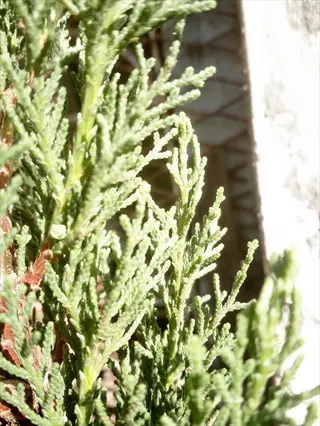
Stricta
- Look: A very popular, tightly columnar selection with a dense, narrow form that reads as the classic pencil cypress.
- Color: Deep dark green scale-like foliage that holds its rich color through the year.
- Use: A reliable default for formal screens and matched accent pairs framing entries or driveways.
- Size: Follows the species range of 40 to 70 feet (12 to 21 meters) tall and 3 to 6 feet (0.9 to 1.8 meters) wide.
- Care: Full sun, well-drained soil, and the same drought-tolerant routine as the species once established.
- Why choose it: The tightest, most uniform column, which is why it is the most widely planted form.

Glauca
- Look: A tight columnar form prized for its cooler tone, sometimes sold as blue Italian cypress.
- Color: Blue-green to gray-green foliage that contrasts handsomely against warmer green plantings.
- Use: A standout accent where you want the column to read cooler and stand apart from a green hedge.
- Size: Matches the species at 40 to 70 feet (12 to 21 meters) tall and just 3 to 6 feet (0.9 to 1.8 meters) wide.
- Care: Identical full-sun, sharp-drainage, drought-tolerant needs as other Italian cypress cultivars.
- Why choose it: Best pick when you want a distinctive blue-green vertical accent rather than plain green.
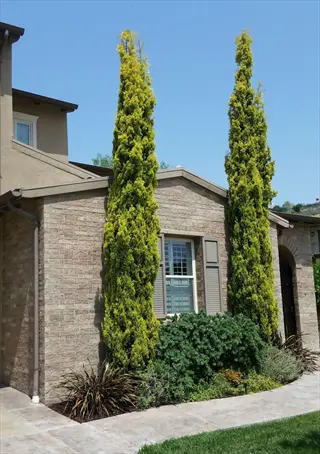
Swanes Golden
- Look: A compact, slow, narrowly columnar cultivar that stays smaller and tidier than the species.
- Color: Golden-yellow new growth along the column that brightens noticeably in full sun.
- Use: A warm-toned accent for smaller gardens and spots where a full-size cypress would overwhelm.
- Size: Stays well below the species maximum, making it easier to fit into modest landscapes.
- Care: Wants the same full sun and well-drained soil, with the gold color strongest in bright light.
- Why choose it: The go-to choice for golden color and a more manageable, compact column.
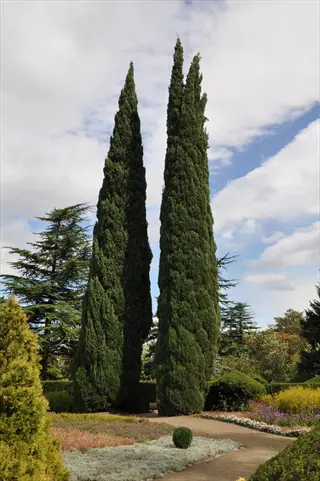
Horizontalis
- Look: The outlier of the group, with a spreading, wide-branching habit instead of the upright column.
- Color: The same dark green foliage as upright forms, just arranged on a broad, open frame.
- Use: A choice for gardeners who want cypress foliage in a horizontal, sculptural shape rather than a vertical accent.
- Size: Spreads much wider and stays far shorter than the columnar selections.
- Care: Shares the species needs for full sun, good drainage, and drought tolerance once established.
- Why choose it: Pick it only when you specifically want a spreading form, not the iconic pencil shape.
Match the cultivar to the job and you will be happy. Pick Stricta for the tightest formal screens. Pick Glauca for a cool blue-green accent. Pick Swanes Golden when you want a smaller, warm-toned column for a tight garden. Horizontalis is the odd one out, so save it for the rare spot where you want a wide, spreading shape.
Pruning, Topping And Size
Routine Pruning Is Rarely Needed
- Natural form: The tree holds its narrow column on its own, so extension sources advise against routine shearing.
- Disease risk: Every cut is a wound and a path for cypress canker, so less pruning usually means a healthier tree.
- When to cut: Limit pruning to removing dead, damaged, or diseased branches rather than shaping the whole tree.
Topping Changes The Shape Forever
- What happens: Cutting the top off flattens the column permanently, and it will not regrow to a natural point.
- When it makes sense: Flat-topping is mainly a fix for a tree growing into eaves or under a fixed height limit.
- Long term: A topped tree reads as a blunt green pillar rather than the iconic spire, so weigh the look before cutting.
Sterilize Tools Every Time
- Hygiene: Wipe blades with a 10% bleach or 70% alcohol solution between cuts to avoid spreading canker.
- Timing: Make any cuts in dry weather, since splashing water during wet spells helps the fungus move between wounds.
- Cleanup: Remove and destroy diseased prunings rather than leaving them near healthy trees.
Manage Size By Selection, Not Cuts
- Choose compact: Pick a smaller cultivar like Swanes Golden when a full 40 to 70 foot (12 to 21 meter) tree is too big.
- Right spot: Give a full-size tree an open site with vertical room so you never need to fight its height.
- Plan ahead: Because the tree grows fast then stops, choosing the right form at planting beats topping later.
Here is where the advice splits in two. Extension sources like UF/IFAS and NC State say you should not prune this tree at all, because the narrow column holds its shape on its own. Practical landscaping guides hand you topping steps instead. Both camps have a point, so you get the honest version of each and pick what fits your yard.
The case against pruning italian cypress comes down to wounds. Every cut opens a door for cypress canker, and the tree rarely needs help to stay slim. So the extension take is simple. Leave the shears in the shed unless you are cutting out a dead or diseased branch.
Now the topping reality, told straight. Cutting the top off a cypress flattens it for good. It will not regrow to a point, ever. Before the cut you have that classic spire reaching up like a green flame. After, you get a blunt green pillar with a flat cap, and that look is permanent.
That is why topping italian cypress is best treated as a last resort, not a habit. It makes sense when a tree is shoving into your eaves or sitting under a fixed height limit you cannot change. The smarter move is to handle size control before you ever plant.
Pick the right tree for the spot and you never fight its height. A dwarf cypress or a compact pick like Swanes Golden tops out small, so it suits a tight bed. A full-size tree wants an open site with room to climb. Because this cypress shoots up fast and then nearly stops, the form you choose at planting is the form you keep.
5 Common Myths
Italian cypress has aggressive, invasive roots that will crack foundations, pipes, and pavement if planted anywhere near a building.
University extension sources rate the roots as not a problem and non-invasive, since the narrow tree has a modest, well-behaved root system.
Italian cypress trees only live about fifty years, so they are a short-term choice that will need replacing within a generation.
Healthy trees live for many decades, and the species can persist for centuries when it stays unstressed and free of disease.
If your Italian cypress catches cypress canker, the right fungicide spray will clear up the infection and save the tree.
There is no effective fungicide cure for cypress canker, so management relies on pruning out infected wood and reducing tree stress.
You should prune and shear Italian cypress often, just like a hedge, to keep that tidy, narrow columnar shape looking neat.
The tree naturally holds a narrow column and extension sources advise against routine pruning, which is mostly unnecessary and can spread disease.
Italian cypress grows so slowly that you will wait many years before it is tall enough to screen a view or fence line.
Young trees grow fast, often 1 to 3 feet (0.3 to 0.9 meters) per year, reaching screening height in just a few seasons.
Conclusion
Good italian cypress care comes down to two things you get right at the start. Pick a sunny, well-drained spot, then give it steady water for the first year or two. After that, this columnar evergreen asks for almost nothing and rewards you with a clean vertical line that holds its shape for years.
Keep the locked numbers in mind as you plan. A mature tree reaches 40 to 70 feet (12 to 21 meters) tall but stays just 3 to 6 feet (0.9 to 1.8 meters) wide. Young trees grow fast, around 1 to 3 feet (0.3 to 0.9 meters) per year, then slow to a crawl. It handles USDA zones 7B to 11, and once it settles in, the drought tolerant roots shrug off long dry summers.
You can plant one close to the house without worry. The roots are non-invasive, so a spot near a foundation or wall is fine. The one real long-term risk is cypress canker, and no spray will cure it. The fix is prevention. A tree that stays unstressed and gets enough water rarely gets sick, so steady care does more than any fungicide ever could.
Match the right cultivar to a bright, well-drained corner and you set up an accent that can stand for decades with very little fuss. Few trees give you this much structure for so little work. Plant it well, water it through its first summers, and the rest mostly takes care of itself.
Glossary
- Columnar habit
- A naturally tall, very narrow growth shape, like a pencil or column, that needs no shearing to stay slim.
- Cultivar
- A cultivated variety of a plant selected for specific traits such as color, size, or a tighter form.
- Cypress canker
- A serious fungal disease (caused by Seiridium) that creates sunken, resin-oozing wounds on cypress branches and has no effective fungicide cure.
- Drought tolerant
- Able to survive long dry spells with little watering once the plant is established.
- Flagging
- The most visible canker symptom, where scattered branches turn yellow to reddish-brown amid otherwise healthy green growth.
- Root rot
- Decay of a plant's roots caused by soggy, poorly drained soil, which can brown and kill an otherwise healthy tree.
- USDA hardiness zones
- A map-based system that rates how cold a region gets, helping gardeners know which plants survive winter there.
- Winter desiccation
- Browning of evergreen foliage when cold, dry winds pull out more moisture than frozen roots can replace.
External Sources
Frequently Asked Questions
How fast do Italian cypress grow per year?
Young Italian cypress commonly grow 1 to 3 feet (0.3 to 0.9 meters) per year, slowing sharply at maturity.
How big do Italian cypress trees get?
They reach 40 to 70 feet (12 to 21 meters) tall with a narrow 3 to 6 foot (0.9 to 1.8 meter) spread.
Do Italian cypress have invasive roots?
No. University extension sources rate Italian cypress roots as not a problem and non-invasive.
Can Italian cypress be planted close to a house?
Yes. Narrow growth and non-invasive roots let it sit reasonably close to a house with sensible spacing.
What are common problems with Italian cypress?
The main problems are:
- Cypress canker, the most destructive disease
- Spider mites in hot, dry weather
- Root rot in poorly drained soil
What is the average lifespan of Italian cypress?
Healthy landscape trees live for many decades, and the species itself can persist for centuries.
Will Italian cypress grow in the UK?
Yes, in sheltered, sunny, well-drained sites away from high rainfall, though trees stay smaller than in hot climates.
Can you cut the top off an Italian cypress tree?
You can, but topping permanently flattens the columnar shape and will not grow back to a point.
Where do Italian cypress trees grow best?
They grow best in full sun, well-drained soil, and warm, dry climates within USDA zones 7B to 11.
What is the prettiest cypress tree?
Many gardeners favor tight columnar Italian cypress cultivars such as Glauca, Stricta, and Swanes Golden.

