
Introduction
Most people picture the bald cypress tree knee-deep in a steamy southern swamp, draped in Spanish moss. That image is real, but it sells the tree short. This swamp native does just as well in an ordinary front yard with regular soil and no standing water at all. It tolerates pollution, compacted ground, and even dry spells. So you can plant it on a normal street far from any bayou, which is just what many towns now do.
The full name is Taxodium distichum. In a yard it grows into a stately tree of 50 to 70 feet tall and 20 to 30 feet wide. It climbs at a steady 1 to 2 feet per year, so you get a real shade tree within a couple of decades. And it sticks around. Clemson and USDA sources put the common lifespan at 400 to 600 years, with a few old giants reported near 1,200. You are planting a tree your great-grandkids could still climb.
Here is the part that throws people off. The bald cypress is a conifer, like a pine or a spruce, but it goes bald. This is a deciduous conifer, so it drops its soft, feathery needles every fall and pushes out fresh green ones each spring. You probably expect a cone-bearing tree to stay green all winter, so the bare winter branches may catch you off guard. The fall show is worth it though, with needles that turn warm yellow to rusty copper before they let go.
You may also know it as the swamp cypress, and that wet-loving past shows up in one odd feature. Trees grown near water often send up woody bumps from their roots called cypress knees, which poke through the soil around the trunk. In a swamp they look striking. In your mowed lawn they become a tripping hazard. That is the kind of honest tradeoff most quick care posts skip over.
This guide fixes that for you. Many care blogs skip the real drawbacks and never tell you where their facts come from. Every number you read here is backed by USDA and state college data. You also get the downsides as plainly as the upsides, from knees and siting to roots and pests. By the end you will know how to plant your tree, where to put it, and whether it fits your yard.
Bald Cypress Tree at a Glance
The bald cypress is one of a small group of conifers that drop their needles each fall, which makes it a true deciduous conifer. Its feathery, needle-like leaves sit on a straight, fluted trunk with a wide, buttressed base. The tree belongs to the redwood family, and its formal name is Taxodium distichum.
In a yard, the mature size runs about 50 to 70 feet tall and 20 to 30 feet wide. Out in the wild, old trees can climb to 100 to 150 feet. You won't see that in your yard. Over 90% of natural stands grow below 100 feet (30 meters) in elevation, where the ground stays wet and warm.
Here are the core numbers at a glance, then I'll break down what each one means for your yard.
The numbers on bald cypress growth rate look like they disagree, but they don't. Clemson Extension calls the pace moderate at 1 to 2 feet per year. UF/IFAS rates it fast and puts young trees at 40 to 50 feet in 15 to 25 years. Site moisture explains the gap. Give the roots steady water and your tree grows on the fast end.
The wide range for USDA hardiness zones matters most if you live near the cold or hot edge. NC State lists zones 4a to 9b, while Clemson stretches it to 11, so plan for roughly zones 4 to 10/11. The tree is monoecious, which means one plant carries both pollen and the small woody seed cones. So you only need a single tree in your yard to see those cones form.
Best Place to Plant and How
The back corner of my yard, where the lawn dips toward a seasonal creek, went from a soggy dead zone to the anchor of the whole property. I planted a Shawnee Brave there about 12 years ago at 6 feet tall. I backfilled the spot where nothing else had ever survived, then watched it take off. The grass had rotted, two shrubs had drowned, and that wet corner kept beating me. Now the tree shades half the yard.
That damp, sunny spot is exactly where to plant bald cypress for the best results. The tree handles standing water, but it does not need a swamp to do well. UF/IFAS notes that growth is often faster on moist, well-drained soil than in the wild swamps where the tree grows on its own.
So the best place to plant is a low, sunny spot that holds moisture without staying flooded all year. Give it full sun and steady water, and it will outpace the same tree stuck in a hot, dry, packed-down corner. Match the tree to the site and you stop fighting your own drainage.
Spacing matters as much as the spot. Clemson says to plant a bald cypress at least 15 feet (4.6 meters) from pavement, walls, and pipes. For a parking lot or a street tree, give it more than 200 square feet (about 19 square meters) of room so the wide crown and roots can spread.
Timing is simple. Early spring or fall works best, since cooler weather lets the roots settle before the tree has to push hard new growth. Once you have picked the right site, the job of planting bald cypress tree roots well comes down to five clear steps.
Pick full sun and at least 15 feet (4.6 meters) of clearance from pavement, walls, and pipes so the wide mature crown and roots have room.
Dig a hole about two to three times the width of the root ball but no deeper, so the root flare sits level with the surrounding soil.
Place the tree straight, backfill with the native soil, and firm it gently to remove air pockets without compacting the soil hard.
Spread mulch in a ring around the tree, keeping it a few inches off the trunk, to hold moisture and protect the young roots.
Soak deeply at planting and keep the root zone evenly moist through the first one to two seasons while the roots settle in.
Give it the 15 feet (4.6 meters) of clearance now; a corner that feels roomy around a 6-foot sapling becomes crowded once the crown reaches 20 to 30 feet (6 to 9 meters) wide.
Soil, Water, and Care Basics
Good news if you hate fuss in the yard. Bald cypress care is mostly a matter of leaving the tree alone once it settles in. This swamp native shrugs off drought, air pollution, packed ground, and even soggy roots.
Your tree does have clear preferences, and matching them early saves you trouble later. It likes moist, acidic, sandy soil below a pH of 6.0. That copies the river bottoms where it grows in the wild. It still does fine in clay, loam, sand, standing water, and even somewhat dry upland spots.
The one soil requirements trap you need to watch is alkaline ground. Soil above a pH of 7.5 can bring on chlorosis, where the needles turn yellow because the roots cannot pull up enough iron. A cheap soil test before you plant flags this. It is the single most common care mistake people make with an otherwise tough tree.
Watering, feeding, and pests round out the short list of things to track. Use the guide below to keep each one simple.
Soil and pH
- Best soil: Moist, acidic, sandy soil below pH 6.0 suits it best, matching its native river-bottom and bayou conditions.
- Tolerances: It still grows in clay, loam, sand, standing water, and somewhat dry upland soils, which makes it very forgiving.
- Watch out: Soil above pH 7.5 can trigger chlorosis, where the needles yellow because the tree cannot take up enough iron.
Watering
- Young trees: Keep the root zone evenly moist through the first one to two seasons so the roots establish well.
- Established trees: It tolerates both wet sites and some drought, so deep watering during long dry spells is usually enough.
- Test first: Feel the soil a few inches down before watering, adding water only when it has begun to dry out.
Feeding and mulch
- Mulch: A doughnut-shaped ring of mulch holds moisture and keeps mowers and string trimmers away from the trunk.
- Fertilizer: This tough native rarely needs heavy feeding; a balanced application in spring is plenty on poor soils.
- Avoid piling: Keep mulch a few inches off the trunk so the bark stays dry and free of rot and pests.
Pests and problems
- Spider mites: Twospotted spider mites worsen in hot, dry summers and cause needle browning and early drop.
- Caterpillars: Bagworms and fall webworms can chew foliage but are usually manageable on an otherwise healthy tree.
- Blights: Twig blight and Cercospora needle blight may appear, and good airflow and cleanup reduce their spread.
Watering is the main job in year one or two. Keep the root zone evenly moist while the roots spread, then back off to deep soaks only during long dry stretches once the tree stands on its own.
For pests, watch for spider mites first, since they flare up in hot, dry summers and brown the needles. A healthy, well-watered tree fends off most trouble on its own, so this really is a plant you can put in the ground and mostly forget.
Cypress Knees and Root System
Cypress knees are the woody, cone-shaped bumps that rise from the ground around the trunk. They grow up from the root system and are also called pneumatophores. For a long time people thought they pulled in air for roots stuck under water. The 2015 Clemson research backs that idea up, and the knees also brace the tree in soft mud.
Water level drives how tall your knees get. On the wettest wild swamp sites they climb from a few centimeters to over 12 feet (3.7 meters), but you will rarely see that. In a normal yard they stay short. Most landscape knees only reach 1 to 3 feet (0.3 to 0.9 meters), and on a dry upland lot you may see none at all.
That last point is the heart of the cypress knees problem for homeowners. Knees mostly form on soggy ground and rarely show up on drier soil or in a lawn you mow on a schedule. So where you plant the tree and how often you mow control them more than anything else. Pick a higher, well-drained spot and keep the grass cut, and knees stay a non-issue.
- They help supply oxygen to roots in waterlogged, low-oxygen swamp soils.
- They add structural support, helping anchor the tree in soft, wet ground.
- Rotting knees become nesting cavities for birds such as warblers.
- On wet lawns they can rise 1 to 3 feet (0.3 to 0.9 meters) and block mowers.
- Closely spaced knees create a tripping hazard near paths and play areas.
- They are hard to remove permanently and tend to regrow if the site stays wet.
Below ground your tree is steadier than scare-story blogs claim. A bald cypress grows a large central taproot plus wide anchoring roots, and that spread teams up with a buttressed base. You end up with a very windfirm tree. USDA notes that even hurricane-force winds rarely tip one over.
You will read that these roots spread three times the canopy and lift every sidewalk in sight. Take those claims with a grain of salt. UF/IFAS reports the roots do not lift sidewalks and curbs as readily as many other species. Still, give the tree room. Clemson advises planting at least 15 feet from pavement and buildings so the trunk and base have space to widen.
In 2015, researchers discovered that the knees act like snorkels, providing oxygen to submerged roots and releasing carbon dioxide from respiring roots.
Cultivars for Smaller Yards
I planted my 'Peve Minaret' dwarf in a tight bed I can see from the kitchen window, and its dense feathery cone glows copper each fall. I added it a few years after my big 'Shawnee Brave', in a spot where a full-size tree would never fit. The whole plant is shorter than the fence behind it, and it still drops that same soft autumn color I love on the species.
The straight species grows to 50 to 70 feet tall and 20 to 30 feet wide, which is too much for most yards. That size is the main reason people pass on this tree. The good news is that the right bald cypress cultivars give you the same look on a much smaller frame.
Clemson lists nine named selections, so you have real choices for tight lots and street strips. A dwarf bald cypress like 'Peve Minaret' fits a small bed or a large pot. A columnar form such as 'Shawnee Brave' climbs tall but stays narrow. A weeping bald cypress like 'Cascade Falls' turns into a striking focal point near a pond.
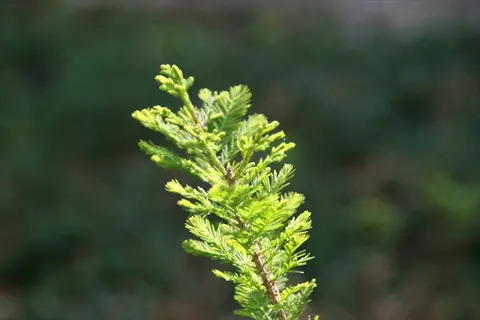
Peve Minaret (dwarf)
- Form: A compact, dense, conical dwarf that stays far shorter than the species, fitting tight beds and small yards.
- Foliage: It carries the same soft, feathery needles, giving a fine texture on a small, tidy frame.
- Fall color: The needles turn warm copper-brown in autumn before dropping, just like the full-size tree.
- Best use: Excellent for containers, small lawns, and spots where a 50 to 70 foot tree would overwhelm.
- Care: It shares the species' tolerance of wet and average soils and needs little routine pruning.
- Why choose it: It delivers the bald cypress look and habit without the large mature footprint.
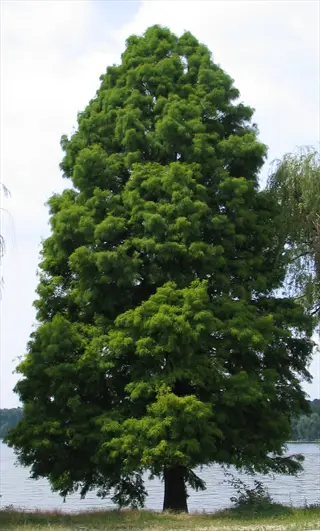
Shawnee Brave (narrow columnar)
- Form: A narrow, upright, columnar selection, also sold as 'Mickelson', that takes up little horizontal space.
- Foliage: Dense, feathery needles clothe the slim, pyramidal crown from top to bottom.
- Fall color: Needles shift to rusty orange-brown in fall before the tree goes bare for winter.
- Best use: Ideal for narrow lots, screens, and street strips where width must stay limited.
- Care: As tough as the species, tolerating wet sites, drought once established, and urban conditions.
- Why choose it: It gives height and presence while keeping a tight, space-saving profile.
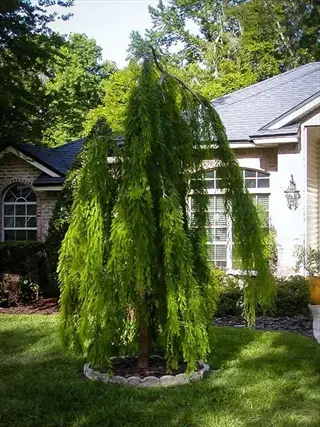
Cascade Falls (weeping)
- Form: A weeping cultivar with cascading branches, often trained over a frame or staked for height.
- Foliage: Soft, draping needles create a flowing, fountain-like texture in the landscape.
- Fall color: The trailing foliage turns coppery before dropping, then reveals a sculptural winter shape.
- Best use: A specimen or focal point for ponds, courtyards, and small accent beds.
- Care: It needs the same moist-soil and sun conditions and may need light shaping to guide its form.
- Why choose it: Its dramatic weeping habit turns a familiar species into a striking garden feature.
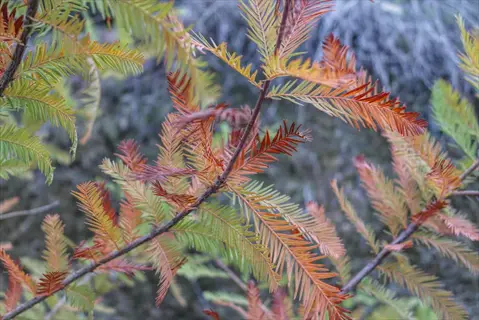
Autumn Gold and Sofine (form and color)
- Form: These selections were chosen for an even, symmetrical pyramidal shape and reliable structure.
- Foliage: Full, feathery needles give dense summer cover on a uniform, well-branched crown.
- Fall color: 'Autumn Gold' is noted for warm golden-yellow to copper fall color before needle drop.
- Best use: Good shade and specimen trees where consistent shape and dependable autumn color matter.
- Care: They follow the species' easy care, tolerating wet sites, average soils, and urban stress.
- Why choose it: They refine the wild species into more predictable, ornamental landscape trees.
Match the variety to your space and you get the feathery foliage and warm fall color without the full-size footprint. Pick a dwarf or columnar form for a tight lot, or a weeping one when you want a single eye-catching plant. These varieties let you enjoy the tree even when a 70-foot giant would swamp the yard.
Wood, Wildlife, and Ecology
So what is bald cypress good for beyond a pretty crown and summer shade? The honest answer is a lot. This tree pulls real weight in the wood it grows, the animals it feeds, and the water it cleans and holds back.
Start with the wood. The heartwood resists rot so well that people gave it the name wood eternal, thanks to a natural oil called cypressene. Builders once chose it for docks, boats, and bridges where any other wood would have soaked through and decayed. The growth is impressive too. One Florida floodplain forest put on 14,000 pounds of biomass per acre in a single year. That tells you how fast a healthy cypress stand can pile on new wood.
The ecological benefits stack up just as fast once you look at what lives in and around these trees. The list below sorts the value into four buckets so you can see exactly why people plant bald cypress for far more than looks.
Rot-resistant wood
- Wood eternal: The decay-resistant heartwood earned the nickname wood eternal from a natural oil called cypressene.
- Historic uses: It was prized for docks, warehouses, boats, bridges, and shingles where moisture would rot other woods.
- Caveat: Old-growth heartwood is the durable part; younger second-growth wood is far more prone to decay.
Shade and beauty
- Shade: Its broad, feathery crown casts cooling summer shade over yards, parks, and streets.
- Seasonal interest: Soft spring growth, full summer foliage, copper fall color, and a sculptural bare winter form give year-round appeal.
- Adaptable: It handles urban stress, pollution, and a wide range of soils, making it a dependable landscape tree.
Wildlife habitat
- Food: Seeds feed wood ducks, wild turkey, squirrels, and evening grosbeaks across its range.
- Nesting: Bald eagles and ospreys nest in the tops of old trees, and warblers use rotting knees as cavities.
- Wetland life: Cypress domes shelter frogs, salamanders, and catfish, supporting whole wetland food webs.
Flood and water services
- Flood control: Wetland cypress slows and spreads floodwaters, easing downstream flooding.
- Erosion control: Its wide, anchoring roots stabilize banks and hold soil in place along rivers and ponds.
- Water filtering: Cypress wetlands trap sediment and pollutants, cleaning the water that passes through.
The wildlife payoff runs deep. Seeds feed wood ducks, wild turkey, squirrels, and evening grosbeaks, while bald eagles and ospreys raise young in the broken tops of old trees. You also get prothonotary warblers, the songbird that nests in cypress stands more than anywhere else. So your tree is not just habitat. It is prime habitat.
Then there is the water work. Wetland cypress slows and spreads floodwaters, and that eases the strain downstream when rivers swell. Its wide roots lock soil in place, and its stands trap sediment and pollutants as water moves through. That mix of flood control and clean water is why crews plant it for restoration work, rain gardens, and eroding banks. The shade is just a bonus.
Cypress is also called the 'wood eternal' because the heartwood is resistant to decay.
5 Common Myths
Bald cypress is an evergreen because it is a conifer, so it keeps its needles green and lush all through the winter.
It is a deciduous conifer and one of only a few cone-bearing trees that drop their needles each fall, releafing every spring.
A bald cypress must be planted in a swamp or standing water, so it cannot survive in an ordinary yard with normal soil.
Though swamp-native, it grows well, often faster, on moist, well-drained upland soil and tolerates clay, sand, and even some drought.
Every bald cypress will push up tall woody knees that wreck the lawn no matter where you choose to plant the tree.
Knees mainly form on wet sites; trees on drier upland soil and in regularly mowed lawns usually produce few or no knees.
Bald cypress has shallow, weak roots, so strong storms and hurricane-force winds will easily topple a mature tree.
Its deep taproot and buttressed base make it remarkably windfirm; even hurricane-force winds rarely overturn a healthy bald cypress.
The bald cypress is the cemetery tree people mean when they call cypress a symbol of death and mourning.
That folklore refers to the Mediterranean cypress, a different species; the American bald cypress carries no such death symbolism.
Conclusion
The bald cypress tree earns its place in a yard the same way it earns its place in a swamp. It is tough, it lives a long time, and it shrugs off the wet, dry, and polluted soils that kill softer trees. Give it a spot with room and sun, and you get a deciduous conifer that feathers out green in spring and burns copper in fall.
Keep the core numbers in your head when you shop. A landscape tree reaches 50 to 70 feet tall and 20 to 30 feet wide, climbs at 1 to 2 feet per year, and can stand for 400 to 600 years. Plant it at least 15 feet from any pavement, driveway, or foundation and most of your headaches never start. Basic bald cypress care after that is light, since it resists deer, wind, and most pests on its own.
The drawbacks are real, but none of them are deal-breakers once you plan around them. Cypress knees only push up on wet or low spots, and steady mowing keeps a lawn clear of them. If your space is tight, a dwarf like Peve Minaret or a columnar like Shawnee Brave gives you the same look in a smaller frame. Match the tree to the spot instead of forcing a full-size native into a cramped lot, and you skip the regret.
The best place to plant one is wherever you want shade and life for the long haul. Birds nest in the crown, the roots hold soil and slow floodwater, and the canopy throws cool shade across hot summers. A tree you set in the ground this year will outlive you, your house, and likely the people who buy it next. Few choices in a yard reach that far forward.
Glossary
- Buttressed base
- A widened, flared trunk base that braces the tree and helps keep it standing in soft, wet ground.
- Chlorosis
- A yellowing of the needles caused when the tree cannot take up enough iron, often in soil that is too alkaline.
- Cypress knees
- Woody, cone-shaped projections that grow up from a bald cypress's roots, mainly on wet sites, and help supply the roots with oxygen.
- Cypressene
- A natural oil in bald cypress heartwood that makes the wood resistant to decay.
- Deciduous conifer
- A cone-bearing tree that drops all its needles each fall and grows new ones in spring, instead of staying evergreen.
- Heartwood
- The dense, older wood at the center of the trunk, which in bald cypress is naturally resistant to rot.
- Pneumatophores
- The technical name for the root projections, like cypress knees, that rise above wet soil or water to help roots get oxygen.
- Taproot
- A large central root that grows straight down, helping anchor the tree and reach deep moisture.
External Sources
Frequently Asked Questions
What are the negatives of a bald cypress tree?
The main negatives are large mature size, knees and surface roots on wet sites, fall needle cleanup, and a poor fit for tight urban lots.
Where is the best place to plant a bald cypress tree?
Best in full sun on moist, acidic soil, with at least 15 feet of clearance from pavement and buildings so the wide crown has room.
How deep do bald cypress tree roots go?
Bald cypress has a large central taproot plus wide lateral and anchoring roots, helping it stay windfirm even in soft, wet soils.
What are the little balls on a bald cypress tree?
They are the tree's round, woody seed cones, averaging about 16 seeds each, which ripen and break apart in fall.
What is the lifespan of a bald cypress tree?
Most bald cypress live 400 to 600 years, and a few documented individuals have reached roughly 1,200 years old.
What does a bald cypress look like in winter?
In winter it is bare, showing a tapered trunk, fine twiggy branches, and reddish-brown, fibrous, peeling bark.
What is a bald cypress tree good for?
It provides rot-resistant lumber, shade and beauty, flood and erosion control, water filtering, and valuable wildlife habitat.
Can you burn bald cypress for firewood?
You can burn it, but as a resinous softwood it produces less heat and more smoke than dense hardwoods like oak.
Do bald cypress trees smell good?
The freshly cut wood has a mild, resinous cypress scent; the living needles and foliage are only faintly aromatic.
Why is the cypress tree a symbol of death?
The symbolism comes from cultural folklore around the Mediterranean cypress in graveyards, not from the American bald cypress itself.